Posts Tagged musician
Day 9 – Red Tape Hell, Musical Heaven
Posted by Musical Nomad in Daily Blog on August 6, 1997
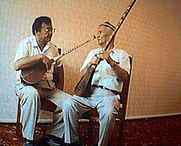 Having been out of action for a while I have not been able to tell you about our meeting with Pattahon Mamadaliev. Sometimes it’s difficult to interview musicians here because of their modesty . if you ask them about themselves they will naturally represent themselves in a very humble way. Pattahon is a good example of this.A respected maqam performer he is particularly famous for his wedding singing in the Fergana style. He is professor at Tashkent state Conservatoire and has performed numerous times on TV and Radio. In fact, the people working in our hotel were thoroughly surprised to see him sitting in their dining room. Perhaps the thing that most distinguishes him is his status as a composer. Pattahon was the first musician to be awarded the honorary title of Hafiz by the new administration after independence. This title is used in the Islamic World to describe one who has learned the Koran by heart, but it can also refer to a master musician. Pattahon is not only an interpreter, he also composes maqam music and texts.
I always enjoy watching older musicians who have played for years, they often have a minimalist style, an economy of expression. Pattahon plays as if his tanbur is a part of him and his voice still retains a power which belies his seventy years. Interestingly when we asked about the age of the tanbur he said it was not old, only fifty years.
 As Pattahon’s life spans much of the period of Soviet rule in Uzbekistan I was keen to ask him about the changes that had come about. Both he and Abdurahim were clear that it had been an ill conceived experiment on the part of the Russians to try to change the musical tradition here. They felt it to be a tribute to the strength of the music and the peoples’ feeling for it that it had survived. Sasha our interpreter and musicologist companion pointed out that this viewpoint was fairly nationalistic and not necessarily representative of all musicians in the country, although there is much evidence that Soviet Cultural Policy had set out to repress the music. Sasha can be heard translating this viewpoint in an excerpt from the interview.This day was to be special for the project. A high ranking official from the Ministry of Foreign Affairs was going to make customs give us our satellite phone. We left for the airport at 9 am in triumphant frame of mind believing we would return within the hour. At 2 pm two bedraggled people walked through the door, black satellite phone in hand. We had been through red tape hell. The country may have reached independence but the old Russian way of doing things remains fully intact. An endless stream of grey concrete ‘huts’ scattered randomly around a wide, bland pot-holed road leading away from the airport. Sleepy Army soldiers guard rusty gates and several stages of payment, slips of paper and rubber stamps get you in.
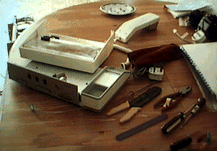
Over a roaring fire a large wok containing gallons of water. Lumps of dirty raw meat and vegetables, sit bubbling away in the middle of one of the yards – who is it for? The atmosphere of the place is slow and still, certainly not an area bubbling with efficiency. The various stages that Uzbekistan customs ask you to go through to acquire your own property is excruitiatingly painful when like us, you are in a rush. The paperwork and arguments burn irretrievably into the memory of all who pass through each ‘hut of frustration’.Though I’m still unwell, I’m keen to see how the new satellite is shaping up. I descend the stairs to find Gary and Paul surrounded by 100 pieces of wreckage – I can’t believe it, the replacement satellite has possibly been corrupted in transit and they are trying to trace an obvious fault. Despite all their efforts the team cannot find one, desperate calls to England are hampered when we can’t get a phone line. I retire to a safe distance, Gary and Paul are not happy. Ten minutes later I am awoken by a combined banging and throbbing – what now? Peering through the door I see Gary manfully priming a petrol generator and Paul planting an earth spike in the dusty courtyard. There wasn’t enough current in the local electricity supply to even work a soldering iron, so this is the solution – make your own electricity. It’s bizarre seeing all this sophisticated satellite gear driven by a petrol generator.
We are told a third satellite transmitter will be hand delivered in a few days to Bukhara. Please stick with us we are doing everything we can, normal ‘service’ will commence shortly.
Day 5 – When I play it seems that I understand the Shamanic tradition
Posted by Musical Nomad in Daily Blog on August 2, 1997
“When I play it seems that I understand the Shamanic tradition. There was a time when I had a supernatural connection with the audience but now I have lost this a little.”
 Raushan is softly spoken and very articulate . She speaks passionately about Kazak music and in particular about the kobuz. She comes from a musical family. Her father, also a musician, always wanted Raushan to play the kobuz. They are from a region near the Aral Sea, which has its own rich musical tradition. Her sisters play flute and oboe, by all accounts outstandingly well. This musicality stretches back for generations.
I started by asking about the history of the kobuz. She explained that very little had been formally recorded as this was predominantly an oral tradition. She recounted a legend of a real person, Korkut, who is often looked upon as a father of the kobuz tradition. He was a Shaman. At his birth the heavens opened and the climate changed. There was thunder and lightning, people were terrified. When the child was older, it became clear that he could foretell the future, and people were afraid of him. They named him Korkut which means the terrible one. One night he was visited in his dreams by an old man who told him that he would die when he was very young.Korkut set about trying to evade death by playing the kobuz. He could not play day and night and so everywhere he went people would dig graves for him. He would ask “Who are these graves for?” They would reply “They are for Korkut.”
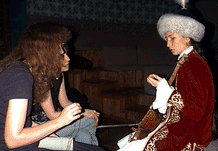 Raushan explained that Korkut wrote many melodies for the kobuz, and is now seen as a classical composer. She performed a piece for us which utilised the metal jingles attached to the instrument. This was a medley of his tunes and is called Abistolgan. This is very ancient music and she often plays it for herself. “It has to be with me always.”
I was very interested by the connection between this instrument and Shamanism. Raushan explained to me that the Shamans had used rattles to heal people. This was the origin of the jingles attached to her instrument. The Shamans improvised on the kobuz, not playing set pieces. It was a sacred instrument.
When Islam came to Central Asia the Muslims disapproved of the Shamans and tried to discourage their practices. As Raushan was a Muslim I asked whether she felt the two traditions were compatible. She said that she felt that they were, but it was not a logical thing. She played me a melody representing how she felt when she read the Koran.
Raushan is a living, creative musician who makes sense of life through sound. This is not a rational process, and it is precisely this ability to evoke things which cannot be explained which marks out a true musician.
“When I play it seems that I understand the Shamanic tradition”.
“There was a time when I had a supernatural connection with the audience but now I have lost this a little.”

Raushan’s instrument is one of the most extraordinary I have ever seen. She explained that the basic design was one which was common amongst the Turkic peoples. This particular one is made in the traditional way, from one piece of wood with no glue or nails. The resonating membrane at the bottom is made of camel skin. The camel, she explained, was almost a sacred animal to her; “A camel’s voice is deeply moving.” The skin used for the instrument comes appropriately from the camel’s throat.
The kobuz has a heart-shaped resonating chamber which in this case is painted dark red emphasising the heart-like imagery. Inside the heart were placed some small pieces of mirror. This was not traditional, but could represent a number of things; summoning ancestral spirits or reflecting bad thoughts were two possibilities. I mentioned the Sufi image of “polishing the mirror of the heart”, a description of purifying the heart for God. She thought it likely that this instrument maker had thought along these lines. There were a number of small details on the instrument – carved symbols representing sun, moon and a star. There were resonances of the Islamic Star & Crescent but subtly changed.
Raushan expressed a wish to search for more repertoire for the kobuz, and to research old pieces.
“Modern composers don’t understand the spirit of the tradition……..they spoil everything…… Kolumbaev was a brilliant player who composed and arranged pieces for the instrument. He was a brilliant improviser…. now he is gone nobody can replace him.”
Raushan aims to play like the ancient masters, not literal authenticity but preservation of the spirit.
Alice, our interpretor during the past few days, invited me to chat with her in her parents home not far from the centre of Almaty. When we arrive the clouds that had been gathering during the day, suddenly opened. The heat of the last few days is immediately quashed by torrential rain. The thunder rages in the darkening sky as I sit down in her room and ask a few questions about her life and music. She talks with an accent divided evenly between Russian and scouse.
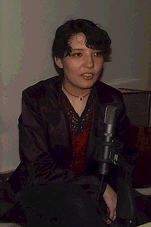 Would you like to be called Alia or Alice?
It doesn’t matter, I’m not bothered
Tell us a little bit about what you are doing in Almaty
I am actually involved in pop music, not really classical traditional but I do appreciate traditional roots, mostly pop musicians and blues based musicians. I have just got back from LIPA which is an institute in Liverpool that was opened by Paul McCartney two years ago. What I really want to do is to participate in the music scene here in Almaty, Kazakstan – because I think its booming now at the moment. Brilliant musicians, absolutely fantastic musicians – guitar players, drummers, vocalists. I want to get a band together. I do have a bass player and a singer but we need a drummer and were gonna start gigging at the end of August. What I wanna do is loads of gigs, I think that’s actually the way to success, do loads of gigs so the word gets spread around. Then probably do a single, then probably an album… I know it sounds cynical but I just wanna be rich and famous, have a jet and travel everywhere.
How would you say the musicians here differ from the musicians you’ve come across in England?
Oh they differ tremendously, because all the guitar players at LIPA (Liverpool Institute of Performing Arts) are into really weird stuff like White Zombie, Panthera and Metallica. Even Metallica is too soft for them. I found that really weird. Plus people are into things like Prodigy which are not popular here at all. In the former Soviet Union Rock and Roll was forbidden, you could go to jail for possessing an Elvis Presley record or wearing bell bottoms or whatever, ridiculous things like that. But still people were really into rock and roll, records were brought here illegally and then copied thousands of times onto tapes. People here are still into things like Nazareth and Led Zeppelin and Deep Purple and that sort of stuff. Nazareth are number one in the charts in Moscow at the moment. They’re into classical rock and classical blues.
Can you see in the future a kind of rock that will be unique to this part of the World, perhaps combining traditional music with rock music?
There is a band at the moment here which attempts to do that and they are just bloody, bloody awful. They are all conservatoire graduates and they study things like Dombra and Kobuz but they just sound awful. Just the worst band I have ever heard in my life… At LIPA for example we were studying guitar players like Ingui Malmsteim, Richie Blackmore and Steve Mores. Once they invited a guitarist, a very distinguished player from Moscow whose name Sasha Lipinsk, he came over to demonstrate his technique. he was playing Jimi Hendrix, all the standards Chuck Berry. People were asking questions like do you wanna play some Russian traditional music something specific weve never heard before something authentic. “No thanks just Jimi Hendrix, Johnny Be Good” stuff like that.
So music is primarily a vehicle for you to be rich and famous rather than the music itself?
I do my music and express myself. I would never do the sort of pop music that some people do in Russia, sort of whores on TV that really sell themselves to become rich and famous, I would never do that I think that is ugly and horrible. Rock and roll comes first really.
I am off to Tashkent, Uzbekistan tomorrow. The journey is either a ten hour drive or a two hour flight. I think I will choose the latter. Join us tomorrow, new country, new city, new music.
Day 3 – Communication happens in many ways
Posted by Musical Nomad in Daily Blog on July 31, 1997
Communication happens in many ways. I was moved by Aby singing a Sufi melody and enjoyed the musical interplay between myself and Mayra with her remarkable voice and dombra playing. Music breaks down barriers.
 We planned for months so that the technology of our project would do likewise; however, for the first few days some crucial pieces of equipment let us down. It has been a fraught time as we build stories for each day for transmission at 9pm only to be jilted at the final hurdle by an unhelpful portable satellite. Gary slowly deteriorates into a shadow of his former self after long days and even longer nights creating web sites and speaking to unhelpful people in far flung corners of the globe. At first the Inmarsat network wouldn’t send my bad spelling around the world. The box that was meant to send the data decided not to play ball. Various attempts to get a good signal included a 4.30 am trip into downtown Almaty searching for a powerpoint amidst late nights vodka stalls. On this last satellite trial a crowd of curious young men gathered, accusing us of being ‘James Bonds’ and making rather unsubtle advances towards Kathrin. Sadly it is all in vain. A new unit is ordered, the logistics of exchange of a large piece of equipment between UK and Kazakstan is underway. Once this has happened we hope to resume our conversation with the world.
 It’s 10 o’clock in the morning and I am scheduled to meet the Minister of Culture for Kazakstan – Valery Kuzembaev. Possibly a very formal occasion, I wear my best T-shirt and Paul is even wearing socks (it’s 30 degrees already!). Gary is all keyed up to give a presentation on a multimedia laptop and Kathrin is ready to translate. Today given the occasion we have a local translator as well. Alia turns up in a trendy outfit, speaks perfect Liverpudlian scouse and plays a Gibson Les Paul guitar in a rhythm and blues band – just what we expected. It turns out Alia studied media at Paul McCartney’s fame school (LIPA) in Liverpool, England – the only Russian girl from Kazakstan ever to do this.
 The Ministry of Culture resides in an old wooden building on Gogol Street. After some initial introductions the Minister began to tell us a little about the cultural situation in Kazakstan. “The difficult thing is the money”, he said. Everything else has to come second now.” Although this is the situation in London or anywhere in the Arts world, I get the impression that maintaining the level of cultural activity that was common here in Soviet times is very difficult. There are well-trained conservatoire musicians in Kazakstan, but unless they are star soloists employment must be difficult to find.The Minister himself is a violinist who taught at the Conservatoire. He explained to us that he still had students. He had once worked in a symphony orchestra in Mexico City. Opposite our hotel is a huge opera house but there are no queues of people to watch opera. It will be interesting to see whether there is anything scheduled for the next few days. The Minister seemed interested in our project and keen to support us in whatever way he could. He gave us the name of a well respected traditional musician whom we plan to meet tomorrow – she is a kobuz player. This is a traditional Kazak instrument with two strings, held vertically and played with a bow.

On our return to Kazakstan on 28th August we are hoping to venture into the Alatau mountains that surround Almaty in search of the nomadic roots of Kazak music. The Minister hoped he could arrange this. Fingers crossed, I could be in for an exciting few days towards the end of the trip.In the afternoon I headed for the voice of Asia Festival site in Gorky park (the other Gorky park). The main music events were not scheduled until 8 pm but during the day the park has the atmosphere of a public holiday. Everywhere families are enjoying the day out, boating on the lake enjoying the ferris wheels and roundabouts.

Karaoke is hugely popular and everybody from teenagers to mums and dads have a go at sing-a-long-a Beatles and some local Kazak pop. The karaoke units are very close together so you often hear three or four different tunes at once – interesting. There is of course not a dombra or kobuz in sight but there are some yurts, the local Nomad tents. I peered into one and was immediately invitedin for chai (tea). Very hospitable I thought and curled up on a fluffy felt cushion. Sat in the dappled light from the wheel shaped smoke hole in the roof, still sipping the refreshing sweet tea I admired the sumptuous felt drapery and also the intricate wooden framework which sustains their considerable weight. Its bad news for foxes as several pelts are hung as decoration from the ‘walls’, eagles aren’t too happy either – There’s a stuffed one perched by the door. Suddenly I’m filled with excitement at the prospect of seeing the real thing up in the mountains – complete with authentic music? Who knows. Then the tea bill arrives…. $25, ‘I made my excuses and left’.
Later on when we returned to the park the place had taken on a different aura. The entrance gate glowed in the dying sunlight and their was an air of expectancy as the young people of Almaty gathered and moved. The distant sounds of multiple Karaoke were almost softened into new age ambience and the odours of a hundred shashlyk stands merged into one ‘smoky’ haze. I bought a concert ticket and headed for the far side of the park.On the way I was enthusiastically requested to join a social gathering in the Yurt I visited earlier. After emphatically refusing several times (the polite thing to do) I was obliged, in the space of two minutes, to drink two vodkas and eat some decidedly chewy sheep meat. I again made my excuses but this time they had more weight as the team were waiting outside anxious to get to the concert.
As we approached the main stage it became obvious that this was no excursion into so-called ‘World music’. The entrance to the arena was guarded by an army of oddly dressed police. Young people were filing in through a maze of barriers. The stage, when it finally came into view, seemed out of place. It was Eurovision, Asia style. A large pyramidal shape pointed skywards over an outrageously lit ‘TV’ stage. Cameras and lights buzzed around the performers as they were ceremoniously wheeled on, one after another to mime to their overly prepared backing tracks. This was ‘pop’, a powerful symbol of an aspiration towards Western values and lifestyle. I watched a couple of local Kazak boys chewing gum and smoking, affecting “attitude” straight from a pop video.The performance standard of the singers from countries ranging from Italy to Kazakstan was good yet there seemed to be something lacking. Audience involvement seemed minimal, the modern production techniques had built a wall between audience and performer.

This was ‘live TV’ but ‘dead’ performance compared to some of the local traditional music. Occasionally one of the singers would use inflections from a traditional singing style but most of the pieces were indistinguishable from Euro-pop. Later on we sat in another bigger Yurt nibbling salad and, yes you guessed it, shashlyk. Out of the darkness came the heart rending sound of the ney, a simple end-blown flute. We were silent, the people outside seemed to stop moving. How is it possible that a single piece of reed can burn into the heart more than any over produced concert? As with the satellite, real communication is weakest when the technology is the message and strongest when you have something to say from the heart.
Join us tomorrow when we meet two highly esteemed musicians of Kazakstan who speak through their instruments, communicate through kobuz and dombra.
Day 0 – Through the telling of stories we try and make sense of our world
Posted by Musical Nomad in Daily Blog on July 28, 1997
‘Through the telling of stories we try and make sense of our world’.
I invite you to share a live story and a journey.
A story in the present tense, a journey about to begin!
Our ancestors gathered around the campfire, our grandparents the radio, our parents the TV. We gather now around the luminescent glow of the World Wide Web.
Is this the ‘The Global Campfire’?
The Millennium draws us to reflect. Our technology has woven a powerful web but has eroded personal contact, many of us crave a ‘sense of belonging’.
My journey in Central Asia is an epic quest. In the tradition of storytelling, I invite you to participate to engage.
Let me hear your voice.
 I’m a musician. Musicians are traditionally storytellers, poets, philosophers, priests, teachers and inventors. In Central Asia this holistic role is alive. As we encounter these musicians, shall we rediscover the integration of life and music?
Nomadic musicians now settled in former Soviet cities, cling to their music. Do they retain an urge to wander?
This will be a ‘live’ journey from ‘concrete jungle’ to wild nomadic pasture. I will travel from the ‘Holy City’ of Bukhara through Samarkand, the ‘Pearl of the East’, along the borders of Afghanistan and Tajikistan. Together with the nomads I plan to venture into the Tien Shan mountains of Kyrgyzstan and the Alatau range of Kazakstan.
I want you to share and contribute to discovery, to meet others whose lives echo distant truths. We will encounter musical traditions and ancient rituals closer to nature and rooted in a shamanistic* past. The desire to search for ‘alternatives’ and ‘chase’ dreams persists.
Share your dreams
 ‘When we travel there is no past or future. We engage with the moment. So much that we take for granted, is suddenly in question as we pack our world into a suitcase.’
Much ‘modern’ life is built around obsessive planning for some mysterious almost mythical ‘future.’ When you travel you live in the ‘now’ – that for me is dangerous and exciting.
As this aircraft descends to Almaty on the 28th July I will again be truly alive!
I become ‘the digital hunter-gatherer.’ Tell me what you seek
What’s out there in that dark city full of new smells and unfamiliar sounds? What secrets lie on tomorrow’s page?
For the next six weeks share the sounds and culture of Central Asia, experience that sense of the present, engage daily with each new corners’ revelation.
The ancients said ‘the person who arrives is not the one who left’.
Join me on a journey of 2500 miles, a thousand faces and as many stories. As the ‘Old Silk Road’ merges with the ‘information superhighway’… perhaps we too will change?
- ‘the drummer who gives life to the spirit’