Posts Tagged Kyrgyzstan
Day 38 – This journey is only the beginning
Posted by Musical Nomad in Daily Blog on September 4, 1997

We set ourselves the impossible task of reflecting on the last six weeks in the space of a few hours. As we have been doing all along, what follows are the immediate impressions of all members of the team. We will continue to add to this site over the coming months. Please continue to send Emails and we will endeavour to answer them.
JAN – Musician
It seems an impossible task to try to sum up our journey using words, so much has happened that cannot be conveyed verbally. The three countries of Central Asia that we have visited are remarkable for their diversity of people and ways of life. We have barely been able to get a flavour of the place, and yet in some ways we have had some profound experiences. It has been a recurring feature of our meetings with people that we have been accepted, welcomed and drawn into houses and families. Trust, tolerance and hospitality, particularly towards visitors is so pronounced that you cannot fail to be moved by it.
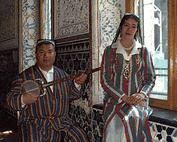 Ways of life are constantly changing all over the world. As they do so the music and culture that is associated with them changes too. It may be preserved in an artificial form, or it may die out completely. We have seen evidence of both these trends in Central Asia. We have also seen abundant evidence of vibrant, living traditions transforming and adapting to new environments. Munadjat Yulchieva (Day 7) is a good example. A nationally renowned figure she has managed to stay faithful to her musical tradition whilst raising the profile of maqam music.
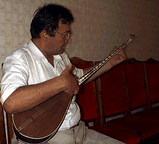 There is a marked distinction between the cultural life of the cities and the rural areas. Even in the pre-Soviet times cities were centres of culture where musicians gathered, the same is true now. Uzbekistan with it’s great cities has preserved the court music tradition even though the courts are long gone. Some musicians retain the link with the original tradition, but there is little space for them now. Abdurahim ( Day 8 ) for example one of the countries most highly esteemed musicians no longer makes a living through music and has become a businessman. Many are leaving the country for America and Israel. Even though there is something of a revival in national music (as a symbol of nationhood) this will not sustain the tradition. Musicians however are endlessly creative, and change comes about through a process of adaptation. The less fashionable Kashgar rubab has been superseded by the Tar from Azerbaijan. Perhaps a new tradition will arise out of the same feelings that inspired the shash maqam.
 In the rural areas the picture seems somewhat different. Musicians play a more integral role. In Kazakstan and Kyrgyzstan which were largely nomadic musicians still sustain an aural tradition which is part of everyday life and life events. Many great musicians are farmers or labourers who are partially self sufficient. Money means little to them and many seemed perplexed by our fees for recordings. The western distinctions of professional and amateur do not apply here. Music is too important to be exploited for money. As the rural ways of life continue so the music has survived alongside it. The hospitality often being inseparable from the music. Malika Askarova (Day 25) is a good example of this. She does not consider herself to be a musician and yet she is able to affect a listener in an extraordinary way. She did not understand why our contracts and fees were necessary. There was a sense that music is a gift which should be given freely, Malika was not the only musician who gave us this impression.
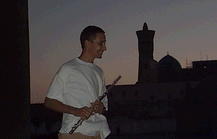 It has been through the attitudes of people that Central Asia has made it’s mark upon me. Whatever the external appearances or current economic situations of the countries, there is still a feeling of a great ‘civilisation’. I mean this in the sense of an internal process of development. A cultured people and not just people with a culture. Many of the musical genres still retain a philosophical and reflective content. These themes reflect a view of life and an attitude towards people that are quite different from those I am used to. The physical and the metaphysical are constantly intertwined in art as in life. The art forms often have a delicacy and subtlety which is deceptive. “The art that conceals art” – always hinting at a greater mystery beyond.
Central Asia is a wonderful and fascinating place. I hope that our reflections serve to wet the appetite of other travelers. Our journey was not a survey of the area, more like an account of some almost random events. Like any supposedly random events they have their own logic and they tell their own story. We will meet again…
Day 33 – another half-ready kobuz nestled like a hibernating wild animal
Posted by Musical Nomad in Daily Blog on August 30, 1997

“It looked like a tree trunk”
For some time now we have been traveling from one Central Asian city to the next, in search of sometimes elusive musicians. It comes as something of a shock to find myself in dramatic mountain scenery within an hour of leaving Almaty. Seemingly vertical surfaces of rock carry the eye upward, to the hazy skyline.
We are camped by a stream in a beautiful valley, this feels like the first opportunity I’ve had to reflect on our journey. Thirty days on the road is a long time in some ways, but it has been a whirlwind tour. I would have been happy to spend weeks visiting any one of the musicians we’ve encountered. I have the impression of being allowed a brief glimpse into a fascinating and absorbing world.
Thinking about Raushan’s kobuz playing yesterday, its directness and simplicity, I felt the urge to improvise a piece about being here in the mountains. I have with me a simple three-holed flute from Africa, which seems the perfect instrument. It’s not every day you get to play in a concert hall like this. The wind carries the sound away very quickly and I feel small in such a vast location. It seems appropriate though – being here gives a sense of perspective on life.
 We had been told that the ‘village of the masters’ was one hour from Almaty. When Nomadmobile 4 set off we were unreliably informed that the village was over a 3000 metre pass. Looking forward to a spectacular ride through the Alatau mountains the Musical Nomad cavalcade started up. After what seemed like twenty minutes we turn off the main road across a small stream and up a steep rocky slope. Two large yellow apartment blocks and a small row of houses nestle in an avenue of electricity pylons. “This is the masters village” the driver informed us. My image of wooden shacks on a wooded hillside was immediately shattered. As soon as we switched off the engine several men began to display carpets and silver ware in the road outside the larger of the two apartments. The crafts are good quality and I bought a rug. Gradually a crowd of village children gathered and we become the centre of attention on a dull Saturday afternoon. They were confused by our presence – this place obviously doesn’t get many visitors.
 A man resembling Shayhk Kushkarov of Day 20 suddenly appeared and amongst his Kazak I recognise the word kobuz. I say Raushan’s name and immediately we have connected. The housing block is home to a community of craftspeople. Tolegen Sarsenbaev, the kobuz maker invites us in to his simple abode. He has a very friendly face, bearded with deep passionate eyes. I immediately sensed his creativity and devotion to his craft. This was a man used to working in harmony with nature. Three large rooms operate as workshop, bedroom , living room, artist studio and kitchen. A tree-trunk in his studio serves as a stand for his musical instruments which he says charges them with energy . He seems to understand why we have come and begins laying out half made kobuz’s all over the living room floor. They look wonderful. Variations on a theme for sure but in their raw state they have an embryonic perfection, living things almost ready. Another partially ready piece which caught my attention was a kobuz case. This looked like a tree trunk and inside another half ready kobuz nestled like a hibernating wild animal.
 Tolegen told me that most of his kobuz’s are designed on the theme of wild animals. He had a bird, a camel and a owl. The profile of the instruments were indeed animal-like. Tolegen described the shape of the soundboard, which on most instruments resembles a heart with a trench underneath. He said this helped the sound to flow from the bottom of the instrument into the centre enabling it to project forwards. He seemed enthusiastic to talk about the technical aspects of his work. I asked him about Raushan’s instrument, particlarly the fingerboard and the lifted nut. He said this was an experiment many years ago and Raushan had requested it particularly for her ‘cuticle’ technique we mentioned yesterday. He was keen to talk about the uses of his instruments and mentioned how the kobuz is a favourite of Shaman for inducing trance like states. He didn’t have a finished instrument to play to us so I showed him my kyl-kyiak which produced some amusement. He refused to play it saying it was ‘imitation kobuz’ So much for Kazak-Kyrgyz relations.
 We also talked about Tolegen’s passionate interest in Shamanistic rituals and his recent meeting with a Shaman, Temish, in Kyrgyzstan at Lake Issyk-Kul. He met Temish when he stayed in the house of Ama, an ‘old and wise babushka’ who is teaching Temish all about the ancient traditions of zikr and Shamanic dances. Tolegen is now making a kobuz for Temish this is the instrument that Shamans used to play in Kazakstan and Kyrgyzstan during zikr’s. I was surprised to hear of Shaman rituals which include zikr. Zikr is an Arabic word used to describe a specific Sufi practice. Perhaps this supports Shaykh Kushkarov’s assertion that the two traditions are connected in Central Asia.
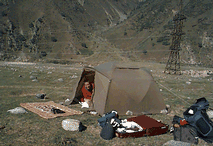 Tolegen is keen to join a zikr next month for which he will hike across the river Yur-Kemin and the Kungey Alatau mountain range (over 4000m high) into Kyrgyzstan and then hitch a lift along Lake Issyk-Kul. I’m interested to know which of the instruments I’ve seen in his workshop is intended for Temish – I’m told he chose one shaped like a bird in flight – a metaphor for the animal spirit.
As we make camp a competition soon emerges for best attempt at rigging a tent. Paul’s team wins hands down, predictably with help from the girl guides. I take advantage of the ‘cold and cold’ running water and avail myself of that handy bush. Gary is in seventh heaven as he plays his Krygyz Komuz and rigs his satellite next to his tent. His feet grounded in the stream, at last a long way from a power point.
As the evening shadows shape new contours into the eternal hills, this is definitely a place to make music. I’m sure tomorrow will bring us closer to the nomad spirit of these Kazak people. We will camp near some mountain villages and via our new interpreter Moldira attempt a dialogue with their remote inhabitants. The musical nomad has truly landed….. ‘When you sleep outside your thoughts are as high as the stars’.
Day 32 – Where there is spirit there is usually music
Posted by Musical Nomad in Daily Blog on August 29, 1997
What oppression causes such sad faces in Almaty? In the hotel reception everyone glowers when you request directions to an urgently needed toilet. When I turn up for breakfast (the other half of bed and breakfast?) I’m marched off to reception where 8 dollars is demanded, cash, now! I smile at a floor manager (each floor of the hotel still has a KGB style ‘watchdog’). She glowers back uncomprehendingly. I point out my bathroom has no water to a hotel supervisor, she glowers at me for interrupting her chat with her friend. I assume this is all the legacy of the Soviet years – it will take a long time to heal these wounds.
Music is the food of the spirit. Outside of the modern cities that spirit seems more alive – perhaps further from beaurocracy and dogma?
In our absence no progress has been made on our proposed Yurt stay, we’ve been out of touch as Kyrgyzstan has no external phone service worth mentioning. We only have a few hours to organise this expedition.
Raushan Obrazbaeva – part two
What of music? One of my favourite musicians so far is Raushan, the hypnotic exponent of the kobuz. Her inspirational performance (Day 4) has remained a high point of the trip. I remembered she had spoken of musicians in the mountains. Perhaps she could help solve our predicament. I was also keen to ask her some more questions in the light of our experiences elsewhere in Central Asia.
In a small and rather noisy cafe in downtown Almaty we showed her how our Internet project had progressed. She was keen to hear Barkut (Day 29) the Kyrgyz kyl-kyiak player. Unfortunately, we did not include this track in our report but I showed her the instrument I had bought from him. Raushan was curious to play what she described as a Kyrgyz variant of the Kazak kobuz. She pointed out some significant differences in design, and sound. Unlike Western instruments, which are very standardised, Central Asian instruments vary widely. Kathy had also bought a Kazak kobuz, which was very different from either Raushan’s instrument or the Kyrgyz kyl-kyiak. The basic design of two string horse hair fiddle is constant – after that it seems to be up to the creativity of the maker. One of the main things Raushan pointed out about the kyl-kyiak was the different playing technique. She plays by pressing her cuticles on the strings like an Indian sarangi player (also a vertical fiddle but with sympathetic strings). The Kyrgyz players press on the strings with the fingertips. These differences are generalisations and there are pieces in the Kazak repertoire that demand different techniques.
“She plays with her cuticles”
Our conversation continued as we moved to the park to record Raushan in the open air – where she likes to play. [Also see Kurmangazi day 28]. She demonstrated some pieces that are inspired by animals – the wolf and the camel. I found myself astonished once again at the variety of expression that Raushan has, literally at her fingertips. Her instrument is close to nature in its simplicity. It produces a complex ‘unpurified’ sound with strong overtones. Raushan’s impressionistic renderings of animal sounds are very abstract in character, simultaneously ancient and modern.
Raushan also likes to play pieces from the European Classical repertoire, and she showed us how she changes the way she holds her bow to emulate a ‘cello. We could have chatted for ever about instrument design and playing techniques. We were conscious though that we had an expedition to organise and so time was short.
A kobuz masterclass and interview
Raushan told me of a village in the foothills of the Alatau Mountains only one hour away from Almaty – ‘The village of craftsmen’. Everyone there is a crafts person – the men making musical instruments and the women making clothing and jewellery. An instrument maker in this village had made her kobuz and she seemed delighted by my interest. It sounds like a beautiful area and apparently we can camp there overnight. Another region she recommends is a 6 hour drive away. This valley surrounding the Shinishke river has ‘real’ Kazak villages with people who still live in traditional ways. There are Yurt encampments – Nomadic herders settling in the rich pastures for the summer months. There is natural beauty. Thirteen thousand foot mountains, white water rivers and rare wildlife such as Ibex and Bobcat. Most importantly, Raushan told us that where there are people there is always music. She reiterated that Kazakstan is a very musical country. Suddenly our trip tomorrow is looking like an exciting adventure.
Raushan had given us some useful leads but we had a very short time to put the wheels into motion. This final week was meant to be a voyage of discovery and we seemed to be steering in the right direction. Nomadmobile 4 has to be organised – this time though we will be self-sufficient, living remotely, eating from carried supplies often miles from anywhere ‘civilised’. The electricity generator will now become our most important piece of eqipment as we send you daily episodes from deep in the mountains.
Jan ‘older and wiser’
Our Kazak interpreter Mary knew of an agency who were allegedly experts in the expedition field. Visiting their premises inspired some confidence. A large ‘ordnance survey’ style map of South East Kazakstan proudly enveloped one wall. In another room professional climbing and camping equipment. They seemed sympathetic to our requirements and listed everything we would require as we told them of our needs. We talked vehicles. Their first suggestion of a decrepit bus was soon jettisoned – the seats were lose, the bodywork crumbling and the wheels buckled. We stipulated two ‘modern’ Gazelle vans which would accommodate the Nomad team, cook, interpreter and drivers. There was also a lengthy conversation about safety. If we were in danger or someone was ill do we have a 24 helicopter rescue number? – they told us no general Kazak ‘mountain rescue’ service existed but the agency had a helicopter for emergencies. As the hours went on we realised we would have to furnish many ‘expedition’ items ourselves. A desperate rush around Almaty’s bazars and prestige shops then ensued. Gary, Paul and myself haggling with old women over the price of cheese and pears. On our way back through the commuter streets of Almaty, white shopping bags in hand we at last felt at one with the city – the locals around seemed to accept us. A pity that tomorrow we finally say good-bye to this, our most familiar city.
Tomorrow we head for the village of the masters, then on into unknown territory, little visited villages of Nomads and Yurts. Music? Who knows. Usually where there is spirit there is music
Day 30 – we try and make sense of our world Pt II
Posted by Musical Nomad in Daily Blog on August 27, 1997
Whats new – Nomad Mixer
This afternoon we were visited by Saparbek Kasmambetov, one of Kyrgyztan’s few manas epic singers. Besides being an esteemed musician Saparbek is also a well known journalist. The parallels between journalistic ‘storytelling’ and the role of the storyteller/musician had already struck us when we met Shoberdy the bakshy singer.
Saparbek sang us some excerpts from the stories. The first is about two heroes. One Kyrgyz, Almanbet Chubak and a Chinese giant named Makeldur . They fight an epic battle in the mountains until Almanbet eventually traps the giant between two mountains and hits him on the head. The head is then displayed in a large bag next to a large pile of stones to demonstrate it’s size. Even without knowing much about Kyrgyz-Chinese relations the symbolism seems clear. We also heard a song about Saparbek’s travels to London. A trip which he recalls with affection. This he described as an improvisation – an elaboration on an existing structure but using contemporary events. Even without understanding the meaning of the words this is a very expressive medium for story-telling. Saparbek uses dramatic hand gestures and a kind of rhythmic chanting which draws the listener into the story. Even out of context it is possible to imagine the effect of this style of performance stretching over twelve or more hours – a kind of hypnotic state could be induced, or at least a heightened receptivity.
The manas epic is a story cycle which takes up to thirteen days to perform. Understandably this is a rare occurrence these days. Consisting of a series of legendary stories it often contains philosophical themes and historical references. It has been passed on orally from father to son for generations. Saparbek, an exception to this rule, ‘learnt it naturally’ and described how it is necessary to have a talent for manas – given by God. It is a huge task to learn all the stories and Saparbek is one of only two ‘manaschi’ who can improvise upon the themes of all the stories. Supposedly the first epics were composed in the 4th century but written references to them (in Arabic) only appear from the 8th century.
The contexts in which manas may be performed include: weddings, funerals and public occasions. It has come to represent a link to the past. A contemporary cultural icon which connects Kyrgyz people to an older way of life. The nomadic culture was non-literate it is therefore only through oral traditions that children learn about the past.
Day 0 raised many issues. ‘Through the telling of stories we try and make sense of our world’. The stories and songs of the three countries we have visited have a purpose. They tell of suffering, joy and of a long, rich past. The songs have a reason for existence and they are alive here. We have met performers who have developed in an oral tradition. A tradition where songs are passed down naturally to each subsequent generation. Like seeds, they grow and flourish if the environment supports them. Music survives through those willing to nurture and spread those seeds – Musical Nomads?
Kyrgyzstan has changed rapidly – according to Gulnaz, the Russians did not arrive until the 19th century. In this short space of time the majority of the population has become settled. Gulnaz works with Information Technology and is thoroughly at home on the internet. This is a hugely accelerated pace of change.
Gulnaz epitomizes what it means to be a citizen of Central Asia. Her family are Kyrgyz, but raised in Russian part of town she attended a Russian school. Her first language is Russian but she understands both Kazak and Uzbek. Her husbands language is also Russian but he speaks no Kyrygz. As they live in Kyrgyzstan she regularly interprets for him.
Gulnaz is a modern woman. She loves pop music especially ‘A-Studio’, Kyrgyzstan’s most popular band. Though she dances until dawn at local discotheques, Gulnaz became fascinated with our project and listened with rapt attention to our unaccompanied folk singers and virtuoso komuz players. A new career beckoned as Gulnaz became an enthusiastic clapper loader – putting the synchronization slates on the front of our recordings (take one etc.). Today Gulnaz leaves us and we shall remember her affectionately as ‘giggling
Tomorrow we return to Kazakstan, older perhaps wiser and certainly overwhelmed by the richness of culture that remains in Central Asia.
The journey has come full circle.
In the mountains near Almaty will we find a resolution?
Have there been any lessons learned?
Did the music and way of life of the people hold any answers?
Perhaps we will meet more musicians in the mountains who are not as settled and who have other perspectives to offer. It’s a long way from over yet, stick around for surprises to come.
Day 28 – Even the Wind Sings
Posted by Musical Nomad in Daily Blog on August 25, 1997
 On our journey through Uzbekistan we came into contact with a vast array of instruments. There were the lutes, Shoberdy’s dombra, Ari’s rubab, Abdurahim’s dutar and Mussafar’s tar to name but a few. The doira (frame drum) featured heavily in Fergana music and the gidchak (lap violin) in Bukharan maqam music. We also saw many other instruments in Samarkand such as the chang, trumpets, nais and surnais.
Traditional musical instruments in Kyrgyzstan do not seem at first glance to be as varied as in Uzbekistan. The key instruments here are the komuz (a 3 stringed plucked dombra, tuned tonic, fifth, tonic) and the kyl-kyiak (the bowed two string lap viol we first saw in Almaty on day 4). The one ‘som’ note (Kyrgyz currency) proudly displays both instruments, symbols of national identity. This identity was also evident in independence day rehearsals. Around the Lenin monument today, hundreds of children gathered in the midday sun. Dressed in bright sequined costumes and playing state issue komuz’s they practiced their routines. The sound was both inspiring and disturbing –
 where is the individualism? In the West we expect at a young age to have a choice of musical instruments. Not surprisingly the cello-like kyl-kyiak is not present in today’s celebrations, it would be a nightmare to play, marching across city squares.
As this is a nomadic country there’s also a prevalence of rural, ‘shepherd’ instruments, some of which have been largely forgotten. Used almost as an accompaniment to nature rather than recital instruments, these include end blown flutes, jaws harps and side blown flutes – we find similar selections in other mountainous countries such as South America. In Biskek we are lucky to be guided by the multi-instrumentalist, Kurmangazy who introduces us to his collection.
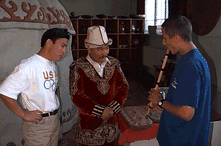 Kurmangazy and his friend and colleague Barkut Shatenov, play a huge variety of instruments, we only had time to see a few today. They performed in front of a large burzoi (yurt) in Biskek University, Department of Archaeology. In Central Asia it is possible to study the ‘national’ instruments in the conservatories. Barkut is a graduate of the conservatoire specialising in komuz and kyl-kyiak. He has considerable presence and mastery of his instruments and we later learned that he is a member of Krygyzstan’s foremost traditional music ensemble.
I asked Barkut about the melodies he played for us and he replied that some went back to the 18th Century. Whether this is part of a continuous older tradition or whether it has been ‘revived’ is hard to say. It is clear that professional players, here in Biskek are concert hall performers who
 dress in national costume and may not have much first-hand experience of the original rural music. Both Barkut and Kurmangazy talked about visiting old, rural musicians to research their music. Kurmangazy asserts that to really understand his music it should be listened to in a rural setting where birdsong and the wind can be heard. Kurmangazy is trained as a classical flautist but he feels that since independence more people are interested in their national culture. He has adapted his classical technique to play a variety of wind instruments, some of which he has made himself. He is likely to produce unnerving vocal sounds at any time and there is a feeling that his sound world is inspired by nature. He plays mainly his own compositions and improvisations with titles such as ‘Conversations with Birds’, ‘Sailor’s Song’ and ‘Children’s Song’.
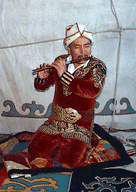 It seems to be a feature of Kyrgyz and Kazak music that musicians will take a sound or rhythm that occurs naturally and translate it onto their instruments. By a process of alchemy this turns into something very poetic. A good example of this is Barkut’s performance of ‘Paravoz’ or train which the composer O. Tumanov, wrote in 1932 after hearing the first train in Kyrgyzstan. There are pieces based on galloping horses and waterfalls. Perhaps urbanisation has had a more disastrous effect on the music than we can comprehend. It is only through the efforts of a few musicians that the music survives in the cities.
The orientation towards nature, dimly perceptible through the din of modern urban culture may also be the reason why Islam never caught on. The Uzbeks already had a strong, settled urban culture before Islam (a very urban religion). The Kazaks and Kyrgyz were still fierce nomads. In the summer many contemporary city dwellers still head for the countryside to live in a burzoi for a month or two and relive their nomadic past.Deeply impressed by yesterdays parade of hats I’m off to buy my own at the Zum department store. I travel by Taxi – which is just another Lada with a light on top. I journey an epic 200 yards before grinding to a halt, we are out of petrol. Quick as a flash our friendly host Djik pulls out a syphon tube and a bucket, and we share petrol. All part of the rich “Central Asia Experience”.
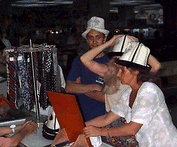
Zum isn’t so much a department store as a bazaar with tickets. Like the infamous Gum store in Moscow you can’t spend money. You choose your item, show it to the assistant, get a ticket, go to a seperate money booth, pay, get another ticket, go back to where you started, and maybe get your item, though by now the assistant has probably forgotten who you are! I bought a hat and a tube of Fanta flavoured toothpaste. There are three sales floors with hats for sale on each – all at different prices! You can go up in the escalator but not down – once you’ve purchased you don’t deserve an escalator.
Each bizarre bazaar sells a variety of products, typically hats, bras, whips and toothpaste. The ramshackle atmosphere is quaint, like Littlewoods in the 50’s (for our British licence fee payers) or maybe the present New York Woolworths for all you colonials. My hat is brill – I will wear it at all forthcoming gigs.
Tomorrow we travel out into the Kyrgyz countryside to Lake Issyk-Kul and meet one of the last surviving rural musicians. Join us.
Day 27 – Two Weddings and a Satellite
Posted by Musical Nomad in Daily Blog on August 24, 1997
 We have set up the satellite in many strange places – it is surprising the number of times we have managed to get a clear view of the Indian Ocean receiver without venturing beyond the nearest road. Sadly there have been too many times when mountains, trees or Soviet apartment blocks have got in the way. Today we had to go somewhere. In a children’s playground in the suburbs of Biskek, Kyrgyzstan, English Nomads could be seen setting up a bizarre array of equipment – morning entertainment for the youngsters. The sound of a motor generator and sight of a ‘sputnik’ in the middle of their playground was too much to resist. After some confused policemen had left us a throng of children gathered and cheered us on as we connected to the world. No big flashing lights or music just Gary saying ‘great – another one off’. We asked them to return at 10 PM for part two.
 I had the opportunity to spend a late Sunday afternoon walking through Biskek with our new Kyrgyz translator Gulnaz Abdrahmanova. It has been 42 degrees for the last few weeks. Now, after a sudden rain, the weather is typically British and a welcome change for the team. One of the first things that strikes me is the people – they are, like in Almaty, dressed in ‘modern’ clothes, very different from the traditional Muslims of the Fergana Valley of two days ago. The city itself is wide, open and filled with Soviet style buildings and monuments. As we walked through Dubovy park filled with decaying carvings, Gulnaz explained how Biskek had bought up many Russian artifacts from other ex-Soviet countries – they were quite keen to pass them on! Biskek is the most ‘Russian’ city we have visited. It is the only ex-CIS city with a statue of Lenin still dominating it’s main square. It is difficult to know how most of the city react to these relics. Will Lenin last much longer? The people do seem proud of some of thier monuments, especially Urkuya Saliyevas a reformer from Osh who led the Kyrgyz female movement after the revolution.

Along the main street there is the familiar mix of subway markets, karaoke cafes and photographer stalls. There are eccentric props used by the photographers including large white gorillas, dead birds in a palm trees and broken down cars. One street stall that caused the team much surprise was an evil spirit removal and fortune telling service. A man in jeans and green shirt waved his arms and hissed Shaman-like chants around each customer. A queue of women sat in the open as each were treated in turn. Our presence caused some embarrassment but we were told this service is very much in demand. Gulnaz’s husband goes once a year and she told me how valuable it was to him. I found it so strange to see this kind of thing performed so openly and I thought how much it differed from our meeting with Shaykh Kushkarov on day 20.
The musician, Kurmangazy Aiylchievich who we are going to meet tomorrow, is larger than life. There is something about him that reminds me of Shoberdy – the Baysun Bakshy [see Day16]. He is a wild, flamboyant virtuosic vodka drinker. Unlike Shoberdy he talks extravagantly about musical healing, Shamans and holistic principles but also plays popular hits at public functions.

By reputation Kurmangazy is Kyrgyzstan’s top musician. I’ve been invited by Kurmangazy to a special location. A double celebration of a 70th birthday and a 50th wedding anniversary. As I climb the staircase of the ‘Kyrgyz National Restaurant’, I’m immediately struck by a sea of hats – the white Alpine-like national hat of the Kyrgyz nomads. The old women all wear head scarves softening their sun-gold faces, few smile, their heads filled with memories?
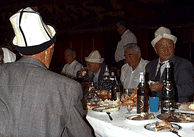
The details vary but I’m sure these occasions have common ground the world over. Solemn vodka laced speeches about ‘fifty happy years,’ on a stage decorated with bouquets and fruit. Children reluctantly pushed to the front, perform party pieces – this time on the national instrument, the komuz. A special delicacy is presented to table – today it’s horse meat – another nomad symbol? Perhaps amongst the gossip there is nostalgia for a Soviet era of greater prosperity and a more certain infrastructure. Nostalgia tempered now by an influx of jobs in fizzy soft drink factories and the fluorescent appeal of catalogue fashions – it’s Sunday and everybody looks their best. In the key of slightly Eb auntie Flo will sing a song: ‘Her mother should know’ – the band struggles to follow.
 Special occasions need special music and Kurmangazy seemed happy to provide the crowd-pleasers. To European ears his band is a bizarre cocktail of popular Kyrgyz melodies, South American music, Jazz and Classical pops. His band are all accomplished conservatoire-trained musicians and appear very relaxed.
 Kurmangazy fronts the band with a frantic energy, swapping frequently between his many wind instruments. The band’s funked-up versions of everything receive a somewhat cool response from the audience of over 50s. The medley of ‘Classic’ hits which Kurmangazy dedicated to us included snippets of Bach, Mozart and Paganini, all arranged in a ‘hooked-on-Classics’ style with a synthesised back-beat. He invited us to attend a healing session he will conduct at midnight!
Once again the team have to extricate themselves from a tricky situation. We are invited to stay and drink endless vodkas and eat horse with the band. Horse intestines are a local delicacy and it testifies to the wealth of the host that it was in plentiful supply. We were told each horse makes four plates of ‘delicacy’ and costs about 1500 USD. We decide to sneak off and send you this transmission.
 Emerging into the street we encounter a traditional wedding in full flight. Two surnai (shawm) players and a drummer play spiralling polyrhythmic music that makes you want to dance. The bride, groom and entourage arrive and a circle dance starts up in the street. Money is pushed into the hands of the dancers. There is a strong link here with the music of Turkey (the Kyrgyz people are a Turkic people) but the surnai is also very similar to the ghaita of Morocco. In France there is a similar double-reed instrument, the bombard. The double headed drum exists worldwide and in France it is known as the tabor. These connections must be well documented, but to see it in real life gives a startling sense of the cultural overlap between Europe and Asia.
Tomorrow we meet the extraordinary Kurmangazy again and hope to discover more about both his music and his research into ancient Kyrgyz culture.
Day 26 – Vultures Circle Looking for Musical Nomads?
Posted by Musical Nomad in Daily Blog on August 23, 1997
 As I write this at 9 pm Krygz time we are driving precariously close to a deep ravine carrying the Naryn river. We work our way up to the top of the Ala-Bel pass at 3184 metres. The road is rocky, slow and the team and equipment are being thrown around. It begins to rain. I have no idea if this report will reach you – will the satellite survive? We have a second pass to come, the Tor-Ashuu at 3600 metres when from the top in the dark, we will attempt to erect the satellite and send you today’s experience.
Last night we said to say Good bye to Bahadir, his son Alisher and Matluba.
 Having crossed the border with us to Osh, they turned round and headed back to Uzbekistan. Nuts. bread and chai for supper, (Uzbek food) 6 hours sleep and back on the road in a much older Russian built Nomad mobile. Out two drivers are friendly and helpful but we have been on the road for 17 days with Bahadir and his gruff manner has grown on us.
As the mountains close around us, the valley is the greenest so far. Agriculture stretches to the horizon, orchards and fields of sweetcorn. The view is occasionally blighted by early 20th century industrial ‘daymares.’ Vultures circle looking for musical nomads without water? We stocked up in Osh – is it enough for 16 hours? Nomadmobile 1 couldn’t travel into Kyrgyztsan – farewell to air-conditioning and the whiff of leaking petrol. Nomadmobile 2 has all the comfort necessary for a quick trip to the seaside on a cool Easter day in England.
 This is Central Asia in August, the seats grind your bum and you sweat a pound for every mile.
Three time zones in one hour, as we cross briefly back into Uzbekistan and then back again into Kyrgyzstan. Even on the foothills of the mountains dreary Soviet style apartment blocks spring up like bloated fungus. The foothills remind me of Llangollen, Wales – without loo paper!
 Kyrgyzstan is different. It is difficult to judge a country by its ‘truck’ stops and small apartments. There is a feeling in the air that these are people who like to move. The Kyrgz in the cities give you a feeling they are frustrated nomads. Kyrgyzstan has a more improvised feel to it. Buildings appear to be placed randomly, the road from Osh to Bishkek appears as a major artery on our map but is often no more than a mountain track. We are not complaining, this is the nomad life… or just mad life..
 The country is vertical. The Soviet’s in their grand scheme obviously realised the enormous potential for damming key valleys and turning the region into a large electricity producer. One of Kyrgyzstan’s biggest exports is electricity. This policy has had some catastrophic effects, there are electric pylons everywhere and subsidiary industries have taken root in areas of great scenic beauty. There are though some positive effects. Traveling through sandy, dry hillscapes for five hours it comes as a magnificent and beautiful surprise to see deep gorges carrying cool turquoise water to large reservoirs. One of the most impressive is lake Toktogul. We turn a hairpin bend and it appears like a mirage, a large blue, mirror ‘sea’ stretching from horizon to horizon. If it were set to music it would be the timpani roll leading to a perfect orhestral cadence.
 We met some interesting characters enroute. One chap at a roadside chaikhana had a motorcycle. He was travelling the same route and was proud of the sheep he had killed for the seat on his bike. He then made an offer of four sheep for Kathrin, Gary suggested twenty dollars intead.
Close to the tea house on a long ridge stands a Burial area. A series of both enclosed and open mounds sit silent as a warm wind whistles. In the distance Lake Toktogul shimmers blue in the afternoon haze. The grave enclosures vary from cathedral-like structures to brick ‘yurts.’ Some even have yurt shaped metal frames, inside a simple mound of earth marks the spot. At the front of the ridge a body, simply wrapped in Muslin leaves an eerie and lasting impression.
It slowly goes dark. We have mountains to climb. Waterfalls and Yurts fade into the steep slopes. Its been a gruelling 18 trek. It’s 4 in the morning and we have just arrived in Biskek – sorry for the late transmission, goodnight. Tomorrow the capital Biskek and best music Krygyzstan can offer.
Day 25 – The Pulse of the Maternal Heart
Posted by Musical Nomad in Daily Blog on August 22, 1997
 There are few female drummers, Evelyn Glennie takes on a male world almost alone. I can’t ever remember seeing female drummers in Africa. For the last couple of days we have been entertained by five women doira players from Kokand. There’s something about the pulse, the heartbeat of the drum that seems close to the maternal spirit, why are there not more female drummers? Rakhimahon Mazokhidova lives her life to a strong rhythm, our interpreter Matluba described her as an entrepreneur worthy of support from BWAK (see day 23). When we met Rakhimahon again in the courtyard of her home, surrounded by children and wild birds, she suggested she sang us a lullaby. No drums just a dignified grandmother singing to an imagined child as many of her real charges now formed an adult audience. I sat spellbound by this charismatic Uzbek star.
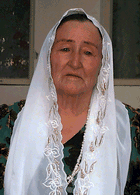 As long as mothers sing to children there’s hope for this world, I hope her many pupils take up this complement to the rattling doira.
We set out on an early morning journey from Kokand to Andijan across the valley to track down a lady called Malika Askarova. She had been recommended to us by our music advisor Dr. Razia Sultanova who was born in the area. We had limited time to find her – with a deadline to get across the border into Kyrgyzstan. Our driver Bahadir took the quest into his own hands. At first we did not mind this, it was his last day with us. He thought the town we were looking for was near Fergana. He then repeated a similar pattern of question, answer, drive: 1 Screech to a halt next to someone who looks ‘intelligent’ 2 Shout politely at them for directions to a village they have never heard of. 3 Go whichever way they suggest and finally 4 At the very next junction, usually 3 minutes later, repeat the loop. After two hours of this we had had enough and gave up. By mistake we found ourselves at the village of Durtor. One feature aroused the curiousity of the team. A circular, mud encased building stood bizarrely in the centre of the square. Balanced on top of this hollow mound was a tree complete with roots, precariously balanced. Strangest of all were the carvings on the top – three swan/dragon-like creatures all in motion, facing the same way. I walked inside and saw Arabic inscriptions carved deep into the ceiling, ‘Allah Askadu’ (Allah is Unique). The locals didn’t know the building’s real purpose but said it had been built during the last war, though it looked pretty new.
A man stood quietly next to a roundabout “Do you know the town Durdur”, “Yes” he replied and continued knowingly, “I know Malika, she’s my neighbour. I’ll take you there”. Later he said Allah had placed him there so he could take us to her. Who knows?
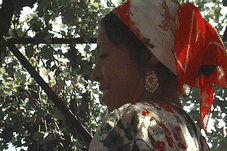 Malika Askarova looks in her forties. She has an expressive and beautiful face which smiles easily. She’s naturally a humble person and could not believe for sometime that we had come to see her. Before long the Uzbek hospitality was bringing us all together and friends and family were gathering to see what was going on. We must have seemed like aliens suddenly arriving out of nowhere in our shiny ‘Nomadmobile’ full of equipment.
Malika is an Otin-Oy or female Sufi. She reads Arabic and studies the ‘old books’ including the works of Ahmad Yasavi – see day 20. She’s called upon for occasions such as weddings and funerals and reads from these old texts in a strong and beautiful voice. She also composes her own songs. When we asked what they were about she explained that she had often been alone in her life, losing her husband when still young. These songs she sang ‘from her heart’ about her life. Malika takes several minutes to prepare herself before singing. Even without understanding the words we could tell they were delivered with considerable emotional force, several of the women present were moved to tears.
We played some recordings to the gathering, Shaykh Kuskarov?s mantra and the Zikr from Kokand. The mantra aroused some curiosity but didn’t seem familiar, however the Zikr induced nods and smiles of recognition. We were told that Malika also performs this Zikr. She became interested in spiritual matters when she was fourteen. Her spiritual mentor was an old woman from the village who also taught her Arabic. Malika’s role is similar to the Kokand women that we met recently. Even though our meeting came about in a strange and unexpected way it seemed quite natural. She has an openness about her that makes you feel welcome and we were all sad to leave.
As the sun slowly falls behind the approaching peaks, we head across the border to Osh.
Tomorrow a mammoth 15 hour journey across Kyrgyzstan to Biskek. We will send a report en-route
Day 0 – Through the telling of stories we try and make sense of our world
Posted by Musical Nomad in Daily Blog on July 28, 1997
‘Through the telling of stories we try and make sense of our world’.
I invite you to share a live story and a journey.
A story in the present tense, a journey about to begin!
Our ancestors gathered around the campfire, our grandparents the radio, our parents the TV. We gather now around the luminescent glow of the World Wide Web.
Is this the ‘The Global Campfire’?
The Millennium draws us to reflect. Our technology has woven a powerful web but has eroded personal contact, many of us crave a ‘sense of belonging’.
My journey in Central Asia is an epic quest. In the tradition of storytelling, I invite you to participate to engage.
Let me hear your voice.
 I’m a musician. Musicians are traditionally storytellers, poets, philosophers, priests, teachers and inventors. In Central Asia this holistic role is alive. As we encounter these musicians, shall we rediscover the integration of life and music?
Nomadic musicians now settled in former Soviet cities, cling to their music. Do they retain an urge to wander?
This will be a ‘live’ journey from ‘concrete jungle’ to wild nomadic pasture. I will travel from the ‘Holy City’ of Bukhara through Samarkand, the ‘Pearl of the East’, along the borders of Afghanistan and Tajikistan. Together with the nomads I plan to venture into the Tien Shan mountains of Kyrgyzstan and the Alatau range of Kazakstan.
I want you to share and contribute to discovery, to meet others whose lives echo distant truths. We will encounter musical traditions and ancient rituals closer to nature and rooted in a shamanistic* past. The desire to search for ‘alternatives’ and ‘chase’ dreams persists.
Share your dreams
 ‘When we travel there is no past or future. We engage with the moment. So much that we take for granted, is suddenly in question as we pack our world into a suitcase.’
Much ‘modern’ life is built around obsessive planning for some mysterious almost mythical ‘future.’ When you travel you live in the ‘now’ – that for me is dangerous and exciting.
As this aircraft descends to Almaty on the 28th July I will again be truly alive!
I become ‘the digital hunter-gatherer.’ Tell me what you seek
What’s out there in that dark city full of new smells and unfamiliar sounds? What secrets lie on tomorrow’s page?
For the next six weeks share the sounds and culture of Central Asia, experience that sense of the present, engage daily with each new corners’ revelation.
The ancients said ‘the person who arrives is not the one who left’.
Join me on a journey of 2500 miles, a thousand faces and as many stories. As the ‘Old Silk Road’ merges with the ‘information superhighway’… perhaps we too will change?
- ‘the drummer who gives life to the spirit’