Posts Tagged Kazakstan
Day 38 – This journey is only the beginning
Posted by Musical Nomad in Daily Blog on September 4, 1997

We set ourselves the impossible task of reflecting on the last six weeks in the space of a few hours. As we have been doing all along, what follows are the immediate impressions of all members of the team. We will continue to add to this site over the coming months. Please continue to send Emails and we will endeavour to answer them.
JAN – Musician
It seems an impossible task to try to sum up our journey using words, so much has happened that cannot be conveyed verbally. The three countries of Central Asia that we have visited are remarkable for their diversity of people and ways of life. We have barely been able to get a flavour of the place, and yet in some ways we have had some profound experiences. It has been a recurring feature of our meetings with people that we have been accepted, welcomed and drawn into houses and families. Trust, tolerance and hospitality, particularly towards visitors is so pronounced that you cannot fail to be moved by it.
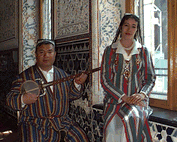 Ways of life are constantly changing all over the world. As they do so the music and culture that is associated with them changes too. It may be preserved in an artificial form, or it may die out completely. We have seen evidence of both these trends in Central Asia. We have also seen abundant evidence of vibrant, living traditions transforming and adapting to new environments. Munadjat Yulchieva (Day 7) is a good example. A nationally renowned figure she has managed to stay faithful to her musical tradition whilst raising the profile of maqam music.
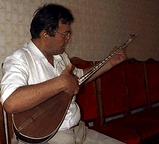 There is a marked distinction between the cultural life of the cities and the rural areas. Even in the pre-Soviet times cities were centres of culture where musicians gathered, the same is true now. Uzbekistan with it’s great cities has preserved the court music tradition even though the courts are long gone. Some musicians retain the link with the original tradition, but there is little space for them now. Abdurahim ( Day 8 ) for example one of the countries most highly esteemed musicians no longer makes a living through music and has become a businessman. Many are leaving the country for America and Israel. Even though there is something of a revival in national music (as a symbol of nationhood) this will not sustain the tradition. Musicians however are endlessly creative, and change comes about through a process of adaptation. The less fashionable Kashgar rubab has been superseded by the Tar from Azerbaijan. Perhaps a new tradition will arise out of the same feelings that inspired the shash maqam.
 In the rural areas the picture seems somewhat different. Musicians play a more integral role. In Kazakstan and Kyrgyzstan which were largely nomadic musicians still sustain an aural tradition which is part of everyday life and life events. Many great musicians are farmers or labourers who are partially self sufficient. Money means little to them and many seemed perplexed by our fees for recordings. The western distinctions of professional and amateur do not apply here. Music is too important to be exploited for money. As the rural ways of life continue so the music has survived alongside it. The hospitality often being inseparable from the music. Malika Askarova (Day 25) is a good example of this. She does not consider herself to be a musician and yet she is able to affect a listener in an extraordinary way. She did not understand why our contracts and fees were necessary. There was a sense that music is a gift which should be given freely, Malika was not the only musician who gave us this impression.
 It has been through the attitudes of people that Central Asia has made it’s mark upon me. Whatever the external appearances or current economic situations of the countries, there is still a feeling of a great ‘civilisation’. I mean this in the sense of an internal process of development. A cultured people and not just people with a culture. Many of the musical genres still retain a philosophical and reflective content. These themes reflect a view of life and an attitude towards people that are quite different from those I am used to. The physical and the metaphysical are constantly intertwined in art as in life. The art forms often have a delicacy and subtlety which is deceptive. “The art that conceals art” – always hinting at a greater mystery beyond.
Central Asia is a wonderful and fascinating place. I hope that our reflections serve to wet the appetite of other travelers. Our journey was not a survey of the area, more like an account of some almost random events. Like any supposedly random events they have their own logic and they tell their own story. We will meet again…
Day 35 – as words fail Diana dies on the Kazak Steppe
Posted by Musical Nomad in Daily Blog on September 1, 1997
In 1961 there was no such medium as the World Wide Web. Had it existed it would probably have failed to announce the birth of Diana Spencer. Last night we stood in a Kazak field a thousand miles from anywhere and logged on with our daily episode. As the news of Diana’s tragic death was announced we stood in disbelief and horror. The national anthem rang out across the Kazak steppe and we fell to silence.
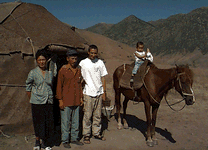
The morning light revealed a lone horseman tying up his horse near his yurt. I approached with a smile and shook hands. His wife and young son joined us with more smiles. I pointed to my video camera asking permission. A gesture and a nod and he mounted his horse, parading with some pride. His young son then took the reins. Eager to share something I offered him a playback of the video. One by one the family watched themselves and amongst the Kazak speech the word ‘Television’ emerged. For the second time in a few hours communications technology found a strange role.
The horseman then gave me his horse whip as a gift, no doubt to him a valuable asset. I gave him a wooden flute in return. Sometimes human understanding has it’s own language even as words fail.
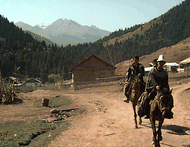 My encounter with Bulat, his wife Gulja and son Almas, had to be curtailed because of our voyage of discovery to a local village. It was only a 15 minute drive from our campsite and it took us further up a scenic tributary valley of the Charyn River. As we neared the village distant snow covered peaks appeared above the wooden rooftops. Alongside each of the valley walls pine forests increased and an occasional shepherd on horseback darted in and out of the rocky outcrops. We passed a hillside graveyard and someone whistled the theme from ‘The Good, The Bad and The Ugly’, this really is the town with no name. At this time of the day most villagers are on the hillside working the land or herding sheep.
 We had made the decision that this part of the journey was to be an adventure. No ‘fixed up’ professional musicians. We are in the Kazakstan wilderness and we intend to discover local musicians the hard way. We stopped and spoke to a passing ‘horse man’. Did he know of any local musicians? The driver communicated by making guitar poses and saying the words dombra and komuz. To our amazement the horseman repeated the word komuz and beckoned us to follow him. Our first conversation with one of the villagers and he seems to be a komuz player! We go to his wooden house fifty metres further down the road. He holds up his hands and says ten tenge (Kazak currency) whilst pointing towards a bucket full of milk. Moldira suddenly tells us the word for milk here is kumyz. Ah well, we thought things were going too smoothly.
A bit further down the road we decided that we need a different approach. How do you find about the cultural life of a small Kazak Village?
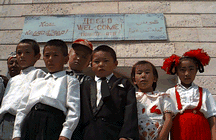 At that moment we passed a building that looked like a school. Children were assembled in a courtyard singing a song which turned out to be the Kazak national anthem. In every school I’ve known the head teachers have always been a mine of information regarding the parents of the children. Perhaps this would be the ideal place to find out who the musicians are in the village. Being the first of September this was the first day back at school but the headmaster had time to talk to us. He was very friendly and welcomed us. The school is housed in a new building which seems well designed. The classrooms are cool and light and everything looks well organised. The word ‘welcome’ is displayed in English above the main entrance. This is possibly because the village is called Kurmetui which means ‘welcome’.
 In the spirit of exchange we offered the school a short presentation during which we would play to them and tell them a little about our project. In return the headmaster offered to allow us to observe a music lesson. He also gave us the names of some musicians two of whom are teachers in the school. It will be fascinating to see how the children respond to our music and also to some of our technology. We will meet them tomorrow at twelve. Who knows what will happen?
Within a few minutes one of the teachers came strolling down the road with his dombra. Kuan, the sports teacher, is also a musician. On the verandah of the school Kuan stood proudly in front of a small group of school children and the Nomad crew. He warmed up by roughly strumming his instrument. This gave an impression of quiet confidence. Suddenly he began to sing and everyone stopped talking and listened. He had a powerful, resonant voice.
 After a short time he performed in front of our two video cameras, his headmaster and the school children. Occasionally he faltered, perhaps not used to this kind of pressure. As in electron microscopy the act of investigation changes the thing you are studying. We are now in a sensitive environment and our presence is possibly an intrusion. It has been my experience that in Central Asia and the much of the world music is often born out of intimacy and trust. Malika and Rakhimahon were good examples. Asking musicians to perform in a ‘professional’ way sometimes causes imbalance. The musicians become ‘the watched’ we are the ‘the watchers ‘. Even the school children, not familiar with cameras, began to freeze.
Tomorrow we will attempt to share.
Day 34 – Take the first left on the A351
Posted by Musical Nomad in Daily Blog on August 31, 1997
 We break camp at 9 am and leave the Almaty area passing the ominously titled ‘Panilov State Farm’. The A351 is a bumpy old ‘B’ road lined with fruit growers selling their wares. Delicious tomatoes that taste like tomatoes, remember those? Melons ooze sweet juice and the apples ‘tang’ in your mouth.
The mountains sit tantalizingly ten miles either side of the road. Horses run wild on the wide open plains. As we travelled we listened to the Kazak folk ensemble of Day 2. One melody that seemed very appropriate contained a Kazak traditional instrument – horses hoof castanets.
 In places the countryside is almost English but the rising thermometer shatters that illusion. There are ‘yurt’ shaped bus shelters decorated with colourful mosaic and men on horses with sun carved faces. Donkey carts pull whole families. Occasionally we encounter ‘the land that time forgot’ – rusting hulks of abandoned industry. Rows of dead cypresses await some forgotten promise of irrigation.
We are heading East from Almaty for supposedly 6 hours towards the Chinese border. In fact the journey turns out to be a 10 hour slog. Our route will take us enticingly close to China. This will be the furthest East that the Musical Nomad project will travel. The lanscape here is dramatic and mostly vertical, it is possible to drive for hours without seeing anyone.
 During the journey we stopped off at the the Charyn River canyon. On some rocks precariously close to the edge of a 200 foot drop I chatted to Moldira our Kazak interpreter. (We have tried to include profiles of people that we have met on our journey. We hope to give a sense of the variety of lifestyles that still co-exist within a fairly small geographical area.)
I already knew that Moldira was a dancer and was very interested in music. So I asked her a bit about her life in Kazakstan.
Could you tell us about your job in Chimkent
 In 1994 I worked in Chimkent, my native town. I was a producer of my own private music club. I had a music programmme on TV. It covered music from both the World and Kazakstan. It was pop music as young people were more interested in this rather than Kazak music. I was also a journalist in the local Chimkent paper called Sebja ‘My Paper’. The TV program was very popular because it was the only one of it’s kind and it was called M95. M for Music, Moldira and Molodjosh (youth). It began in 95. My program was on twice a week and in Chimkent it had 6000 viewers. I was very popular because I presented and scripted it.
Why did you leave?
The technical side was not very good and my aim was to make quality programmes. I think that it is better to have no programme at all rather than a poor one. We never had enough time for filming and we only had one camera. Also we could not travel much to meet musicians.
But it was a very popular TV programme?
I think so because every second or third person would stop me in the street and say ‘hello, I know your programme’
Do you think you want to continue working in television?
 I don’t know because there are still technical problems in Alpha TV, Chimkent (the TV company I worked for). I like languages and I want to speak better English and German. Maybe in the future I will want to return but I haven’t studied economics or management and showbusiness is heavily connected to money. I was the manager of my own dancing group. and I managed a music club in Almaty which was the first of it’s kind. In 1992 there was a competition between Almaty music clubs and ours was the best.
What sort of music club was it?
Some years ago it was discotheque, now it is a TV and Radio station. Bigger, programmes, concerts, music competitions.
What do you think of Kazak TV?
Some programmes are primitive. They are often samey and repetitive
Do you still dance?
I haven’t studied dance but I like it very much. I can do any kind of dance. Especially funk. I know Kazak traditional dancing of course, it’s in my blood.
Do you like Kazak traditional music?
It is natural for me to like it, Yes.
Is it common to find pop music with Kazak melodies?
 There are some traditional melodies in modern mixes and I enjoy this. Because it’s old music with a new look. We can’t forget our old musical traditions. It is very important.
How do feel about Kazakstan after independence?
The first things that were changed in our country specifically in Almaty were the restaurants, nightclubs. We have freedom, liberty
Is this good?
I think it is not just good. But it is freedom. Each person can feel free. To visit interesting places not just the Kino, cinema, which is primitive. So many foreigners come to Almaty which makes it very interesting.
Do you feel positive about the future?
I hope but I don’t know
Do you feel its possible to find a job?
Yes I think its possible if you have ambition.
The kind of work you have been doing, TV, Radio could you have done that before independence?
Yes but now it is more easier.
You told me you like the natural beauty around Almaty?
 Nature is my second home. I like it very much. Fresh air and the mountains are fabulous. People are nothing compared to the mountains. That is an important point. I dream about the lakes, rivers, nature, mountains, rocks, deserts.
Do you think more people will visit Kazakstan to see these places?
Yes. I have worked with many foreigners and they usually say it is so beautiful. The mountains and the stars and this makes me happy.
We drive on through desert steppe at the edge of the mountain – a yellow furze, almost a cowboy’s Arizona. In a valley near Zalanas I see my first ‘wild’ Nomad yurt. As the sun sets, after nine hours drive, a man on horse-back tells us we can camp near his yurt. We set up our tents somewhere in the wilds of Kazakstan.
Tomorrow. We visit the nearby local village. Join us and see what happens.
Day 33 – another half-ready kobuz nestled like a hibernating wild animal
Posted by Musical Nomad in Daily Blog on August 30, 1997

“It looked like a tree trunk”
For some time now we have been traveling from one Central Asian city to the next, in search of sometimes elusive musicians. It comes as something of a shock to find myself in dramatic mountain scenery within an hour of leaving Almaty. Seemingly vertical surfaces of rock carry the eye upward, to the hazy skyline.
We are camped by a stream in a beautiful valley, this feels like the first opportunity I’ve had to reflect on our journey. Thirty days on the road is a long time in some ways, but it has been a whirlwind tour. I would have been happy to spend weeks visiting any one of the musicians we’ve encountered. I have the impression of being allowed a brief glimpse into a fascinating and absorbing world.
Thinking about Raushan’s kobuz playing yesterday, its directness and simplicity, I felt the urge to improvise a piece about being here in the mountains. I have with me a simple three-holed flute from Africa, which seems the perfect instrument. It’s not every day you get to play in a concert hall like this. The wind carries the sound away very quickly and I feel small in such a vast location. It seems appropriate though – being here gives a sense of perspective on life.
 We had been told that the ‘village of the masters’ was one hour from Almaty. When Nomadmobile 4 set off we were unreliably informed that the village was over a 3000 metre pass. Looking forward to a spectacular ride through the Alatau mountains the Musical Nomad cavalcade started up. After what seemed like twenty minutes we turn off the main road across a small stream and up a steep rocky slope. Two large yellow apartment blocks and a small row of houses nestle in an avenue of electricity pylons. “This is the masters village” the driver informed us. My image of wooden shacks on a wooded hillside was immediately shattered. As soon as we switched off the engine several men began to display carpets and silver ware in the road outside the larger of the two apartments. The crafts are good quality and I bought a rug. Gradually a crowd of village children gathered and we become the centre of attention on a dull Saturday afternoon. They were confused by our presence – this place obviously doesn’t get many visitors.
 A man resembling Shayhk Kushkarov of Day 20 suddenly appeared and amongst his Kazak I recognise the word kobuz. I say Raushan’s name and immediately we have connected. The housing block is home to a community of craftspeople. Tolegen Sarsenbaev, the kobuz maker invites us in to his simple abode. He has a very friendly face, bearded with deep passionate eyes. I immediately sensed his creativity and devotion to his craft. This was a man used to working in harmony with nature. Three large rooms operate as workshop, bedroom , living room, artist studio and kitchen. A tree-trunk in his studio serves as a stand for his musical instruments which he says charges them with energy . He seems to understand why we have come and begins laying out half made kobuz’s all over the living room floor. They look wonderful. Variations on a theme for sure but in their raw state they have an embryonic perfection, living things almost ready. Another partially ready piece which caught my attention was a kobuz case. This looked like a tree trunk and inside another half ready kobuz nestled like a hibernating wild animal.
 Tolegen told me that most of his kobuz’s are designed on the theme of wild animals. He had a bird, a camel and a owl. The profile of the instruments were indeed animal-like. Tolegen described the shape of the soundboard, which on most instruments resembles a heart with a trench underneath. He said this helped the sound to flow from the bottom of the instrument into the centre enabling it to project forwards. He seemed enthusiastic to talk about the technical aspects of his work. I asked him about Raushan’s instrument, particlarly the fingerboard and the lifted nut. He said this was an experiment many years ago and Raushan had requested it particularly for her ‘cuticle’ technique we mentioned yesterday. He was keen to talk about the uses of his instruments and mentioned how the kobuz is a favourite of Shaman for inducing trance like states. He didn’t have a finished instrument to play to us so I showed him my kyl-kyiak which produced some amusement. He refused to play it saying it was ‘imitation kobuz’ So much for Kazak-Kyrgyz relations.
 We also talked about Tolegen’s passionate interest in Shamanistic rituals and his recent meeting with a Shaman, Temish, in Kyrgyzstan at Lake Issyk-Kul. He met Temish when he stayed in the house of Ama, an ‘old and wise babushka’ who is teaching Temish all about the ancient traditions of zikr and Shamanic dances. Tolegen is now making a kobuz for Temish this is the instrument that Shamans used to play in Kazakstan and Kyrgyzstan during zikr’s. I was surprised to hear of Shaman rituals which include zikr. Zikr is an Arabic word used to describe a specific Sufi practice. Perhaps this supports Shaykh Kushkarov’s assertion that the two traditions are connected in Central Asia.
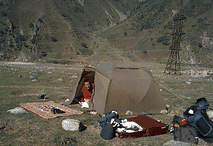 Tolegen is keen to join a zikr next month for which he will hike across the river Yur-Kemin and the Kungey Alatau mountain range (over 4000m high) into Kyrgyzstan and then hitch a lift along Lake Issyk-Kul. I’m interested to know which of the instruments I’ve seen in his workshop is intended for Temish – I’m told he chose one shaped like a bird in flight – a metaphor for the animal spirit.
As we make camp a competition soon emerges for best attempt at rigging a tent. Paul’s team wins hands down, predictably with help from the girl guides. I take advantage of the ‘cold and cold’ running water and avail myself of that handy bush. Gary is in seventh heaven as he plays his Krygyz Komuz and rigs his satellite next to his tent. His feet grounded in the stream, at last a long way from a power point.
As the evening shadows shape new contours into the eternal hills, this is definitely a place to make music. I’m sure tomorrow will bring us closer to the nomad spirit of these Kazak people. We will camp near some mountain villages and via our new interpreter Moldira attempt a dialogue with their remote inhabitants. The musical nomad has truly landed….. ‘When you sleep outside your thoughts are as high as the stars’.
Day 32 – Where there is spirit there is usually music
Posted by Musical Nomad in Daily Blog on August 29, 1997
What oppression causes such sad faces in Almaty? In the hotel reception everyone glowers when you request directions to an urgently needed toilet. When I turn up for breakfast (the other half of bed and breakfast?) I’m marched off to reception where 8 dollars is demanded, cash, now! I smile at a floor manager (each floor of the hotel still has a KGB style ‘watchdog’). She glowers back uncomprehendingly. I point out my bathroom has no water to a hotel supervisor, she glowers at me for interrupting her chat with her friend. I assume this is all the legacy of the Soviet years – it will take a long time to heal these wounds.
Music is the food of the spirit. Outside of the modern cities that spirit seems more alive – perhaps further from beaurocracy and dogma?
In our absence no progress has been made on our proposed Yurt stay, we’ve been out of touch as Kyrgyzstan has no external phone service worth mentioning. We only have a few hours to organise this expedition.
Raushan Obrazbaeva – part two
What of music? One of my favourite musicians so far is Raushan, the hypnotic exponent of the kobuz. Her inspirational performance (Day 4) has remained a high point of the trip. I remembered she had spoken of musicians in the mountains. Perhaps she could help solve our predicament. I was also keen to ask her some more questions in the light of our experiences elsewhere in Central Asia.
In a small and rather noisy cafe in downtown Almaty we showed her how our Internet project had progressed. She was keen to hear Barkut (Day 29) the Kyrgyz kyl-kyiak player. Unfortunately, we did not include this track in our report but I showed her the instrument I had bought from him. Raushan was curious to play what she described as a Kyrgyz variant of the Kazak kobuz. She pointed out some significant differences in design, and sound. Unlike Western instruments, which are very standardised, Central Asian instruments vary widely. Kathy had also bought a Kazak kobuz, which was very different from either Raushan’s instrument or the Kyrgyz kyl-kyiak. The basic design of two string horse hair fiddle is constant – after that it seems to be up to the creativity of the maker. One of the main things Raushan pointed out about the kyl-kyiak was the different playing technique. She plays by pressing her cuticles on the strings like an Indian sarangi player (also a vertical fiddle but with sympathetic strings). The Kyrgyz players press on the strings with the fingertips. These differences are generalisations and there are pieces in the Kazak repertoire that demand different techniques.
“She plays with her cuticles”
Our conversation continued as we moved to the park to record Raushan in the open air – where she likes to play. [Also see Kurmangazi day 28]. She demonstrated some pieces that are inspired by animals – the wolf and the camel. I found myself astonished once again at the variety of expression that Raushan has, literally at her fingertips. Her instrument is close to nature in its simplicity. It produces a complex ‘unpurified’ sound with strong overtones. Raushan’s impressionistic renderings of animal sounds are very abstract in character, simultaneously ancient and modern.
Raushan also likes to play pieces from the European Classical repertoire, and she showed us how she changes the way she holds her bow to emulate a ‘cello. We could have chatted for ever about instrument design and playing techniques. We were conscious though that we had an expedition to organise and so time was short.
A kobuz masterclass and interview
Raushan told me of a village in the foothills of the Alatau Mountains only one hour away from Almaty – ‘The village of craftsmen’. Everyone there is a crafts person – the men making musical instruments and the women making clothing and jewellery. An instrument maker in this village had made her kobuz and she seemed delighted by my interest. It sounds like a beautiful area and apparently we can camp there overnight. Another region she recommends is a 6 hour drive away. This valley surrounding the Shinishke river has ‘real’ Kazak villages with people who still live in traditional ways. There are Yurt encampments – Nomadic herders settling in the rich pastures for the summer months. There is natural beauty. Thirteen thousand foot mountains, white water rivers and rare wildlife such as Ibex and Bobcat. Most importantly, Raushan told us that where there are people there is always music. She reiterated that Kazakstan is a very musical country. Suddenly our trip tomorrow is looking like an exciting adventure.
Raushan had given us some useful leads but we had a very short time to put the wheels into motion. This final week was meant to be a voyage of discovery and we seemed to be steering in the right direction. Nomadmobile 4 has to be organised – this time though we will be self-sufficient, living remotely, eating from carried supplies often miles from anywhere ‘civilised’. The electricity generator will now become our most important piece of eqipment as we send you daily episodes from deep in the mountains.
Jan ‘older and wiser’
Our Kazak interpreter Mary knew of an agency who were allegedly experts in the expedition field. Visiting their premises inspired some confidence. A large ‘ordnance survey’ style map of South East Kazakstan proudly enveloped one wall. In another room professional climbing and camping equipment. They seemed sympathetic to our requirements and listed everything we would require as we told them of our needs. We talked vehicles. Their first suggestion of a decrepit bus was soon jettisoned – the seats were lose, the bodywork crumbling and the wheels buckled. We stipulated two ‘modern’ Gazelle vans which would accommodate the Nomad team, cook, interpreter and drivers. There was also a lengthy conversation about safety. If we were in danger or someone was ill do we have a 24 helicopter rescue number? – they told us no general Kazak ‘mountain rescue’ service existed but the agency had a helicopter for emergencies. As the hours went on we realised we would have to furnish many ‘expedition’ items ourselves. A desperate rush around Almaty’s bazars and prestige shops then ensued. Gary, Paul and myself haggling with old women over the price of cheese and pears. On our way back through the commuter streets of Almaty, white shopping bags in hand we at last felt at one with the city – the locals around seemed to accept us. A pity that tomorrow we finally say good-bye to this, our most familiar city.
Tomorrow we head for the village of the masters, then on into unknown territory, little visited villages of Nomads and Yurts. Music? Who knows. Usually where there is spirit there is music
Day 30 – we try and make sense of our world Pt II
Posted by Musical Nomad in Daily Blog on August 27, 1997
Whats new – Nomad Mixer
This afternoon we were visited by Saparbek Kasmambetov, one of Kyrgyztan’s few manas epic singers. Besides being an esteemed musician Saparbek is also a well known journalist. The parallels between journalistic ‘storytelling’ and the role of the storyteller/musician had already struck us when we met Shoberdy the bakshy singer.
Saparbek sang us some excerpts from the stories. The first is about two heroes. One Kyrgyz, Almanbet Chubak and a Chinese giant named Makeldur . They fight an epic battle in the mountains until Almanbet eventually traps the giant between two mountains and hits him on the head. The head is then displayed in a large bag next to a large pile of stones to demonstrate it’s size. Even without knowing much about Kyrgyz-Chinese relations the symbolism seems clear. We also heard a song about Saparbek’s travels to London. A trip which he recalls with affection. This he described as an improvisation – an elaboration on an existing structure but using contemporary events. Even without understanding the meaning of the words this is a very expressive medium for story-telling. Saparbek uses dramatic hand gestures and a kind of rhythmic chanting which draws the listener into the story. Even out of context it is possible to imagine the effect of this style of performance stretching over twelve or more hours – a kind of hypnotic state could be induced, or at least a heightened receptivity.
The manas epic is a story cycle which takes up to thirteen days to perform. Understandably this is a rare occurrence these days. Consisting of a series of legendary stories it often contains philosophical themes and historical references. It has been passed on orally from father to son for generations. Saparbek, an exception to this rule, ‘learnt it naturally’ and described how it is necessary to have a talent for manas – given by God. It is a huge task to learn all the stories and Saparbek is one of only two ‘manaschi’ who can improvise upon the themes of all the stories. Supposedly the first epics were composed in the 4th century but written references to them (in Arabic) only appear from the 8th century.
The contexts in which manas may be performed include: weddings, funerals and public occasions. It has come to represent a link to the past. A contemporary cultural icon which connects Kyrgyz people to an older way of life. The nomadic culture was non-literate it is therefore only through oral traditions that children learn about the past.
Day 0 raised many issues. ‘Through the telling of stories we try and make sense of our world’. The stories and songs of the three countries we have visited have a purpose. They tell of suffering, joy and of a long, rich past. The songs have a reason for existence and they are alive here. We have met performers who have developed in an oral tradition. A tradition where songs are passed down naturally to each subsequent generation. Like seeds, they grow and flourish if the environment supports them. Music survives through those willing to nurture and spread those seeds – Musical Nomads?
Kyrgyzstan has changed rapidly – according to Gulnaz, the Russians did not arrive until the 19th century. In this short space of time the majority of the population has become settled. Gulnaz works with Information Technology and is thoroughly at home on the internet. This is a hugely accelerated pace of change.
Gulnaz epitomizes what it means to be a citizen of Central Asia. Her family are Kyrgyz, but raised in Russian part of town she attended a Russian school. Her first language is Russian but she understands both Kazak and Uzbek. Her husbands language is also Russian but he speaks no Kyrygz. As they live in Kyrgyzstan she regularly interprets for him.
Gulnaz is a modern woman. She loves pop music especially ‘A-Studio’, Kyrgyzstan’s most popular band. Though she dances until dawn at local discotheques, Gulnaz became fascinated with our project and listened with rapt attention to our unaccompanied folk singers and virtuoso komuz players. A new career beckoned as Gulnaz became an enthusiastic clapper loader – putting the synchronization slates on the front of our recordings (take one etc.). Today Gulnaz leaves us and we shall remember her affectionately as ‘giggling
Tomorrow we return to Kazakstan, older perhaps wiser and certainly overwhelmed by the richness of culture that remains in Central Asia.
The journey has come full circle.
In the mountains near Almaty will we find a resolution?
Have there been any lessons learned?
Did the music and way of life of the people hold any answers?
Perhaps we will meet more musicians in the mountains who are not as settled and who have other perspectives to offer. It’s a long way from over yet, stick around for surprises to come.
Day 8 – The Land of Lutes
Posted by Musical Nomad in Daily Blog on August 5, 1997
The Land of Lutes
Every journey has it’s trials and today we’re having our fair share. Last night I was struck down with a bug, without going into graphic detail. I am now laid up in bed unable to be of much use to anyone. As if this were not enough Gary and Kathrin are at various Government Departments wading through acres of red tape. The officials in Tashkent are very suspicious about our new imported Satellite transmitter – are we really James Bondski? Only a letter from the Minister of Foreign Affairs can convince them to release this much needed lifeline. Without this we cannot continue our dialogue or bring you the exciting music we have been hearing. We hope we will soon be ‘on-line’ eager to reply to your e-mails. Only Paul is left back at the ranch, Dat machine in one hand, camera in the other. He loves it really! While I catch up on much needed sleep I leave you in his capable hands. I know he’s dying to tell you about lutes.
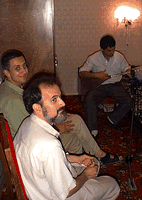 As one of the guitarists and sitarist in our team I’m fascinated by the ‘lutes’ we encounter. I’ve just been lent a dutar by Abdurahim Hamidov. Living with the dutar, having it around my room playing it, I feel invited in to a sort of magic. It has made me incredibly aware of the close relationship between all these Central Asian instruments and most of the world’s ‘lutes’. The two-stringed dombras and dutars have all the latent characteristics of the guitar, the Oud and the sitar. The tuning in fourths (and fifths), the tendency to play parallel patterns up and down the fingerboard – the modal scales are all common to these more familiar instruments. The rasguedo of the dutar is almost “flamenco” in character. The vibrato and portamento techniques are reminiscent of the classical Oud of Arabia.
If the lute began in Central Asia as many scholars believe, what fascinating journeys it has made – into China, India, Arabia and Europe – taking new names and new shapes but retaining its Central Asian roots.
Abdurahim Hamidov who I met today is an incredible virtuoso on the dutar. He also knows many of the other lutes of the area and explained their relationship. According to Abdurahim the dombra which we heard a lot of in Kazakstan is primarily a folk instrument. Though if you refer back to Day 4, you can hear that Aygul Ulkenbaeva is now taking the dombra to a more sophisticated level.Abdurahim regards his dutar as a classical instrument, especially in the context of the Shash maqam though he often performs solo as well as accompanying singers.
Physically, the dutar is more sophisticated and highly decorated with beautifully made silk strings instead of the factory produced nylon strings of the dombra. Curiously his dutar retains its modal scale – it has not been ‘improved’ to a fully chromatic version (yet!). Abdurahim also asserts that his dutar has different tunings; in fourths, fifths and unison whereas he alleges the dombra doesn’t (I’m not convinced).
I encountered another fascinating lute yesterday, the Kashgar rubab played by Munajat’s teacher Shavkat Mirzaev. This is a five string lute with four metal and one silk string – an unusual mix. The silk string is very thick and provides a rich bass. The four metal strings are arranged in two pairs and are used for melody. The rubab has a haunting sound enhanced by its parchment sounding board and the harmonic richness of those pairs of metal strings. There are superficial relationships here to the saz of Turkey and the bouzouki of Greece. Earlier, in a taxi I heard the local version of Greek popular music or Rembetika – it’s a strange and wonderful world.
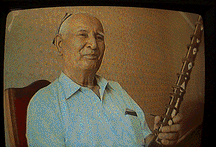 Wow, another lute – today we met Pattahon Mamadaliev, a fantastic 70 year old guy. He sings with a consuming passion and accompanies himself on the tanbur. It has four bronze strings. In India bronze is a sacred metal, I must check out its significance here. The tanbur has very thick gut frets to enable a deep vibrato, it’s made from mulberry and apricot. Pattahon possesses an intensity of performance and a sincere unmannered humility. I played some Spanish lute music for the musicians, Pattahon and Abdurahim. Abdurahim said he understood this 15th century lute music perfectly, which is interesting. This music is very polyphonic ‘in many parts’ as opposed to most Central Asian music which is often monodic. They also enjoyed a bit of pseudo-Flamenco – this is also interesting as Pattahon’s passion and style is reminiscent of Canto Joto from Andalucia in Southern Spain, a deep form of flamenco. Somebody must have told the lute to “go forth and multiply “- I’m ever more convinced that the lute family originated here as most scholars assert.
I’m currently in the lap of luxury – our little guest house even has a tiny swimming pool. I banged my head trying it out – perhaps it will knock some sense into me? The food here is the best so far in Central Asia – delicious Vegetarian stuff – not that common in the land of the rising Kebab.
I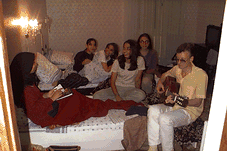 got caught last night serenading five Muslim girls in their bedroom – their father just laughed and went to bed – not the expected reaction. The girls enjoyed a Bo-Diddly song but thought Shash maqam was ‘pretty cool’. They are on holiday from Chicago, so that probably explains their frankly modern behaviour. Jan still has the “montezumas revenge”, so retires early. Kathrin and Gary are simply exhausted, endless wrangling and still we can’t get our satellite out of customs.
Tomorrow, who knows?
Day 6 – On the aircraft it’s bedlam and as people push and fight for the seats
Posted by Musical Nomad in Daily Blog on August 3, 1997
Travel Day – Almaty, Kazakstan to Tashkent, Uzbekistan]  The time in Almaty has been a fantastic beginning to the Musical Nomad. Despite satellite problems, a dodgy diet and oppressive heat the music has sustained us all. It’s 4.15 in the morning and we have been back on the road for over four hours. We are at the airport and some decidedly dodgy dealing is going on.
Some official has just run off with our air tickets and everybody is pushing for kickbacks to get the Musical Nomad equipment on the tiny jet assigned to take us to Tashkent. At 5.30 am we stand on the steps of the aircraft, finally poised to board, one of the aircrew demands “50 dollars or you don’t get on.” We reluctantly succumb.

On the aircraft it’s bedlam and as people push and fight for the seats. The in-flight catering consists of a bottle of water and some paper cups.
I land safely in Tashkent, the best is yet to come. The ground crew refuse to unload the plane and I find myself part of a human chain. The Musical Nomad crew become ‘Tashkent Ground Services Limited’ and we offload not just our stuff, but everybody else’s! Gary, our multimedia whizz, is also a registered giant and thinks nothing of hauling four cases at a time. Paul said ‘You see life in the new BBC.’
 It’s all part of the adventure. Tomorrow that includes meeting Uzbekistan’s foremost singer, Munadjat Yulchieva, I’m full of anticipation – I may play the flute with her, I’m trying to learn about the Shash Maqam (six modes). Log on tomorrow and hear how I get on.
Day 5 – When I play it seems that I understand the Shamanic tradition
Posted by Musical Nomad in Daily Blog on August 2, 1997
“When I play it seems that I understand the Shamanic tradition. There was a time when I had a supernatural connection with the audience but now I have lost this a little.”
 Raushan is softly spoken and very articulate . She speaks passionately about Kazak music and in particular about the kobuz. She comes from a musical family. Her father, also a musician, always wanted Raushan to play the kobuz. They are from a region near the Aral Sea, which has its own rich musical tradition. Her sisters play flute and oboe, by all accounts outstandingly well. This musicality stretches back for generations.
I started by asking about the history of the kobuz. She explained that very little had been formally recorded as this was predominantly an oral tradition. She recounted a legend of a real person, Korkut, who is often looked upon as a father of the kobuz tradition. He was a Shaman. At his birth the heavens opened and the climate changed. There was thunder and lightning, people were terrified. When the child was older, it became clear that he could foretell the future, and people were afraid of him. They named him Korkut which means the terrible one. One night he was visited in his dreams by an old man who told him that he would die when he was very young.Korkut set about trying to evade death by playing the kobuz. He could not play day and night and so everywhere he went people would dig graves for him. He would ask “Who are these graves for?” They would reply “They are for Korkut.”
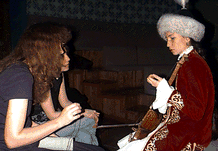 Raushan explained that Korkut wrote many melodies for the kobuz, and is now seen as a classical composer. She performed a piece for us which utilised the metal jingles attached to the instrument. This was a medley of his tunes and is called Abistolgan. This is very ancient music and she often plays it for herself. “It has to be with me always.”
I was very interested by the connection between this instrument and Shamanism. Raushan explained to me that the Shamans had used rattles to heal people. This was the origin of the jingles attached to her instrument. The Shamans improvised on the kobuz, not playing set pieces. It was a sacred instrument.
When Islam came to Central Asia the Muslims disapproved of the Shamans and tried to discourage their practices. As Raushan was a Muslim I asked whether she felt the two traditions were compatible. She said that she felt that they were, but it was not a logical thing. She played me a melody representing how she felt when she read the Koran.
Raushan is a living, creative musician who makes sense of life through sound. This is not a rational process, and it is precisely this ability to evoke things which cannot be explained which marks out a true musician.
“When I play it seems that I understand the Shamanic tradition”.
“There was a time when I had a supernatural connection with the audience but now I have lost this a little.”

Raushan’s instrument is one of the most extraordinary I have ever seen. She explained that the basic design was one which was common amongst the Turkic peoples. This particular one is made in the traditional way, from one piece of wood with no glue or nails. The resonating membrane at the bottom is made of camel skin. The camel, she explained, was almost a sacred animal to her; “A camel’s voice is deeply moving.” The skin used for the instrument comes appropriately from the camel’s throat.
The kobuz has a heart-shaped resonating chamber which in this case is painted dark red emphasising the heart-like imagery. Inside the heart were placed some small pieces of mirror. This was not traditional, but could represent a number of things; summoning ancestral spirits or reflecting bad thoughts were two possibilities. I mentioned the Sufi image of “polishing the mirror of the heart”, a description of purifying the heart for God. She thought it likely that this instrument maker had thought along these lines. There were a number of small details on the instrument – carved symbols representing sun, moon and a star. There were resonances of the Islamic Star & Crescent but subtly changed.
Raushan expressed a wish to search for more repertoire for the kobuz, and to research old pieces.
“Modern composers don’t understand the spirit of the tradition……..they spoil everything…… Kolumbaev was a brilliant player who composed and arranged pieces for the instrument. He was a brilliant improviser…. now he is gone nobody can replace him.”
Raushan aims to play like the ancient masters, not literal authenticity but preservation of the spirit.
Alice, our interpretor during the past few days, invited me to chat with her in her parents home not far from the centre of Almaty. When we arrive the clouds that had been gathering during the day, suddenly opened. The heat of the last few days is immediately quashed by torrential rain. The thunder rages in the darkening sky as I sit down in her room and ask a few questions about her life and music. She talks with an accent divided evenly between Russian and scouse.
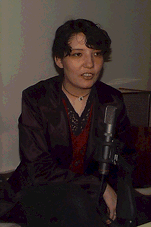 Would you like to be called Alia or Alice?
It doesn’t matter, I’m not bothered
Tell us a little bit about what you are doing in Almaty
I am actually involved in pop music, not really classical traditional but I do appreciate traditional roots, mostly pop musicians and blues based musicians. I have just got back from LIPA which is an institute in Liverpool that was opened by Paul McCartney two years ago. What I really want to do is to participate in the music scene here in Almaty, Kazakstan – because I think its booming now at the moment. Brilliant musicians, absolutely fantastic musicians – guitar players, drummers, vocalists. I want to get a band together. I do have a bass player and a singer but we need a drummer and were gonna start gigging at the end of August. What I wanna do is loads of gigs, I think that’s actually the way to success, do loads of gigs so the word gets spread around. Then probably do a single, then probably an album… I know it sounds cynical but I just wanna be rich and famous, have a jet and travel everywhere.
How would you say the musicians here differ from the musicians you’ve come across in England?
Oh they differ tremendously, because all the guitar players at LIPA (Liverpool Institute of Performing Arts) are into really weird stuff like White Zombie, Panthera and Metallica. Even Metallica is too soft for them. I found that really weird. Plus people are into things like Prodigy which are not popular here at all. In the former Soviet Union Rock and Roll was forbidden, you could go to jail for possessing an Elvis Presley record or wearing bell bottoms or whatever, ridiculous things like that. But still people were really into rock and roll, records were brought here illegally and then copied thousands of times onto tapes. People here are still into things like Nazareth and Led Zeppelin and Deep Purple and that sort of stuff. Nazareth are number one in the charts in Moscow at the moment. They’re into classical rock and classical blues.
Can you see in the future a kind of rock that will be unique to this part of the World, perhaps combining traditional music with rock music?
There is a band at the moment here which attempts to do that and they are just bloody, bloody awful. They are all conservatoire graduates and they study things like Dombra and Kobuz but they just sound awful. Just the worst band I have ever heard in my life… At LIPA for example we were studying guitar players like Ingui Malmsteim, Richie Blackmore and Steve Mores. Once they invited a guitarist, a very distinguished player from Moscow whose name Sasha Lipinsk, he came over to demonstrate his technique. he was playing Jimi Hendrix, all the standards Chuck Berry. People were asking questions like do you wanna play some Russian traditional music something specific weve never heard before something authentic. “No thanks just Jimi Hendrix, Johnny Be Good” stuff like that.
So music is primarily a vehicle for you to be rich and famous rather than the music itself?
I do my music and express myself. I would never do the sort of pop music that some people do in Russia, sort of whores on TV that really sell themselves to become rich and famous, I would never do that I think that is ugly and horrible. Rock and roll comes first really.
I am off to Tashkent, Uzbekistan tomorrow. The journey is either a ten hour drive or a two hour flight. I think I will choose the latter. Join us tomorrow, new country, new city, new music.
Day 4 – Let the music and musical instruments be the bridge between the peoples of the World
Posted by Musical Nomad in Daily Blog on August 2, 1997
“Let the music and musical instruments be the bridge between the peoples of the World…You are the ambassadors and I wish you success” Izbazar Balbazulov – Director of Museum of Kazak Musical Instruments
 The Minister of Culture pulls some strings. Arranged at the last minute, here we are in the presence of two great virtuosi back in the Museum of Kazak Musical Instruments. We are expectant of good playing, though nothing could prepare us for the brilliance of the emotional journey to follow.
 He had arranged for us to meet one of the greatest exponents of the kobuz. This was an instrument that none of us knew much about so we crammed ourselves and our gear into the first Lada that would stop and headed for Panfilov park. Everywhere in Almaty people have been extremely helpful to us. They seem eager that their arts and culture are represented. This has been wonderful, but has made us aware of having a responsibility towards the artists that we meet. This spirit of helpfulness manifested itself in two musicians – Raushan Obrazbaeva the kobuz player and Aygul Ulkenbaeva a dombra player. We knew we were pushing our luck to record, film and interview them in the time that we had, yet still do them justice.
 As we heard Aygul tuning her dombra we knew this was special. It was clear from the way that she handled her instrument that she was a virtuoso, not a folkloric performer of ‘museum’ music. As she began I was immediately struck by her poise and grace. Just like master musicians anywhere in the world, she transcended the apparent limitations of her instrument. Time stood still and we forgot that we were listening to a two stringed instrument, this music seemed universal. Paul came in from next door where he had been monitoring the recording, visibly paler. This was too good to miss, we just had to record it all. Aygul’s playing style is very extrovert and almost choreographed. She uses magnificent hand gestures to illustrate her music. It would be easy to make comparisons with extravagant concert pianists, but I felt this to be an integral part of her personal playing style. With her fully chromatic dombra she takes the instrument to new heights of expression. Her rasguedo strumming is flamenco in rhythm and fire. Her wide vibrato is almost as outrageous as the whammy bar on a Fender Stratocaster. Perhaps Aygul is a Segovia of the Dombra, extending its repertoire and range of tone colour, taking it to a new audience. This was very definitely classical music. There were no folk songs nostalgically invoking bygone eras, it was pure instrumental music. The drama of watching an instrumentalist weave a story in sound transcends any historical, national or cultural label.
 These are not every-day experiences, and my head buzzed with questions. I hadn’t realised there was a living and vibrant classical tradition in Kazakstan, with composers writing for traditional instruments. Essentially the classical music seems to have developed and refined the folk art form rather than losing contact with it entirely as seems to have happened in the West. This should be seen as a natural process, it has happened all over the world. It seems to be part of urban life, and increasing sophistication. It would be simplistic to describe this as the influence of ‘Russification’, although Russia has clearly been a huge influence here. We should not be bemoaning the loss of ‘traditional’ music, but celebrating the survival of a distinctly Kazak form of musical expression.
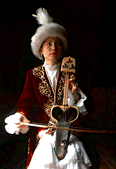 Raushan now took the stage to play the kobuz. Both musicians had been wearing traditional costume, and Raushan looked extraordinary in her long embroidered velvet gown with fur trimmed hat complete with shamanic-looking feathers. Her two-stringed horse hair fiddle is capable of creating almost unbelievably intense sounds. Whereas Aygul had been outgoing and virtuosic in her performance style, Raushan was introspective, as if summoning up ancestral spirits. She plays with closed eyes and rocks like a pendulum, in the dim light of the museum. I feel I’m in the presence of something very, very special. The sound of the kobuz is at times very close to the human voice. The emotional impact is immediate, it almost wails sometimes and it breaks your heart. We were astounded, not just by technical ability, but by the intensity and passion of her playing. The sound seemed to come from everywhere, to embrace you. Multiphonic effects brought to mind Mongolian overtone singing, primal sounds that were curiously abstract, impossible to notate. Simultaneously beautiful and terrifying. Raushan is able to move, in the space of one bow, from sorrowful and restrained Shostokovichian cello to guttural animal scream. I thought of Paul next door with his headphones turned up, and wondered what he must have been thinking. Once again all our expectations had been confounded. Gary pointed out during the performance that some of the music sounded very contemporary and accessible, and yet the pieces were hundreds of years old.
 I managed to find a moment to sit down with Raushan to ask her about the music. Is the kobuz the shaman’s fiddle? Are the attached jingles a vestigial shaman’s rattle? Can ancient Shamanic music connect with modern audiences? Join us tomorrow – let us have your views.
The curator Izbazar Balbazulov is a warm and enthusiastic man. He is extremely proud of his museum and rightly so. We gather with Alia in his kingdom, surrounded by paintings of Kazak greats. Musical instruments overflow from the shelves. As Gary and Paul fill in his guest book with good wishes and thanks, Izbazar points to a very special entry: President Yeltzin dropped by, back in 1991. Our gratitude is evident and he responds:”Let the music and musical instruments be the bridge between the peoples of the World…You are the ambassadors and I wish you success”.

He plays his dombra, Kathrin buys a kobuz, Jan blows on a hollowed out wooden Kazak ney, Paul checks his rushes, Gary checks his flys. On we go.
The musicians we heard today are innovators and trail blazers with a strong sense of identity.
Tomorrow I hope for a different perspective, I interview Alia, our interpreter about her Rhythm and Blues band, a young persons ‘take’ on Kazak music.