Posts Tagged musician
Day 38 – This journey is only the beginning
Posted by Musical Nomad in Daily Blog on September 4, 1997

We set ourselves the impossible task of reflecting on the last six weeks in the space of a few hours. As we have been doing all along, what follows are the immediate impressions of all members of the team. We will continue to add to this site over the coming months. Please continue to send Emails and we will endeavour to answer them.
JAN – Musician
It seems an impossible task to try to sum up our journey using words, so much has happened that cannot be conveyed verbally. The three countries of Central Asia that we have visited are remarkable for their diversity of people and ways of life. We have barely been able to get a flavour of the place, and yet in some ways we have had some profound experiences. It has been a recurring feature of our meetings with people that we have been accepted, welcomed and drawn into houses and families. Trust, tolerance and hospitality, particularly towards visitors is so pronounced that you cannot fail to be moved by it.
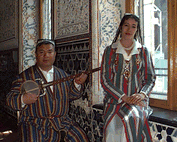 Ways of life are constantly changing all over the world. As they do so the music and culture that is associated with them changes too. It may be preserved in an artificial form, or it may die out completely. We have seen evidence of both these trends in Central Asia. We have also seen abundant evidence of vibrant, living traditions transforming and adapting to new environments. Munadjat Yulchieva (Day 7) is a good example. A nationally renowned figure she has managed to stay faithful to her musical tradition whilst raising the profile of maqam music.
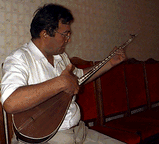 There is a marked distinction between the cultural life of the cities and the rural areas. Even in the pre-Soviet times cities were centres of culture where musicians gathered, the same is true now. Uzbekistan with it’s great cities has preserved the court music tradition even though the courts are long gone. Some musicians retain the link with the original tradition, but there is little space for them now. Abdurahim ( Day 8 ) for example one of the countries most highly esteemed musicians no longer makes a living through music and has become a businessman. Many are leaving the country for America and Israel. Even though there is something of a revival in national music (as a symbol of nationhood) this will not sustain the tradition. Musicians however are endlessly creative, and change comes about through a process of adaptation. The less fashionable Kashgar rubab has been superseded by the Tar from Azerbaijan. Perhaps a new tradition will arise out of the same feelings that inspired the shash maqam.
 In the rural areas the picture seems somewhat different. Musicians play a more integral role. In Kazakstan and Kyrgyzstan which were largely nomadic musicians still sustain an aural tradition which is part of everyday life and life events. Many great musicians are farmers or labourers who are partially self sufficient. Money means little to them and many seemed perplexed by our fees for recordings. The western distinctions of professional and amateur do not apply here. Music is too important to be exploited for money. As the rural ways of life continue so the music has survived alongside it. The hospitality often being inseparable from the music. Malika Askarova (Day 25) is a good example of this. She does not consider herself to be a musician and yet she is able to affect a listener in an extraordinary way. She did not understand why our contracts and fees were necessary. There was a sense that music is a gift which should be given freely, Malika was not the only musician who gave us this impression.
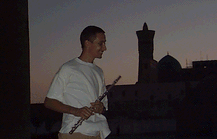 It has been through the attitudes of people that Central Asia has made it’s mark upon me. Whatever the external appearances or current economic situations of the countries, there is still a feeling of a great ‘civilisation’. I mean this in the sense of an internal process of development. A cultured people and not just people with a culture. Many of the musical genres still retain a philosophical and reflective content. These themes reflect a view of life and an attitude towards people that are quite different from those I am used to. The physical and the metaphysical are constantly intertwined in art as in life. The art forms often have a delicacy and subtlety which is deceptive. “The art that conceals art” – always hinting at a greater mystery beyond.
Central Asia is a wonderful and fascinating place. I hope that our reflections serve to wet the appetite of other travelers. Our journey was not a survey of the area, more like an account of some almost random events. Like any supposedly random events they have their own logic and they tell their own story. We will meet again…
Day 37 – Timeless songs for the next generation
Posted by Musical Nomad in Daily Blog on September 3, 1997
 I almost didn’t meet Aygul. As soon as I arrived in the village of Saty I was told of a dombra player I simply must hear. “Not another dombra player” went the cry. What a wonderful surprise then to meet a young girl of thirteen with such talent and charisma.
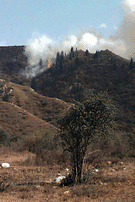
The Musical Nomad project is all about discovery. Finding out through the universal language of music about a people and their culture. On our penultimate day we left our campsite with very little hope of finding musicians. We headed for a town called Saty (meaning steps in Kazak) about 30 minutes drive away. We came out of the fertile tributary valley and into the wide, barren plain of the silty Charyn river. On our way smoke could be seen billowing from the grassy forested areas of the valley peaks. Occasionally a flame would explode, twenty or thirty feet high. The long hot summer is taking its toll and forest fires burn freely and naturally. In the long brown grasslands horses and cattle barely move in the midday heat. Suddenly the dusty road turns into the town.
 With very little to signify a transition, a row of houses appear. The town stretches for about a mile, the wide road lined on each side by wooden farm and administrative building. Next to a large yellow school a wooden hut doubles as the main store. We approached and bought drinks. We asked the shopkeeper if there are any local musicians. Moldira, our interpreter, scribbled down three names. One is an old man who apparently sings. We went to his house. A mad wolf-like dog attacked me. I then learned that the old man is ill and cannot be seen. I suspected the other contacts would prove as fruitless. It was now the hottest part of the day and we were trying to track down the second contact. Local people in the street seemed to point in the same direction when we ask. A group of teenagers passed us with a guitar. The guitar has a skull etched into the back and the boys also pointed in the same direction.
 We followed a road through the dusty, cattle infested streets. There was an air of sleepiness about the town. Occasionally a wagon filled with hay to dangerous levels careered carelessly through the narrow roads. We stopped near a large metal gate. Moldira peered over the top and confronted an old lady. After a short conversation I found out that this is a musical home. The whole family play dombra and sing. The daughter has won competitions and the eldest brother, currently working in the field, plays weddings and is well known to everyone in the village. We told the old lady, Salima about our project and who we are. She seemed almost expectant of our arrival. She invited the whole team with full equipment into her garden, her house, her world. A small girl in school uniform skipped towards the house. The garden is large. There are stables, small orchards and white clay ovens for cooking and bread making. This family like many others in this area are self sufficient. Salima asked us to take our shoes off and come into the house.
 Inside the house we were shown around by Salima and introduced to her daughter, Aygul. Looking like any thirteen year old just back from school she greeted us politely. It was only a little later we discovered that she was the star musician of the family.
The traditional village house is small and simple, but very homely. The entrance way is wood panelled on the outside giving a very ‘alpine’ feel and metal clad on the inside. This looked, rather disconcertingly, like the inside of a spaceship with resonance’s of Shaykh Kushkarov’s centre. See day 20. Presumably this had some functional value of which we were not aware. Certainly the house was very cool. Within ten minutes Aygul was changing into national costume. She assumed an extraordinary presence as soon as she took the dombra into her hands. Seeing so many musicians in such a short space of time can cause the palette to become jaded. Aygul’s fresh and direct voice has a poignancy and honesty that is rare among performers of any age. All of us were touched by her performance. Aygul has recently won a music competition and so is no stranger to performing. She appeared on Kazak TV as a result. This might explain her natural manner in front of cameras and microphones. The fact that her family are all musical may also contribute. Whatever the reason it was noticeable that neither Aygul, or her brother Nurlan seemed in the slightest bit perturbed by our presence.
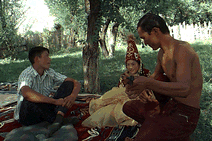
People arrived at the house, watched, drank tea and left as if it was all completely normal. This was good for us as we didn’t feel we were putting them through an ordeal. Nurlan has an unusually strong and intense voice with an energetic style of dombra playing. He has been a school music teacher but now works the fields. He performs professionally at weddings (toys) and on public holidays. He’s been playing since childhood. It seems that both he and his brother have helped Aygul to learn to play, but they stress the fact that she had a desire to learn.
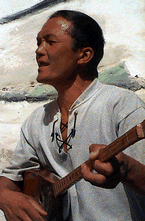
She learnt naturally – in other words she’s largely self taught. Aygul has been surrounded by music from a young age. Both have extraordinary voices which they describe as ‘coming from nature.’ For such a musical family it seemed strange to us that they don’t perform together. They possess only one working dombra, and they explained that ‘each person has their own voice’. This means presumably that they have different vocal ranges, but perhaps also different ways of expressing a song. Theirs is a solo singing tradition.Aygul sang a love song called ‘Altynai’. This song is addressed to a girl whose name means golden moon. These kinds of songs seem quite typical. Nurlan’s song ‘Karagymai’ was also a love song “Sweetheart, life without you is nothing”

Last night’s campsite had little to commend it, previous incumbents had left a trail of empty beer bottles and cigarette ends. We decided to move on and spend our last night on the steppe somewhere we wished to remember. Only twenty minutes drive found us further down the valley with a cleaner site and a clearer river.

I decided to light a fire, to gather one last time around the ancient embers – to reflect. With singers like Aygul and Nurlan the tradition is in safe hands and some timeless songs will probably pass to the next generation. Tomorrow we journey 8 hours back to Almaty. The Musical Nomad project nears an end. Please join us as we, the Nomad team share our personal reflections on a journey that has changed us all.
Day 35 – as words fail Diana dies on the Kazak Steppe
Posted by Musical Nomad in Daily Blog on September 1, 1997
In 1961 there was no such medium as the World Wide Web. Had it existed it would probably have failed to announce the birth of Diana Spencer. Last night we stood in a Kazak field a thousand miles from anywhere and logged on with our daily episode. As the news of Diana’s tragic death was announced we stood in disbelief and horror. The national anthem rang out across the Kazak steppe and we fell to silence.
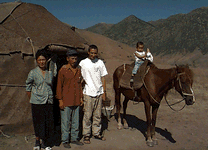
The morning light revealed a lone horseman tying up his horse near his yurt. I approached with a smile and shook hands. His wife and young son joined us with more smiles. I pointed to my video camera asking permission. A gesture and a nod and he mounted his horse, parading with some pride. His young son then took the reins. Eager to share something I offered him a playback of the video. One by one the family watched themselves and amongst the Kazak speech the word ‘Television’ emerged. For the second time in a few hours communications technology found a strange role.
The horseman then gave me his horse whip as a gift, no doubt to him a valuable asset. I gave him a wooden flute in return. Sometimes human understanding has it’s own language even as words fail.
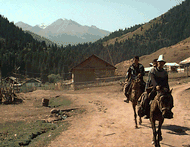 My encounter with Bulat, his wife Gulja and son Almas, had to be curtailed because of our voyage of discovery to a local village. It was only a 15 minute drive from our campsite and it took us further up a scenic tributary valley of the Charyn River. As we neared the village distant snow covered peaks appeared above the wooden rooftops. Alongside each of the valley walls pine forests increased and an occasional shepherd on horseback darted in and out of the rocky outcrops. We passed a hillside graveyard and someone whistled the theme from ‘The Good, The Bad and The Ugly’, this really is the town with no name. At this time of the day most villagers are on the hillside working the land or herding sheep.
 We had made the decision that this part of the journey was to be an adventure. No ‘fixed up’ professional musicians. We are in the Kazakstan wilderness and we intend to discover local musicians the hard way. We stopped and spoke to a passing ‘horse man’. Did he know of any local musicians? The driver communicated by making guitar poses and saying the words dombra and komuz. To our amazement the horseman repeated the word komuz and beckoned us to follow him. Our first conversation with one of the villagers and he seems to be a komuz player! We go to his wooden house fifty metres further down the road. He holds up his hands and says ten tenge (Kazak currency) whilst pointing towards a bucket full of milk. Moldira suddenly tells us the word for milk here is kumyz. Ah well, we thought things were going too smoothly.
A bit further down the road we decided that we need a different approach. How do you find about the cultural life of a small Kazak Village?
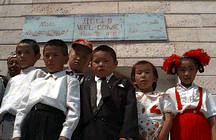 At that moment we passed a building that looked like a school. Children were assembled in a courtyard singing a song which turned out to be the Kazak national anthem. In every school I’ve known the head teachers have always been a mine of information regarding the parents of the children. Perhaps this would be the ideal place to find out who the musicians are in the village. Being the first of September this was the first day back at school but the headmaster had time to talk to us. He was very friendly and welcomed us. The school is housed in a new building which seems well designed. The classrooms are cool and light and everything looks well organised. The word ‘welcome’ is displayed in English above the main entrance. This is possibly because the village is called Kurmetui which means ‘welcome’.
 In the spirit of exchange we offered the school a short presentation during which we would play to them and tell them a little about our project. In return the headmaster offered to allow us to observe a music lesson. He also gave us the names of some musicians two of whom are teachers in the school. It will be fascinating to see how the children respond to our music and also to some of our technology. We will meet them tomorrow at twelve. Who knows what will happen?
Within a few minutes one of the teachers came strolling down the road with his dombra. Kuan, the sports teacher, is also a musician. On the verandah of the school Kuan stood proudly in front of a small group of school children and the Nomad crew. He warmed up by roughly strumming his instrument. This gave an impression of quiet confidence. Suddenly he began to sing and everyone stopped talking and listened. He had a powerful, resonant voice.
 After a short time he performed in front of our two video cameras, his headmaster and the school children. Occasionally he faltered, perhaps not used to this kind of pressure. As in electron microscopy the act of investigation changes the thing you are studying. We are now in a sensitive environment and our presence is possibly an intrusion. It has been my experience that in Central Asia and the much of the world music is often born out of intimacy and trust. Malika and Rakhimahon were good examples. Asking musicians to perform in a ‘professional’ way sometimes causes imbalance. The musicians become ‘the watched’ we are the ‘the watchers ‘. Even the school children, not familiar with cameras, began to freeze.
Tomorrow we will attempt to share.
Day 29 – Home Cooking on the Road to Issyk-Kul
Posted by Musical Nomad in Daily Blog on August 26, 1997
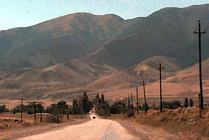 My journey covers over 3500 miles mostly by road. Today I set out for Lake Issyk-Kul, a resort area famous for its mineral rich water. I am told the road is bad. Nomadmobile 2 has left us and I anxiously wait to see how much further we can descend into highway hell. With trepidation I look-out from our apartment and behold an apparition. A brand new Chevrolet Winnebago mobile home – it even has a fridge! The only problem is our ton of satellite equipment – this is precariously balanced in a plywood bulkhead over my head. One bump too many and I’m an ex-Nomad.

On the way to Balykchy to meet our musician Saparbek Kasmambetov we stopped off for a visit at Barchagul’s house (the mother-in-law of Gulnaz our interpreter). I always enjoy visiting local houses as it gives the truest insight into the way of life. Barchagul invited us in for chai, which turned out to be chai, bread, chips, jam, yogurt, bread etc. We should have guessed by now.
Barchagul is a special lady. Besides being a doctor she lives in a typical rural house and keeps sheep, chickens, rabbits as well as growing fruit and veg. 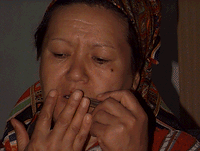 The gardens are full of produce and conserves and pickles were being made in readiness for the winter. No doubt the family work very hard but it is an enviable life. All the food is fresh, the bread homemade and the milk straight from the cow. Barchagul played us her jaws harp (Krygyz call these temir ooz komuz). The jaws harp was kept in a beautiful wooden box handmade by her husband. As we left their house laden with apples and pickles, Barchagul presented the instrument to Kathrin, saying ‘it’s a women’s instrument’. Once again the hospitality overwhelms us.
I am soon engulfed in beautiful precipitous mountains, blue and snow capped. To the left a desert town
 Tashblak – ‘the land of stones’, to my right a motorway services with a difference. Joe’s Yurt Cafe is a surreal mix – fizzy American cola and traditional chai both served in a bozui (Krygyz Yurt literally meaning ‘white house’). The waitresses are dressed for a Manhattan disco and outside a stuffed Ibex succumbs to the moths.
I’m due to meet the musician Saparbek but on arrival in Balykchy, I receive the sad news that he unexpectedly had to go to hospital in Biskek. His son tells me it is not too serious and I will see him in Biskek tomorrow – all part of life’s rich tapestry.
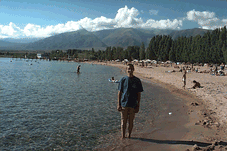
Instead I sample Lake Iyssk-Kul – it’s wonderfully relaxing swimming surrounded by Alpine-like peaks. When I emerge I experience a bout of the shivers – apparently this is normal – a lady from one of the bozui gives me some free chai and a blanket and I soon recover.
Tomorrow back to Biskek in the imperial Nomadmobile and the wonderful music of Kasmabetov.
Day 27 – Two Weddings and a Satellite
Posted by Musical Nomad in Daily Blog on August 24, 1997
 We have set up the satellite in many strange places – it is surprising the number of times we have managed to get a clear view of the Indian Ocean receiver without venturing beyond the nearest road. Sadly there have been too many times when mountains, trees or Soviet apartment blocks have got in the way. Today we had to go somewhere. In a children’s playground in the suburbs of Biskek, Kyrgyzstan, English Nomads could be seen setting up a bizarre array of equipment – morning entertainment for the youngsters. The sound of a motor generator and sight of a ‘sputnik’ in the middle of their playground was too much to resist. After some confused policemen had left us a throng of children gathered and cheered us on as we connected to the world. No big flashing lights or music just Gary saying ‘great – another one off’. We asked them to return at 10 PM for part two.
 I had the opportunity to spend a late Sunday afternoon walking through Biskek with our new Kyrgyz translator Gulnaz Abdrahmanova. It has been 42 degrees for the last few weeks. Now, after a sudden rain, the weather is typically British and a welcome change for the team. One of the first things that strikes me is the people – they are, like in Almaty, dressed in ‘modern’ clothes, very different from the traditional Muslims of the Fergana Valley of two days ago. The city itself is wide, open and filled with Soviet style buildings and monuments. As we walked through Dubovy park filled with decaying carvings, Gulnaz explained how Biskek had bought up many Russian artifacts from other ex-Soviet countries – they were quite keen to pass them on! Biskek is the most ‘Russian’ city we have visited. It is the only ex-CIS city with a statue of Lenin still dominating it’s main square. It is difficult to know how most of the city react to these relics. Will Lenin last much longer? The people do seem proud of some of thier monuments, especially Urkuya Saliyevas a reformer from Osh who led the Kyrgyz female movement after the revolution.

Along the main street there is the familiar mix of subway markets, karaoke cafes and photographer stalls. There are eccentric props used by the photographers including large white gorillas, dead birds in a palm trees and broken down cars. One street stall that caused the team much surprise was an evil spirit removal and fortune telling service. A man in jeans and green shirt waved his arms and hissed Shaman-like chants around each customer. A queue of women sat in the open as each were treated in turn. Our presence caused some embarrassment but we were told this service is very much in demand. Gulnaz’s husband goes once a year and she told me how valuable it was to him. I found it so strange to see this kind of thing performed so openly and I thought how much it differed from our meeting with Shaykh Kushkarov on day 20.
The musician, Kurmangazy Aiylchievich who we are going to meet tomorrow, is larger than life. There is something about him that reminds me of Shoberdy – the Baysun Bakshy [see Day16]. He is a wild, flamboyant virtuosic vodka drinker. Unlike Shoberdy he talks extravagantly about musical healing, Shamans and holistic principles but also plays popular hits at public functions.

By reputation Kurmangazy is Kyrgyzstan’s top musician. I’ve been invited by Kurmangazy to a special location. A double celebration of a 70th birthday and a 50th wedding anniversary. As I climb the staircase of the ‘Kyrgyz National Restaurant’, I’m immediately struck by a sea of hats – the white Alpine-like national hat of the Kyrgyz nomads. The old women all wear head scarves softening their sun-gold faces, few smile, their heads filled with memories?
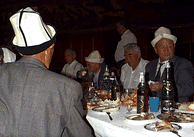
The details vary but I’m sure these occasions have common ground the world over. Solemn vodka laced speeches about ‘fifty happy years,’ on a stage decorated with bouquets and fruit. Children reluctantly pushed to the front, perform party pieces – this time on the national instrument, the komuz. A special delicacy is presented to table – today it’s horse meat – another nomad symbol? Perhaps amongst the gossip there is nostalgia for a Soviet era of greater prosperity and a more certain infrastructure. Nostalgia tempered now by an influx of jobs in fizzy soft drink factories and the fluorescent appeal of catalogue fashions – it’s Sunday and everybody looks their best. In the key of slightly Eb auntie Flo will sing a song: ‘Her mother should know’ – the band struggles to follow.
 Special occasions need special music and Kurmangazy seemed happy to provide the crowd-pleasers. To European ears his band is a bizarre cocktail of popular Kyrgyz melodies, South American music, Jazz and Classical pops. His band are all accomplished conservatoire-trained musicians and appear very relaxed.
 Kurmangazy fronts the band with a frantic energy, swapping frequently between his many wind instruments. The band’s funked-up versions of everything receive a somewhat cool response from the audience of over 50s. The medley of ‘Classic’ hits which Kurmangazy dedicated to us included snippets of Bach, Mozart and Paganini, all arranged in a ‘hooked-on-Classics’ style with a synthesised back-beat. He invited us to attend a healing session he will conduct at midnight!
Once again the team have to extricate themselves from a tricky situation. We are invited to stay and drink endless vodkas and eat horse with the band. Horse intestines are a local delicacy and it testifies to the wealth of the host that it was in plentiful supply. We were told each horse makes four plates of ‘delicacy’ and costs about 1500 USD. We decide to sneak off and send you this transmission.
 Emerging into the street we encounter a traditional wedding in full flight. Two surnai (shawm) players and a drummer play spiralling polyrhythmic music that makes you want to dance. The bride, groom and entourage arrive and a circle dance starts up in the street. Money is pushed into the hands of the dancers. There is a strong link here with the music of Turkey (the Kyrgyz people are a Turkic people) but the surnai is also very similar to the ghaita of Morocco. In France there is a similar double-reed instrument, the bombard. The double headed drum exists worldwide and in France it is known as the tabor. These connections must be well documented, but to see it in real life gives a startling sense of the cultural overlap between Europe and Asia.
Tomorrow we meet the extraordinary Kurmangazy again and hope to discover more about both his music and his research into ancient Kyrgyz culture.
Day 17 – Ten Second Tornadoes on the Road to Samarkand
Posted by Musical Nomad in Daily Blog on August 14, 1997
 “The Road to Samarkand” and not a sign of Bing Crosby or Bob Hope (one of Paul’s jokes for the oldies on the web).
We set off early from Baysun and received a ‘right royal’ send off from the mayor and deputy mayor – they carry our luggage and grip our hands in gratitude for spending time with them and ask us to return. As the ‘Nomadmobile” heads off out of the town a morning light glances low over the Zerafshan ridge. The vertical landscape is dotted occasionally with Yurts, small ‘ten second tornadoes’ and herds of goats. We have to swerve precariously close to the edge of steep gorges narrowly avoiding various bovine animals.
 Our driver, Bahadir who has just had his fifth grandchild, is fully in control. Gradually the heat rises and the hills disappear as we come out of the mountains. A big right turn at Karsi and we are on a fast, flat, perpetually straight road to Samarkand – the only interest being an occasional near vehicle crash either through potholed roads or badly misjudged overtaking. Eventually we near the outskirts of Samarkand and say good-bye to Sasha, he has to catch a bus to Tashkent. “Farewell comrades”, he says.
This trip has had its highs and lows, from the exhilaration of meeting wonderful musicians to the frustration of having no petrol. Through it all one figure seems almost unruffled by anything. Always patient, calm and considered, Sasha, our translator and advisor is a kind of centre of gravity, a point of stability for us. He has been on the road with us now for ten days so is used to our strange ways. He has acted far beyond the call of duty, and his understanding of Uzbek social graces has been invaluable . He always seems to be considering some “problem” (a word he likes to use) or reading a book (preferably in classical Persian). Suddenly something will amuse him and his bearded face will ignite with infectious laughter.

Things work at their own pace here and Sasha understands this better than anyone. It’s easy to forget that this mild mannered man is an accomplished scholar, he wears his learning lightly and doesn’t need to impress anyone.
In one conversation with Sasha I caught a glimpse of the difficulty musicians here face trying to communicate with the outside world. Sasha gave the analogy of an Asian musician trying to describe Beethoven using his own musical terms of reference. Inevitably distortions would arise. This situation compares roughly with the efforts of some European scholars who come to Central Asia to research music. Sasha was at pains to point out that there were Europeans who understood this music better than some local scholars.This problem of unconscious Euro-centrism is something which musicians treat with indulgence here. Sasha kindly added that our project had a completely different brief, to introduce this music to a wide audience.
Patience and wisdom are rare qualities, Sasha possesses them in abundance.
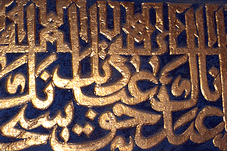
I arrive in Samarkand to find there is no room at the inn (again!). Samarkand only has two ‘bed and breakfasts’ and they’re full. I’m shunted off to a small courtyard with some abandoned bedrooms and parking space for the Nomadmobile. Gary is concerned that we have a clear line of site to the Indian Ocean – whatever that means. (Satellite?) I’m just happy to wash the dust off my feet.

Samarkand is often described as the ‘Pearl of the East.’ The tall madrassahs supporting deep blue domes and the majesty of scale could produce a thousand descriptive superlatives. The city is, like Bukhara undergoing major refurbishment and soon celebrates its 1250th year. It also hosts a week long “Music of the East” Festival starting 25th August, this is one of the biggest events in the area for many years.
The Registan, one of the most celebrated monuments shows signs of preparation – tomorrow I will see it in the dawn light and get you some photos. When we arrive twenty traditional trumpet players rehearse their fanfare and stage positions for the opening ceremony – it reminds me of a Dad’s Army drill. The whole city has a sense of life and movement. Things are changing, fast. There is transition and excitement in the air, music and dance are commonplace on the street and in the specially designated tourist areas. I will explore this more in the next two days. Everywhere in the world, folk culture is presented as entertainment for “package tourists”. Samarkand is no exception. At 6 pm every evening local musicians and dancers re-enact an Uzbek legend with music, mime, puppetry and fire eating. It’s beautifully done and although stylized maintains a joyful innocence.
 The costumes are probably exaggerated, the music simplified, the legend made larger than life with roaring flame. Yet for all that bemused confused tourists get a taste of a wonderful culture. If they want to know more there are CDs and ‘Musical Nomads’. I was particularly impressed by the doira (frame drum) players with their intricate poly rhythms – I arranged to see them for a detailed session on Usul – the rhythmic patterns of Central Asia. The chang (oriental hammered dulcimer) player is also worth a closer listen.
Join me tomorrow as we explore the city and meet frame drum and other traditional Uzbek folk musicians – I may even get to meet my first Central Asian flautist
Day 16 – Let us hear your voice
Posted by Musical Nomad in Daily Blog on August 13, 1997
 The journey to Baysun in South Eastern Uzbekistan, today took us over several mountain passes close to the Afghan and Tajik border. The environment is barren and inhospitable with few rivers or lakes to nourish the harsh land. We passed through several suspicious random checkpoints which had no obvious reason for existance – the regional boundaries seem inappropriate in such ‘samey’ terrain. Many of the panoramas call to mind Arizona, mini Grand Canyons appear with extraordinary regularity. As we approached from the West, the sun sets turning the sandy landscape Martian. We round a bend and nestled below a 12,000 ft ridge an apparent oasis comes into view. Baysun is surprisingly large with a population of nearly 23,000; its main sources of income are meat and wheat. It has a large supermarket, a diminutive produce market and a house of culture, complete with 1000 seater cinema.
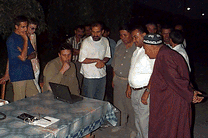 When we arrived there was some confusion as the famous Baysun ensemble had left town. They had been sent for a two week ‘gig’ in Tashkent and were our only form of contact – initially we were asked to leave.
After the shock died down the town’s officials began to buzz around us. What to do? Some people from another land had descended on their town. There followed a lengthy approval procedure, we were taken to Turakul Hamraev’s office (Baysun’s Mayor) – a yard with a table and phone. We had to explain our mission, do an impromtu Multimedia presentation and smile a lot at the various dignitaries. After an hour or so of ‘checking’ each other out we were suddenly honored guests – the transition into that mode almost lost on a tired ‘Nomad’ team. Many of the local musicians were also in the throng. Another musician we wanted to meet, Shoberdy Bakshy who had now been told to spend time with us tomorrow and to cancel a financially lucrative wedding ceremony.
 Once accepted we received a welcome of such kindness and honesty that we were at first very disconcerted. The deputy major of the Baysun region, Samariddin Mustafakulov had been given the unenvious job of looking after us at 9 pm. He opened a restaurant for us to eat after our long trip, he made available at a moments notice, a Daja (a summer house in the past used by Russian officials) and he even waited at our late night table plying us with vodka. Throughout the coming day he would accompany us everywhere, standing over the lengthy video and audio recordings, following us into the mountains for a location shoot with the Bakshy singer – making sure we were happy and at every moment filling our chai cups with vodka. Ourstandard refusal of we have too much work to do eventually worked.
The Soviet’s pulled out of this area and indeed the whole of Uzbekistan back in 1992. The control reverted back to the indigenous people who retained many of the Soviet ways. Here in Baysun there is the remarkable combination of a warm and friendly people living in the shadow of the past – things have moved on but at a far decelerated pace.
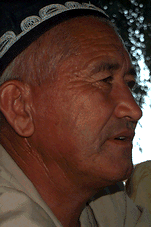 Sometimes musicians are more than just players of music. Sometimes concert pianists disappear into a world of their own creation – lost in music. Jazz musicians talk of being ‘high on music’ and anyone lucky enough to play an instrument occasionally feels that sense of the music taking over. When Shoberdy Bakshy sings, gently thrumming on his dombra, clocks pause. His voice is a low chested throb rising to a scream. His dombra dances with the rhythm of something anciently human. Short songs in his repertoire last 20 minutes, the long ones several days. For us he wishes to record a 2-hour epic – our longest tape lasts merely 60 minutes. Shoberdy composes on the spot, taking an old theme and reweaving it into a new opus featuring all members of the “Musical Nomad”.
The biggest frustration of travelling is not being able to share experiences with the ‘folks’ back home. Here we have the immediacy of satellite communication, sharing a moment with the World. My ‘moment’ today was driving through the mountains sitting next to Shoberdy who was singing his song about our arrival in Uzbekistan. Sasha, Bahadir, the deputy mayor, everyone was in the story – each laughted and nodded as their name was mentioned. It suddenly struck me that he was doing exactly what we were doing, telling a story live, responding to the environment. This spontaneity affected me more than anything else.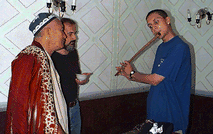 In interview he spoke of his songs of friendship, love and nature. In the presence of the microphone he declined to speak of Shamanism – he just oozes ‘spirit’ from the ends of his calluosed fingers. Shoberdy Bakshy is a wild man who dances to a different drum and drinks vodka like water. May he live a long and mysterious life.
Tomorrow – Samarkand. We take the ‘Golden Road’ to discover the music of the ‘Pearl of the East’.
Day 15 – Bukhara to Baysun, into the mountains at last
Posted by Musical Nomad in Daily Blog on August 12, 1997
 Before setting off from Bukhara this morning, we called in at the workshop of an instrument maker, Karomat Mukimov. It was not long before we were surrounded by the master’s young apprentices and were being shown the intricacies of tuning tars. Karomat and Sasha had been at the Tashkent Conservatory together 23 years ago, so there was a mini reunion going on. Amongst the instruments in his shop was a tanbur from the nineteenth century, it had been lovingly restored by this master. It transpired that the tanbur had once belonged to Leviche Babakhanor, grandfather of Ari (a musician we met three days ago). This news came as something of a shock. Why would the family sell such a beautiful instrument? It was heavily inlaid and was quite obviously made for an important player. Sasha told us that Ari had referred to an instrument of Leviche’s which had been sold to a maker. This tanbur was an antique with historical value, having belonged to one of the last Bukharan court musicians. Here it was for sale. Admittedly not cheap, but we would have been free to take it abroad. It crossed our minds to buy it and give it back to Ari – where it belonged. The story went that one of Ari’s brothers had gone to live in Israel and had exchanged this instrument for an new one. It seemed sad to see it here but at least it was now restored and perhaps would end up in the hands of a player.
My thoughts now turned to a doira, a frame drum, that I had seen several days before, but had then seemed absurdly overpriced. Whether it was the effect of half an hour of conversation, or Sasha’s connection with the instrument maker, I’ll never know, but the price suddenly dropped by a third. We struck a deal and I walked away the proud owner of a high quality doira. Now all I have to do is persuade someone to show me a few tricks.
 This project involves plenty of travelling around Central Asia. After all I am the ‘Musical Nomad’. Of course the truth of the matter is I am accompanied by a small, specialist team. Our ‘nomad horse’ for the last two weeks is a Volkswagen Caravelle, with enough seats for six people and five large flightcases.In Central Asia a driver is more than simply a driver, he constantly nurses and cleans the car, never leaves it and finds petrol in the most unlikely places. Our Uzbek driver Bahadir is a real character and devout individual. He is a stout man with a face half resembling Mel Brooks and a sleepy manner. We were amused watching Bahadir buying petrol. He would chase lorry drivers, hug and kiss them and spend hours in the back yard of strangers.
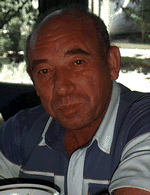 Our delicate computer, communications and audio/video equipment are at the mercy of his driving skills and we all too often have to tell him, through Sasha, to ‘slow down!’ This gets lost in the translation as within minutes we are once again careering through potholed hairpin bends. Bahadir also has an uncanny ability to forget things – only basic things such as which town we asked to stop in!. With all his faults though he has some key redeeming features – his devotion to his religion and his mild manner which conceals a strength alien to many in the West.
Yurts and oil wells line the improbable road to Baysun. A semi desert of stunted shrubs strectches to a hazy horizon. The mode of transport switches from dodgy trucks to lively donkeys, laden with unknown produce bound for market.
I n many Islamic countries you wield a camera at your peril. In Tunisia for example, even pointing a camera at a person is considered deeply offensive. I entered the lively market at Karsi full of trepidation. Everywhere the rich fruit colours of high summer beg for Kodachrome. Reds in apples and tomatoes, golden yellow pears, grapes, as black as night. In direct competition for photogenic appeal were the gorgeous Tajic clothes of the Uzbek women. I gestured to my camera with a thumbs up and a smile – smiles were returned. Suddenly I was the most popular guy in town – everybody wanted to be photographed and video’d. It gets better. The fruit sellers started to compete for my attention by paying me in fruit. I left the market laden with bags, totally bemused but thrilled. The generosity of these people had been such a surprising contrast.
 In the cities of the former Soviet Union the legacy of too many conquering Tzars and an autonomous state is a frozen fear still reflected in faces. Here in the country people further from the hub of beaurocracy seem to retain an earlier innocence. As we arrive in Baysun unannounced in the early evening, word spreads fast. Soon a whole greeting committee turn out to welcome us to this small town in the mountains famous for its music.
Tomorrow the ‘Bakshy of Baysun’.
Day 13 – a satellite beams from Bukhara
Posted by Musical Nomad in Daily Blog on August 10, 1997
Human contact can take many forms. There is contact when you play or hear a piece of music which triggers a primal reaction within. There is contact when you meet someone who, though living a different life to your own, can understand and relate. There is a contact through ‘communications’, be it a simple conversation or a satellite bouncing signals around the world. Today we made contact. Through music, with people of Bukhara and finally, at last with you the audience.
In our wonderful location preparations are underway to turn the already lavish interior into a ‘new’ set for a different musician. Today we meet a gidchak player (traditional lap violin). Video and audio are in record pause and the scene is set for action. We suddenly get the news that the musician has had to ‘do’ a wedding and cannot make today. Our first ‘non-starter’! Simultaneously, a young man who has traveled eighteen hours to be with us walks into ‘The Musical Nomad’ circle. Howard Drake has brought us a new, fully functional portable communications satellite unit – this is the third one and expectations are high. Will the project finally become two way?
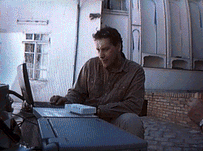 Gary becomes more ecstatic as the levers are pulled and the turbines begin to roll – we feel there is a direct parallel here with the early days of TV, this shaky yet elegant production echoes those early pioneers. Suddenly we get full connection, we are in full contact with the outside world. There is little jumping up and down, it’s too hot for that but a great sense of relief as the music, photographs and writing of the past twelve days are efficiently pumped onto the World Wide Web.
 Something significant is happening in Bukhara. The ancient city takes on a new role. No longer a staging post on the silk road, Bukhara’s main asset in now its magnificent architecture. Everywhere scaffolding is springing up and crumbling fortresses and monuments are acquiring a facelift. People who remember the city in its faded glory fear ‘Bukhara-Disney’ and ‘theme park city’. Personally I am sure it will look magnificent. The Bukhara that celebrates 2500 years is part manufactured but somehow the spirit rings true. What I would like to see is a stronger resistance to Coca Cola culture and cheap diluted europop – both already starting to take over in the otherwise tranquil city square.
Everything moves on and its important that we keep some record of the past. The tools of a musician develop and change with the needs of the music.
 In the local museum I saw some sad old relics of what used to be a gidchak, a tanbur and some 17th century drums. In an unprecedented way the guide allowed us to play one of the drums and again its voice rang out. Living instruments need this, when stuffed and entombed in glass they die – the strings rot and the heads split and they no longer represent the essential vivacity of their function.
The Musical Nomad project fulfills and important function – with every musician we meet we make a state of the art digital audio visual record of their technique, they play at least one whole piece. We hope in this way to make a living record of Central Asian Music now – a real legacy for our grandchildren.
 Its is common in Bukhara to find yourself sitting on a wall or bench to admire a building or chat to locals. I chatted to Mohammed, I asked him whether he knows any musicians in town. “My brothers are musicians”, he said, “they run a music shop”. Not quite believing our luck we followed him to his house in the early evening. After a few minutes walk through the narrow backstreets we entered a simple local house with a characteristic courtyard, reminiscent of an African compound. We greeted Mohammed’s wife, Aisha and their young son of three months old lay asleep on a blanket. Soon their two young daughters aged about three and five arrived home from playing in the streets. We drank tea and Mohammed went to fetch some musical instruments.
 There is an ease about people in Bukhara. A warmth which shows itself in the small everyday incidents. Bukharans are naturally hospitable and still curious enough about foreigners to stop and chat . It is obvious however that times are harder since independence and some locals are struggling. Encounters with people like Mohammed’s family are precious therefore for getting an insight into how people live. Undoubtedly Mohammed wanted to sell us instruments but he was also pleased to be able to entertain. We chatted to his daughters and when the conversation ran out I played a Hebrew folk song on my flute – the children seemed intrigued and listened intently. Out came the photo album and we saw their wedding snaps and family momentos. We were asked if we had children. Aisha was surprised that only Paul and I did (she was married when she was seventeen and must only be in her early twenties now). Missing my baby son Tal back home in the UK, I picked up their little one and felt him to be a comforting presence there in my lap. These are feelings that translate well wherever you find yourself in the world. Feelings everyone understands.
 Mohammed returned with his instruments and a raucous noise was struck up within seconds. Rubab, doira, surnai and nai. Unfortunately all the instruments were of poor quality and I bought the ney more as a souvenir of the evening than as a useful instrument. Mohammed seemed pleased and we all trooped cheerfully out into the now dark Bukharan backstreets. We said our good-byes, promised them a copy of the photo Gary had taken of the family, and headed back to the guest house.
Tomorrow I meet a musician playing a gidchak, the traditional violin of Uzbekistan. I then go on a pilgrimage to the tomb of a 13th Century mystic, one of my main reasons for coming to Central Asia
Day 12 – Bukhara – holy city. 2500 years of written history, 6000 years of mythology
Posted by Musical Nomad in Daily Blog on August 9, 1997
 I’m lucky to lodge in the old Jewish quarter, a film set fit for Cecil B. De Mille. At each corner architectural delights charm the eye, gold shimmers in the intricate mosaic. My guest house, built in 1908 for a Jewish family, has a wonderful room of Tajik design. The high beam ceiling of plain wood contrasts with the vibrant glory of the richly ornamented walls. Here is the inspiration for William Morris and ‘Art Noveau’, all combined in a glorious synthesis of colour and light. Alcoves richly decorated are adorned further with Chinese bowls and Turkic tea sets. The shuttered windows filter the morning sunlight and silk curtains drift in a Bukharan breeze.
 The centrepiece is a small wooden platform covered with a gold-threaded cloth and cushions coloured to shame a biblical Joseph.Our musician Ari Babakhanov frets his Kashgar rubab and weaves a spell in sound. Outside a rogue shutter crashes but the spell cannot be broken. Emissaries from the ‘Musical Nomad’ silence every window for miles and Ari once more weaves a quiet magic. High on the walls Hebrew script proclaims a faith long at home in Bukhara.
“Persian-speaking Jewish communities seem to have existed in the larger oasis and riverine towns of Transoxiania for over a millennium. Documentation of the origins and early history of these communities is extremely sparse, but legends speak of the importation of skilled Jewish craftsmen from Iran by a succession of Central Asian rulers, beginning with Timur (1338-1405), and a Tashkent based archaeologist has reported on the existence of a Jewish cemetery in Samarkand before Timur’s time.”
Theodore Levin: “The Hundred Thousand Fools of God” (reproduced by permission of the Author, pub. Indiana Univ. Press)
After his marvellous performance Ari invited us to spend some time with his family on the outskirts of ‘modern’ Bukhara. As we pull up outside his flat he steps out to meet us. He has the kind of face that you immediately warm to, with as distinctively Jewish features as I have ever seen, a sun-torn face which speaks volumes. I sense he is a deeply thoughtful man.
Inside his typically styled soviet flat there are faded paintings of Bukhara and ‘colourised’ black and white photographs of his son and daughter. We are welcomed, and meet his wife, daughter and grandchildren. Traditional rugs line the walls and there is a piano, played by his daughter, Susanna. They are a musical dynasty. As we drink tea and chat everyone seems quite at home. He has a ‘deceased’ Bulgarian guitar hung above the TV, a tanbur props up a bookcase and his prize rubab lives in one of the back bedrooms. We “have a go” at playing Ari’s instruments much to his amusement and Paul is instructed to play the antiquated guitar. It needs new strings and an overhaul but Paul struggles manfully on.
 Lunch arrives, it is delicious but unfortunately we cannot do justice to it. Try as we might it just keeps on coming. Whether this is Jewish hospitality or Bukharan we cannot tell but Ari’s wife urges us on with despairing looks and huge portions of everything. The ice, by now seems well and truly broken and Paul’s guitar comes out for another tune. We try to persuade Ari and Susanna to play together but they don’t seem in the mood. Ari, besides being a consummate Shash Maqam artist, also plays Western classical music on his rubab. He likes Spanish and Italian music and wants to make a “World music” CD. As I look around the table at us, the team, Ari’s family, Bahadir (our driver) and Sasha (our musical adviser), I wonder whether we somehow reflect the polyethnic character of the city – Jews, Muslims, Christians and doubters all happily sitting down together.
 We later huddle together in a back bedroom for an intimate discussion. The Bukharan wind whistles through the overground pipes outside singing a discordant melody. Ari seems very relaxed as we talk, occasionally his voice becomes animated, deeper and more powerful when he warms to a question. He tells of his background and of learning the Shash Maqam as a child. Now in his seventies, Ari shows us a medal he gained in Moscow playing at a ‘Soviet Festival for Youth’. He has composed songs still sung today by famous singers in the capital. From the age of twelve he learnt the maqams. He showed us transcriptions (published in 1924) of the maqams notated by the Russian, Uspenski. He is keen to talk about his hereditary tradition and of a past when musicians were held in high esteem. His grandfather, Levi, was a court musician and would play, before the Russian revolution to the Emirs (Uzbek ‘Royalty’) and after 1924 to high ranking Soviet officials. I hear in his rich Russian voice a real sense of longing for the ‘good old days’ when musicians like his grandfather, would play with musicians such as Maarufjon Tashpulatov, Najmiddin Nasriddinov.
“For three generations the Babakhanov family had played a central role in the musical life of Bukhara. Levi Babakhabov (1874-1926) is still revered as one of the greatest of Bukharian singers…”
Theodore Levin “Fools of God”
 The Soviets began to see this music as dangerous along with the movements led by the Mullahs and Sheikhs of the time. Ari’s grandfather feeling at risk in Bukhara had to escape to Samarkand. Mysteriously he suddenly died. Some believe he was deliberately poisoned by the oppressive power but there is no real proof of this. I am keen to find out whether there is anyone else who can continue the old Bukharian traditions? His voice stutters and he sounds resigned as he says “nobody, nobody now. I am the last one”.These words echo painfully as he tells further of a few students who may one day be able to play the music. Are we witness to a form of musical ‘extinction’? Commercial and political pressure has all but stamped out the last members of a joyous and heartfelt musical tradition. A tradition relevant to today’s societies in the West – tales and music of longing and devotion. We say goodbye to the family and leave them in their apartment block and we return to our lavish B&B in the ‘old Jewish quarter’.
Ari still dreams of one day restoring Shash Maqam to it’s former glory.
Tomorrow – This city is full of music. Join us as we bring the sights and sounds of Bukhara, live – yes, a third satellite unit is arriving!