Archive for category Daily Blog
Day 10 – Seven Heavens Beneath a Waterfall
Posted by Musical Nomad in Daily Blog on August 7, 1997
 It was a strange experience walking into a BBC building in the middle of Tashkent – a small piece of England, a refuge, an embassy. Jenny Norton who runs BBC Monitoring Tashkent had been a very good contact for us when this journey was planned. Today she met us in her office, a room rented as part of a hotel complex. Being very interested in our journey, she was happy to advise us about the areas we are planning to travel to. She pointed out that as part of our description of musicians and music it is likely some sensitive issues will be touched on. “Tell it like it is” she announced. She mentioned the relative peace and stability in Uzbekistan compared with the problems in Afghanistan and Tajikistan. She assured us we would be safe following the planned route of the rest of our journey.
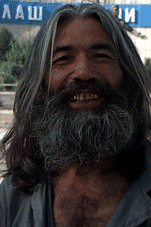 Whilst wandering around Tashkent in the sweltering heat, we came across an intriguing character standing by a fountain in Alimdjan’s Square – in memory of the great Uzbek writer. His face had the weather-beaten look of someone who spends a lot of time in the open. He could have been forty …or sixty, it was hard to tell. He started to tell us about the significance of this place. It was not, as we had thought, just another piece of grandiose Soviet architecture but had all kinds of cosmological significance. This genial and likeable gentleman goes by the rather unusual name of Alpha-Omega. Intrigued by his stories, we followed him down some steps to what appeared to be a maintenance room of some kind – this was his home. He welcomed us in, sat us down and offered us tea. He then continued with his story.
As far as we could understand, he was describing all the cosmic forces acting upon this spot. He gave an explanation of the ‘seven heavens’, the five parts of the human body and the four elements. His wide-ranging conversation darted from one subject to the next, seemlessly. Somehow it all seemed connected. By now there were complex cosmological diagrams and mathematical symbols drawn on a piece of paper.He explained how all the religions were in fact one and how Jesus Christ was coming again soon, in fact he was already born. He described himself as a Dervish, a Sufi holy man and said that he was a reincarnation of Ibn Al Arabi, a famous Andalucian saint. This statement was followed by a complex astrological breakdown of how this fortuitous event (his reincarnation) had happened.

A couple of books we saw lying around his room were indeed works by classical Sufi authors. He lived very tidily in this simple room and wanted no money from us. ‘Everyone is welcome here’, he said. We asked if he knew any musicians. ‘I’ve met some… up there’ , and he pointed to the sky.
Tomorrow we are travelling to the Holy City of Bukhara. Our first real interception with the Silk Road. I am eagerly anticipating this city – log in and find out about musicians we will be meeting.
Day 9 – Red Tape Hell, Musical Heaven
Posted by Musical Nomad in Daily Blog on August 6, 1997
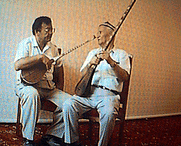 Having been out of action for a while I have not been able to tell you about our meeting with Pattahon Mamadaliev. Sometimes it’s difficult to interview musicians here because of their modesty . if you ask them about themselves they will naturally represent themselves in a very humble way. Pattahon is a good example of this.A respected maqam performer he is particularly famous for his wedding singing in the Fergana style. He is professor at Tashkent state Conservatoire and has performed numerous times on TV and Radio. In fact, the people working in our hotel were thoroughly surprised to see him sitting in their dining room. Perhaps the thing that most distinguishes him is his status as a composer. Pattahon was the first musician to be awarded the honorary title of Hafiz by the new administration after independence. This title is used in the Islamic World to describe one who has learned the Koran by heart, but it can also refer to a master musician. Pattahon is not only an interpreter, he also composes maqam music and texts.
I always enjoy watching older musicians who have played for years, they often have a minimalist style, an economy of expression. Pattahon plays as if his tanbur is a part of him and his voice still retains a power which belies his seventy years. Interestingly when we asked about the age of the tanbur he said it was not old, only fifty years.
 As Pattahon’s life spans much of the period of Soviet rule in Uzbekistan I was keen to ask him about the changes that had come about. Both he and Abdurahim were clear that it had been an ill conceived experiment on the part of the Russians to try to change the musical tradition here. They felt it to be a tribute to the strength of the music and the peoples’ feeling for it that it had survived. Sasha our interpreter and musicologist companion pointed out that this viewpoint was fairly nationalistic and not necessarily representative of all musicians in the country, although there is much evidence that Soviet Cultural Policy had set out to repress the music. Sasha can be heard translating this viewpoint in an excerpt from the interview.This day was to be special for the project. A high ranking official from the Ministry of Foreign Affairs was going to make customs give us our satellite phone. We left for the airport at 9 am in triumphant frame of mind believing we would return within the hour. At 2 pm two bedraggled people walked through the door, black satellite phone in hand. We had been through red tape hell. The country may have reached independence but the old Russian way of doing things remains fully intact. An endless stream of grey concrete ‘huts’ scattered randomly around a wide, bland pot-holed road leading away from the airport. Sleepy Army soldiers guard rusty gates and several stages of payment, slips of paper and rubber stamps get you in.
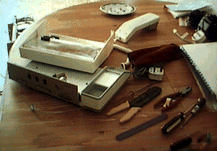
Over a roaring fire a large wok containing gallons of water. Lumps of dirty raw meat and vegetables, sit bubbling away in the middle of one of the yards – who is it for? The atmosphere of the place is slow and still, certainly not an area bubbling with efficiency. The various stages that Uzbekistan customs ask you to go through to acquire your own property is excruitiatingly painful when like us, you are in a rush. The paperwork and arguments burn irretrievably into the memory of all who pass through each ‘hut of frustration’.Though I’m still unwell, I’m keen to see how the new satellite is shaping up. I descend the stairs to find Gary and Paul surrounded by 100 pieces of wreckage – I can’t believe it, the replacement satellite has possibly been corrupted in transit and they are trying to trace an obvious fault. Despite all their efforts the team cannot find one, desperate calls to England are hampered when we can’t get a phone line. I retire to a safe distance, Gary and Paul are not happy. Ten minutes later I am awoken by a combined banging and throbbing – what now? Peering through the door I see Gary manfully priming a petrol generator and Paul planting an earth spike in the dusty courtyard. There wasn’t enough current in the local electricity supply to even work a soldering iron, so this is the solution – make your own electricity. It’s bizarre seeing all this sophisticated satellite gear driven by a petrol generator.
We are told a third satellite transmitter will be hand delivered in a few days to Bukhara. Please stick with us we are doing everything we can, normal ‘service’ will commence shortly.
Day 8 – The Land of Lutes
Posted by Musical Nomad in Daily Blog on August 5, 1997
The Land of Lutes
Every journey has it’s trials and today we’re having our fair share. Last night I was struck down with a bug, without going into graphic detail. I am now laid up in bed unable to be of much use to anyone. As if this were not enough Gary and Kathrin are at various Government Departments wading through acres of red tape. The officials in Tashkent are very suspicious about our new imported Satellite transmitter – are we really James Bondski? Only a letter from the Minister of Foreign Affairs can convince them to release this much needed lifeline. Without this we cannot continue our dialogue or bring you the exciting music we have been hearing. We hope we will soon be ‘on-line’ eager to reply to your e-mails. Only Paul is left back at the ranch, Dat machine in one hand, camera in the other. He loves it really! While I catch up on much needed sleep I leave you in his capable hands. I know he’s dying to tell you about lutes.
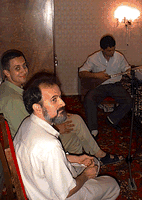 As one of the guitarists and sitarist in our team I’m fascinated by the ‘lutes’ we encounter. I’ve just been lent a dutar by Abdurahim Hamidov. Living with the dutar, having it around my room playing it, I feel invited in to a sort of magic. It has made me incredibly aware of the close relationship between all these Central Asian instruments and most of the world’s ‘lutes’. The two-stringed dombras and dutars have all the latent characteristics of the guitar, the Oud and the sitar. The tuning in fourths (and fifths), the tendency to play parallel patterns up and down the fingerboard – the modal scales are all common to these more familiar instruments. The rasguedo of the dutar is almost “flamenco” in character. The vibrato and portamento techniques are reminiscent of the classical Oud of Arabia.
If the lute began in Central Asia as many scholars believe, what fascinating journeys it has made – into China, India, Arabia and Europe – taking new names and new shapes but retaining its Central Asian roots.
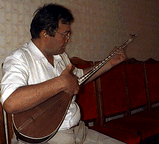 Abdurahim Hamidov who I met today is an incredible virtuoso on the dutar. He also knows many of the other lutes of the area and explained their relationship. According to Abdurahim the dombra which we heard a lot of in Kazakstan is primarily a folk instrument. Though if you refer back to Day 4, you can hear that Aygul Ulkenbaeva is now taking the dombra to a more sophisticated level.Abdurahim regards his dutar as a classical instrument, especially in the context of the Shash maqam though he often performs solo as well as accompanying singers.
Physically, the dutar is more sophisticated and highly decorated with beautifully made silk strings instead of the factory produced nylon strings of the dombra. Curiously his dutar retains its modal scale – it has not been ‘improved’ to a fully chromatic version (yet!). Abdurahim also asserts that his dutar has different tunings; in fourths, fifths and unison whereas he alleges the dombra doesn’t (I’m not convinced).
I encountered another fascinating lute yesterday, the Kashgar rubab played by Munajat’s teacher Shavkat Mirzaev. This is a five string lute with four metal and one silk string – an unusual mix. The silk string is very thick and provides a rich bass. The four metal strings are arranged in two pairs and are used for melody. The rubab has a haunting sound enhanced by its parchment sounding board and the harmonic richness of those pairs of metal strings. There are superficial relationships here to the saz of Turkey and the bouzouki of Greece. Earlier, in a taxi I heard the local version of Greek popular music or Rembetika – it’s a strange and wonderful world.
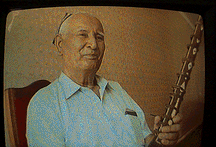 Wow, another lute – today we met Pattahon Mamadaliev, a fantastic 70 year old guy. He sings with a consuming passion and accompanies himself on the tanbur. It has four bronze strings. In India bronze is a sacred metal, I must check out its significance here. The tanbur has very thick gut frets to enable a deep vibrato, it’s made from mulberry and apricot. Pattahon possesses an intensity of performance and a sincere unmannered humility. I played some Spanish lute music for the musicians, Pattahon and Abdurahim. Abdurahim said he understood this 15th century lute music perfectly, which is interesting. This music is very polyphonic ‘in many parts’ as opposed to most Central Asian music which is often monodic. They also enjoyed a bit of pseudo-Flamenco – this is also interesting as Pattahon’s passion and style is reminiscent of Canto Joto from Andalucia in Southern Spain, a deep form of flamenco. Somebody must have told the lute to “go forth and multiply “- I’m ever more convinced that the lute family originated here as most scholars assert.
I’m currently in the lap of luxury – our little guest house even has a tiny swimming pool. I banged my head trying it out – perhaps it will knock some sense into me? The food here is the best so far in Central Asia – delicious Vegetarian stuff – not that common in the land of the rising Kebab.
I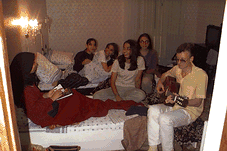 got caught last night serenading five Muslim girls in their bedroom – their father just laughed and went to bed – not the expected reaction. The girls enjoyed a Bo-Diddly song but thought Shash maqam was ‘pretty cool’. They are on holiday from Chicago, so that probably explains their frankly modern behaviour. Jan still has the “montezumas revenge”, so retires early. Kathrin and Gary are simply exhausted, endless wrangling and still we can’t get our satellite out of customs.
Tomorrow, who knows?
Day 7 – “My soul was taking flight” Navai
Posted by Musical Nomad in Daily Blog on August 4, 1997
 “My soul was taking flight” Navai
Tashkent is Uzbekistan’s capital and by all accounts the busiest city in Central Asia. At first it feels very similar to Almaty, it has that Russian sprawlness about it, wide roads, an endless stream of Soviet structures surrounded by semi-shanty suburbia. Closer inspection reveals many hidden treasures. The apricot trees used in many musical instruments especially the tanbur, line up along the dusty Russian backroads and avenues, giving the place a Mediterranean feel.
The heat builds to a forbidding level by 10am and it’s best to keep out of direct sunlight, particularly in one of Tashkent’s most lively environments, Chorsu Bazar. Gary, who has traveled here before, suggested we look around. The bazar is a large market, a place where local people gather. The centre piece is a large skeletal dome at least 150ft high in the middle which envelops a vast range of spice, dairy and fruit stalls, spreading outwards in concentric circles. As we walked through here the smells of produce and sounds of multiple Uzbek ghetto blasters bellowing at distortion level seemed quite familiar. One of the first things I noticed are the women who dress in bright, traditional clothes – a far cry from the Almaty women who have adopted a relativly bland ‘chain store’ look.
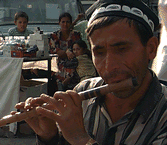 Throughout the market there are stalls (often metal buckets with fruit in them), entertainers and chaikhana’s (small tables on which to sip tea). Paul was able to finally buy a belt for his decreasing waist and I was attracted by a lonely flutist, busking in a secluded corner. He was blind and gave the traditional open palm, hands over face to accept blessings whenever he felt some money land in his lap. He occasionally played a haunting Maqam-type melody and I was moved, not just by the music but by his obvious predicament. Not far from the flute player three young boys entertained.One was supplying the ‘come and see’ music on a Western snare drum beating a marching rhythm while circling the younger ones. They performed acrobatics and increasingly dangerous manoevres over broken glass and nails. I didn’t stay for the tricks they had planned for later in the act, some of the sharp implements were bigger than the boy’s themselves. Before we left the bazar I was struck by an image, a series of steps leading back up to the second level. On each side women sold bread as smoke from Shashlyk stands billowed across many brightly coloured metal ornamental stalls. This was where local people came to do their daily business, where you can eat good food for a tenth of the price of the Hamburger joints in the centre of town. Gary is right, this is the real Tashkent.
Later on that morning we ventured across town to the Museum of Applied Arts. A prosaic name for something very precious and visually stunning. It had once been the private house of a rich Russian with a taste for the traditional arts. The courtyard entrance leads up a staircase to a small hall. The hall is decorated in Islamic style with brightly painted plaster and wood carvings. Every direction is ‘candy’ for the eye. Alcoves hold vases aglow with primary tint and the marble centre piece turns out to be a perfect place for our stereo microphone. This morning we are meeting one of Uzbekistans most celebrated singers and her ensemble. In the serene calm of the hall we met Munadjat Yulchieva and her teacher and mentor Shavkat Mirzaev – if this wasn’t enough of a daunting prospect it was also to be our first encounter with the ancient Shash Maqam tradition of Central Asia.
Shash Maqam possibly dates from as far back as the Timurid dynasty, around the 15th century. It was the music of the courts and in the important centres of Bukhara, Khiva and Khokhand this repertoire flourished. The words Shash Maqam refer to the Bukharan tradition and mean six maqams (in Persian) there is also a Khivan tradition of Alti Yarim Maqam (6 and a half maqams) and from Khokand Chahar Maqam (four maqams)
The word Maqam is often translated as ‘mode’, but in fact the word has many more connotations than our ‘mode’ or ‘scale’. In this case it refers to collections of compositions ordered into cycles or suites. This represents the classical “art music” tradition of Uzbekistan.
Munadjat is one of the most popular performers in the Fergana- Tashkent style (four maqams). This school differs from the Bukharan style, it is strongly linked to the Uzbek language (as opposed to Tajik) and is sometimes referred to as ‘free maqam’.
For such a celebrity, Munadjat has taken an unconventional route to success. She was born in a small village near Andijan, and worked the feilds with the rest of her family. The story goes that she applied to the Higher Conservatoire of Music, vocal arts department, not realising that they trained opera singers. She was turned down for singing ‘out of tune’ but was heard from outside the door of the audition room by one of Uzbekistan’s most famous composers, Shavkat Mirzaev. He became her teacher and the rest, as they say, is history.
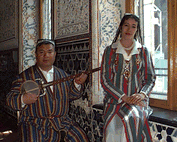 In the weeks leading up to this trip I had studied recordings of Munadjat for the purposes of research. I immediately found her voice almost absurdly moving and was soon listening to her constantly. Today’s meeting was a great opportunity to get a bit closer to the music and to find out more about its background.I am told that when Munadjat performed in London recently the audience cried and I can believe it. Besides being possessed of one of the most moving voices you have ever heard, she has an undefinable magnetism which is transfixing.
This seems to stem from a sincerity of feeling , a devotion that pervades every note and every gesture. The Uzbek and Persian texts that Munadjat sings are remarkable for the feelings of love and yearning they portray, even in English translation. These poems are classical texts written by famous Sufi poets. They cover philosophical and metaphysical themes, often using the metaphor of a lover yearning for their beloved. Through this device the poets portray the yearning for the presence of God. As Shawkat pointed out however, you need a special education to understand their poetry . The texts are multi-layered with words implying several meanings. One would need to speak several languages and have a training in Sufi philosophy and spiritual practice to plumb the depths of the meaning.
For most of us, however, the pure sound of the language has a profound effect. The music tends to be slow, creating a feeling of space and serenity. Within this timeless space the yearning of the voice is almost painful
“My beloved was to come tonight, with his face like a rose and his figure like that of a cypress-tree; but he didn’t
The whole night, sleep deserted my eyes
Full of hope, I would take a few steps on the road towards him
My soul was taking flight, but this fickle betrayer didn’t come
Bereft of his angel face, I wept and wept like a mad woman
Whoever saw me must have thought that I was a fool
Is there such a thing as a faithful suitor? If there is one, why does not every step lead him to his beloved?
Navai, rejoice in the house of your heart
For sadness never floods a house where wine flows”
The song “Munadjat” means prayer, and the melody was used by Sufis even before the poem by Navai (1441-1501) was written. It is now a famous melody of the region and Munadjat (whose name also means prayer) has made it her own. The performance begins with the voice whispering a secret confidence. As the piece progresses the melody ascends in pitch and volume with incredible control and restraint. The climax of the piece (or awj) is searing in intensity and superhuman in volume.
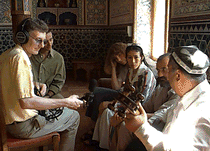 During this trip we have been lucky enough to meet musicians who are national celebrities. They have been relaxed, accessible people who possess great humility. Munadjat and Shavkat are no exception.
As we sat and chatted to them about their lives and music, there emerged a sense that Shavkat and Munadjat feel music is an essential ingredient in life, it is impossible to live without it. To give vent to one’s feelings of pain and joy, almost in a Cathartic way is somehow purifying. When asked about Uzbek pop music Shavkat simply said that he did not listen to it. There was an implication, however, that he felt it might be detrimental to the Classical music.
Munadjat often defers to Shavkat to answer questions, which he does in a very articulate way. They seemed encouraged by the number of students training to play Uzbek Classical music. I was curious to know whether musicians still maintained a connection with the Sufi practice that inspired this heartfelt music. This is a difficult thing to judge, especially since Sufism was discouraged during Soviet times. There was an attempt to secularise this music, which the Russians saw as feudal, into an innocuous lyric poetry. Reading between the lines though, I sense that there are still musicians for whom music is a sacred art.
Tommorow we meet two of the most celebrated lutenists (dutar and tanbur) in the country, Abdurakim Hamidov and Pattahon Mamadaliev – who is also one of Uzbekistan’s foremost composer/singers. Join us for a full report.
Day 6 – On the aircraft it’s bedlam and as people push and fight for the seats
Posted by Musical Nomad in Daily Blog on August 3, 1997
Travel Day – Almaty, Kazakstan to Tashkent, Uzbekistan]  The time in Almaty has been a fantastic beginning to the Musical Nomad. Despite satellite problems, a dodgy diet and oppressive heat the music has sustained us all. It’s 4.15 in the morning and we have been back on the road for over four hours. We are at the airport and some decidedly dodgy dealing is going on.
Some official has just run off with our air tickets and everybody is pushing for kickbacks to get the Musical Nomad equipment on the tiny jet assigned to take us to Tashkent. At 5.30 am we stand on the steps of the aircraft, finally poised to board, one of the aircrew demands “50 dollars or you don’t get on.” We reluctantly succumb.

On the aircraft it’s bedlam and as people push and fight for the seats. The in-flight catering consists of a bottle of water and some paper cups.
I land safely in Tashkent, the best is yet to come. The ground crew refuse to unload the plane and I find myself part of a human chain. The Musical Nomad crew become ‘Tashkent Ground Services Limited’ and we offload not just our stuff, but everybody else’s! Gary, our multimedia whizz, is also a registered giant and thinks nothing of hauling four cases at a time. Paul said ‘You see life in the new BBC.’
 It’s all part of the adventure. Tomorrow that includes meeting Uzbekistan’s foremost singer, Munadjat Yulchieva, I’m full of anticipation – I may play the flute with her, I’m trying to learn about the Shash Maqam (six modes). Log on tomorrow and hear how I get on.
Day 5 – When I play it seems that I understand the Shamanic tradition
Posted by Musical Nomad in Daily Blog on August 2, 1997
“When I play it seems that I understand the Shamanic tradition. There was a time when I had a supernatural connection with the audience but now I have lost this a little.”
 Raushan is softly spoken and very articulate . She speaks passionately about Kazak music and in particular about the kobuz. She comes from a musical family. Her father, also a musician, always wanted Raushan to play the kobuz. They are from a region near the Aral Sea, which has its own rich musical tradition. Her sisters play flute and oboe, by all accounts outstandingly well. This musicality stretches back for generations.
I started by asking about the history of the kobuz. She explained that very little had been formally recorded as this was predominantly an oral tradition. She recounted a legend of a real person, Korkut, who is often looked upon as a father of the kobuz tradition. He was a Shaman. At his birth the heavens opened and the climate changed. There was thunder and lightning, people were terrified. When the child was older, it became clear that he could foretell the future, and people were afraid of him. They named him Korkut which means the terrible one. One night he was visited in his dreams by an old man who told him that he would die when he was very young.Korkut set about trying to evade death by playing the kobuz. He could not play day and night and so everywhere he went people would dig graves for him. He would ask “Who are these graves for?” They would reply “They are for Korkut.”
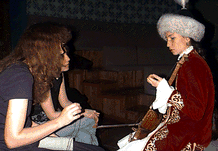 Raushan explained that Korkut wrote many melodies for the kobuz, and is now seen as a classical composer. She performed a piece for us which utilised the metal jingles attached to the instrument. This was a medley of his tunes and is called Abistolgan. This is very ancient music and she often plays it for herself. “It has to be with me always.”
I was very interested by the connection between this instrument and Shamanism. Raushan explained to me that the Shamans had used rattles to heal people. This was the origin of the jingles attached to her instrument. The Shamans improvised on the kobuz, not playing set pieces. It was a sacred instrument.
When Islam came to Central Asia the Muslims disapproved of the Shamans and tried to discourage their practices. As Raushan was a Muslim I asked whether she felt the two traditions were compatible. She said that she felt that they were, but it was not a logical thing. She played me a melody representing how she felt when she read the Koran.
Raushan is a living, creative musician who makes sense of life through sound. This is not a rational process, and it is precisely this ability to evoke things which cannot be explained which marks out a true musician.
“When I play it seems that I understand the Shamanic tradition”.
“There was a time when I had a supernatural connection with the audience but now I have lost this a little.”

Raushan’s instrument is one of the most extraordinary I have ever seen. She explained that the basic design was one which was common amongst the Turkic peoples. This particular one is made in the traditional way, from one piece of wood with no glue or nails. The resonating membrane at the bottom is made of camel skin. The camel, she explained, was almost a sacred animal to her; “A camel’s voice is deeply moving.” The skin used for the instrument comes appropriately from the camel’s throat.
The kobuz has a heart-shaped resonating chamber which in this case is painted dark red emphasising the heart-like imagery. Inside the heart were placed some small pieces of mirror. This was not traditional, but could represent a number of things; summoning ancestral spirits or reflecting bad thoughts were two possibilities. I mentioned the Sufi image of “polishing the mirror of the heart”, a description of purifying the heart for God. She thought it likely that this instrument maker had thought along these lines. There were a number of small details on the instrument – carved symbols representing sun, moon and a star. There were resonances of the Islamic Star & Crescent but subtly changed.
Raushan expressed a wish to search for more repertoire for the kobuz, and to research old pieces.
“Modern composers don’t understand the spirit of the tradition……..they spoil everything…… Kolumbaev was a brilliant player who composed and arranged pieces for the instrument. He was a brilliant improviser…. now he is gone nobody can replace him.”
Raushan aims to play like the ancient masters, not literal authenticity but preservation of the spirit.
Alice, our interpretor during the past few days, invited me to chat with her in her parents home not far from the centre of Almaty. When we arrive the clouds that had been gathering during the day, suddenly opened. The heat of the last few days is immediately quashed by torrential rain. The thunder rages in the darkening sky as I sit down in her room and ask a few questions about her life and music. She talks with an accent divided evenly between Russian and scouse.
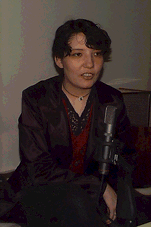 Would you like to be called Alia or Alice?
It doesn’t matter, I’m not bothered
Tell us a little bit about what you are doing in Almaty
I am actually involved in pop music, not really classical traditional but I do appreciate traditional roots, mostly pop musicians and blues based musicians. I have just got back from LIPA which is an institute in Liverpool that was opened by Paul McCartney two years ago. What I really want to do is to participate in the music scene here in Almaty, Kazakstan – because I think its booming now at the moment. Brilliant musicians, absolutely fantastic musicians – guitar players, drummers, vocalists. I want to get a band together. I do have a bass player and a singer but we need a drummer and were gonna start gigging at the end of August. What I wanna do is loads of gigs, I think that’s actually the way to success, do loads of gigs so the word gets spread around. Then probably do a single, then probably an album… I know it sounds cynical but I just wanna be rich and famous, have a jet and travel everywhere.
How would you say the musicians here differ from the musicians you’ve come across in England?
Oh they differ tremendously, because all the guitar players at LIPA (Liverpool Institute of Performing Arts) are into really weird stuff like White Zombie, Panthera and Metallica. Even Metallica is too soft for them. I found that really weird. Plus people are into things like Prodigy which are not popular here at all. In the former Soviet Union Rock and Roll was forbidden, you could go to jail for possessing an Elvis Presley record or wearing bell bottoms or whatever, ridiculous things like that. But still people were really into rock and roll, records were brought here illegally and then copied thousands of times onto tapes. People here are still into things like Nazareth and Led Zeppelin and Deep Purple and that sort of stuff. Nazareth are number one in the charts in Moscow at the moment. They’re into classical rock and classical blues.
Can you see in the future a kind of rock that will be unique to this part of the World, perhaps combining traditional music with rock music?
There is a band at the moment here which attempts to do that and they are just bloody, bloody awful. They are all conservatoire graduates and they study things like Dombra and Kobuz but they just sound awful. Just the worst band I have ever heard in my life… At LIPA for example we were studying guitar players like Ingui Malmsteim, Richie Blackmore and Steve Mores. Once they invited a guitarist, a very distinguished player from Moscow whose name Sasha Lipinsk, he came over to demonstrate his technique. he was playing Jimi Hendrix, all the standards Chuck Berry. People were asking questions like do you wanna play some Russian traditional music something specific weve never heard before something authentic. “No thanks just Jimi Hendrix, Johnny Be Good” stuff like that.
So music is primarily a vehicle for you to be rich and famous rather than the music itself?
I do my music and express myself. I would never do the sort of pop music that some people do in Russia, sort of whores on TV that really sell themselves to become rich and famous, I would never do that I think that is ugly and horrible. Rock and roll comes first really.
I am off to Tashkent, Uzbekistan tomorrow. The journey is either a ten hour drive or a two hour flight. I think I will choose the latter. Join us tomorrow, new country, new city, new music.
Day 4 – Let the music and musical instruments be the bridge between the peoples of the World
Posted by Musical Nomad in Daily Blog on August 2, 1997
“Let the music and musical instruments be the bridge between the peoples of the World…You are the ambassadors and I wish you success” Izbazar Balbazulov – Director of Museum of Kazak Musical Instruments
 The Minister of Culture pulls some strings. Arranged at the last minute, here we are in the presence of two great virtuosi back in the Museum of Kazak Musical Instruments. We are expectant of good playing, though nothing could prepare us for the brilliance of the emotional journey to follow.
 He had arranged for us to meet one of the greatest exponents of the kobuz. This was an instrument that none of us knew much about so we crammed ourselves and our gear into the first Lada that would stop and headed for Panfilov park. Everywhere in Almaty people have been extremely helpful to us. They seem eager that their arts and culture are represented. This has been wonderful, but has made us aware of having a responsibility towards the artists that we meet. This spirit of helpfulness manifested itself in two musicians – Raushan Obrazbaeva the kobuz player and Aygul Ulkenbaeva a dombra player. We knew we were pushing our luck to record, film and interview them in the time that we had, yet still do them justice.
 As we heard Aygul tuning her dombra we knew this was special. It was clear from the way that she handled her instrument that she was a virtuoso, not a folkloric performer of ‘museum’ music. As she began I was immediately struck by her poise and grace. Just like master musicians anywhere in the world, she transcended the apparent limitations of her instrument. Time stood still and we forgot that we were listening to a two stringed instrument, this music seemed universal. Paul came in from next door where he had been monitoring the recording, visibly paler. This was too good to miss, we just had to record it all. Aygul’s playing style is very extrovert and almost choreographed. She uses magnificent hand gestures to illustrate her music. It would be easy to make comparisons with extravagant concert pianists, but I felt this to be an integral part of her personal playing style. With her fully chromatic dombra she takes the instrument to new heights of expression. Her rasguedo strumming is flamenco in rhythm and fire. Her wide vibrato is almost as outrageous as the whammy bar on a Fender Stratocaster. Perhaps Aygul is a Segovia of the Dombra, extending its repertoire and range of tone colour, taking it to a new audience. This was very definitely classical music. There were no folk songs nostalgically invoking bygone eras, it was pure instrumental music. The drama of watching an instrumentalist weave a story in sound transcends any historical, national or cultural label.
 These are not every-day experiences, and my head buzzed with questions. I hadn’t realised there was a living and vibrant classical tradition in Kazakstan, with composers writing for traditional instruments. Essentially the classical music seems to have developed and refined the folk art form rather than losing contact with it entirely as seems to have happened in the West. This should be seen as a natural process, it has happened all over the world. It seems to be part of urban life, and increasing sophistication. It would be simplistic to describe this as the influence of ‘Russification’, although Russia has clearly been a huge influence here. We should not be bemoaning the loss of ‘traditional’ music, but celebrating the survival of a distinctly Kazak form of musical expression.
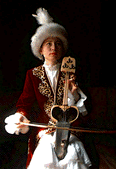 Raushan now took the stage to play the kobuz. Both musicians had been wearing traditional costume, and Raushan looked extraordinary in her long embroidered velvet gown with fur trimmed hat complete with shamanic-looking feathers. Her two-stringed horse hair fiddle is capable of creating almost unbelievably intense sounds. Whereas Aygul had been outgoing and virtuosic in her performance style, Raushan was introspective, as if summoning up ancestral spirits. She plays with closed eyes and rocks like a pendulum, in the dim light of the museum. I feel I’m in the presence of something very, very special. The sound of the kobuz is at times very close to the human voice. The emotional impact is immediate, it almost wails sometimes and it breaks your heart. We were astounded, not just by technical ability, but by the intensity and passion of her playing. The sound seemed to come from everywhere, to embrace you. Multiphonic effects brought to mind Mongolian overtone singing, primal sounds that were curiously abstract, impossible to notate. Simultaneously beautiful and terrifying. Raushan is able to move, in the space of one bow, from sorrowful and restrained Shostokovichian cello to guttural animal scream. I thought of Paul next door with his headphones turned up, and wondered what he must have been thinking. Once again all our expectations had been confounded. Gary pointed out during the performance that some of the music sounded very contemporary and accessible, and yet the pieces were hundreds of years old.
 I managed to find a moment to sit down with Raushan to ask her about the music. Is the kobuz the shaman’s fiddle? Are the attached jingles a vestigial shaman’s rattle? Can ancient Shamanic music connect with modern audiences? Join us tomorrow – let us have your views.
The curator Izbazar Balbazulov is a warm and enthusiastic man. He is extremely proud of his museum and rightly so. We gather with Alia in his kingdom, surrounded by paintings of Kazak greats. Musical instruments overflow from the shelves. As Gary and Paul fill in his guest book with good wishes and thanks, Izbazar points to a very special entry: President Yeltzin dropped by, back in 1991. Our gratitude is evident and he responds:”Let the music and musical instruments be the bridge between the peoples of the World…You are the ambassadors and I wish you success”.

He plays his dombra, Kathrin buys a kobuz, Jan blows on a hollowed out wooden Kazak ney, Paul checks his rushes, Gary checks his flys. On we go.
The musicians we heard today are innovators and trail blazers with a strong sense of identity.
Tomorrow I hope for a different perspective, I interview Alia, our interpreter about her Rhythm and Blues band, a young persons ‘take’ on Kazak music.
Day 3 – Communication happens in many ways
Posted by Musical Nomad in Daily Blog on July 31, 1997
Communication happens in many ways. I was moved by Aby singing a Sufi melody and enjoyed the musical interplay between myself and Mayra with her remarkable voice and dombra playing. Music breaks down barriers.
 We planned for months so that the technology of our project would do likewise; however, for the first few days some crucial pieces of equipment let us down. It has been a fraught time as we build stories for each day for transmission at 9pm only to be jilted at the final hurdle by an unhelpful portable satellite. Gary slowly deteriorates into a shadow of his former self after long days and even longer nights creating web sites and speaking to unhelpful people in far flung corners of the globe. At first the Inmarsat network wouldn’t send my bad spelling around the world. The box that was meant to send the data decided not to play ball. Various attempts to get a good signal included a 4.30 am trip into downtown Almaty searching for a powerpoint amidst late nights vodka stalls. On this last satellite trial a crowd of curious young men gathered, accusing us of being ‘James Bonds’ and making rather unsubtle advances towards Kathrin. Sadly it is all in vain. A new unit is ordered, the logistics of exchange of a large piece of equipment between UK and Kazakstan is underway. Once this has happened we hope to resume our conversation with the world.
 It’s 10 o’clock in the morning and I am scheduled to meet the Minister of Culture for Kazakstan – Valery Kuzembaev. Possibly a very formal occasion, I wear my best T-shirt and Paul is even wearing socks (it’s 30 degrees already!). Gary is all keyed up to give a presentation on a multimedia laptop and Kathrin is ready to translate. Today given the occasion we have a local translator as well. Alia turns up in a trendy outfit, speaks perfect Liverpudlian scouse and plays a Gibson Les Paul guitar in a rhythm and blues band – just what we expected. It turns out Alia studied media at Paul McCartney’s fame school (LIPA) in Liverpool, England – the only Russian girl from Kazakstan ever to do this.
 The Ministry of Culture resides in an old wooden building on Gogol Street. After some initial introductions the Minister began to tell us a little about the cultural situation in Kazakstan. “The difficult thing is the money”, he said. Everything else has to come second now.” Although this is the situation in London or anywhere in the Arts world, I get the impression that maintaining the level of cultural activity that was common here in Soviet times is very difficult. There are well-trained conservatoire musicians in Kazakstan, but unless they are star soloists employment must be difficult to find.The Minister himself is a violinist who taught at the Conservatoire. He explained to us that he still had students. He had once worked in a symphony orchestra in Mexico City. Opposite our hotel is a huge opera house but there are no queues of people to watch opera. It will be interesting to see whether there is anything scheduled for the next few days. The Minister seemed interested in our project and keen to support us in whatever way he could. He gave us the name of a well respected traditional musician whom we plan to meet tomorrow – she is a kobuz player. This is a traditional Kazak instrument with two strings, held vertically and played with a bow.

On our return to Kazakstan on 28th August we are hoping to venture into the Alatau mountains that surround Almaty in search of the nomadic roots of Kazak music. The Minister hoped he could arrange this. Fingers crossed, I could be in for an exciting few days towards the end of the trip.In the afternoon I headed for the voice of Asia Festival site in Gorky park (the other Gorky park). The main music events were not scheduled until 8 pm but during the day the park has the atmosphere of a public holiday. Everywhere families are enjoying the day out, boating on the lake enjoying the ferris wheels and roundabouts.

Karaoke is hugely popular and everybody from teenagers to mums and dads have a go at sing-a-long-a Beatles and some local Kazak pop. The karaoke units are very close together so you often hear three or four different tunes at once – interesting. There is of course not a dombra or kobuz in sight but there are some yurts, the local Nomad tents. I peered into one and was immediately invitedin for chai (tea). Very hospitable I thought and curled up on a fluffy felt cushion. Sat in the dappled light from the wheel shaped smoke hole in the roof, still sipping the refreshing sweet tea I admired the sumptuous felt drapery and also the intricate wooden framework which sustains their considerable weight. Its bad news for foxes as several pelts are hung as decoration from the ‘walls’, eagles aren’t too happy either – There’s a stuffed one perched by the door. Suddenly I’m filled with excitement at the prospect of seeing the real thing up in the mountains – complete with authentic music? Who knows. Then the tea bill arrives…. $25, ‘I made my excuses and left’.
Later on when we returned to the park the place had taken on a different aura. The entrance gate glowed in the dying sunlight and their was an air of expectancy as the young people of Almaty gathered and moved. The distant sounds of multiple Karaoke were almost softened into new age ambience and the odours of a hundred shashlyk stands merged into one ‘smoky’ haze. I bought a concert ticket and headed for the far side of the park.On the way I was enthusiastically requested to join a social gathering in the Yurt I visited earlier. After emphatically refusing several times (the polite thing to do) I was obliged, in the space of two minutes, to drink two vodkas and eat some decidedly chewy sheep meat. I again made my excuses but this time they had more weight as the team were waiting outside anxious to get to the concert.
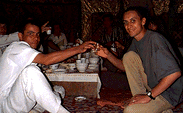
As we approached the main stage it became obvious that this was no excursion into so-called ‘World music’. The entrance to the arena was guarded by an army of oddly dressed police. Young people were filing in through a maze of barriers. The stage, when it finally came into view, seemed out of place. It was Eurovision, Asia style. A large pyramidal shape pointed skywards over an outrageously lit ‘TV’ stage. Cameras and lights buzzed around the performers as they were ceremoniously wheeled on, one after another to mime to their overly prepared backing tracks. This was ‘pop’, a powerful symbol of an aspiration towards Western values and lifestyle. I watched a couple of local Kazak boys chewing gum and smoking, affecting “attitude” straight from a pop video.The performance standard of the singers from countries ranging from Italy to Kazakstan was good yet there seemed to be something lacking. Audience involvement seemed minimal, the modern production techniques had built a wall between audience and performer.

This was ‘live TV’ but ‘dead’ performance compared to some of the local traditional music. Occasionally one of the singers would use inflections from a traditional singing style but most of the pieces were indistinguishable from Euro-pop. Later on we sat in another bigger Yurt nibbling salad and, yes you guessed it, shashlyk. Out of the darkness came the heart rending sound of the ney, a simple end-blown flute. We were silent, the people outside seemed to stop moving. How is it possible that a single piece of reed can burn into the heart more than any over produced concert? As with the satellite, real communication is weakest when the technology is the message and strongest when you have something to say from the heart.
Join us tomorrow when we meet two highly esteemed musicians of Kazakstan who speak through their instruments, communicate through kobuz and dombra.
Day 2 – I didn’t realise it would happen on the second day!
Posted by Musical Nomad in Daily Blog on July 30, 1997
“I had hoped that during this trip I would have the chance to play the flute alongside some of the musicians I had encountered. I didn’t realise it would happen on the second day!”
 The museum of Kazak Musical Instruments has a surreal air about it. It’s a wooden ‘fairy-tale’ castle enclosed in a cocoon of Soviet administrative architecture. Surreal also because as you enter the building there is a feeling of setting foot in a timeless world of ancient practice and frozen tradition. As your eyes adjust to the darkness, the treasures inside slowly emerge. A large map of Kazakstan clearly displays the instruments of each of its regions. A few surprises for me – is that an ocarina near Almaty? Are harps so widely used throughout Kazakstan?
 The six or so rooms that constitute the Museum are devoted mainly to three things. The composers of Kazak music (many of whom were once politicians in the Soviet system), the instruments (many originals used by the composers themselves) and some ancient artefacts which illustrate the origins of Kazak music. The rather sad looking musical instruments are ceremoniously displayed behind glass cases, deprived of a musicians touch. A small button now allows you to hear wonderfully ‘grainy’ recordings of their instruments. The playing sounds remarkably authentic and has an honesty about it. Some highlights include a bass dombra, presumably scaled up to provide the ‘low end’ to Russian designed Kazak ensembles and a selection of a horse hair string instruments. One of these is very similar to the West African “khallam” (from the Wolof people).
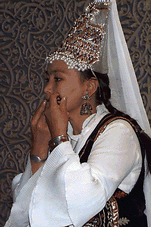 As we wandered around engrossed we were joined by Abylai, our friend who yesterday invited us to join him and his ensemble for a performance and chat about his world.Later I endeavoured to talk with Abylai a little about himself and about music. He was born in China, of Chinese parents, and went to a Kazak School. There is a large Kazak population in China, where the peoples are quite integrated. It was here that he acquired a taste for Kazak music. He studied music in Peking and since coming to Kazakstan in 1975 has been increasingly involved in local music. As something of a “musical nomad” himself he is liable to give you a list of all the styles of music he is able to play. He played us a musical medley which seemed to encompass most of Asia and considerable parts of Southern Europe. It was impossible to fathom the full depth of his knowledge in this short encounter. In one respect he emulates his mentor Al Farabi, he is a polymath, a philosopher, a performer and composer. Al Farabi is a famous name in Islamic scholarship, mostly for his Kitab al-musiqi al-kabir (the great book of music). This is a widely translated classic. Al Farabi was a true Hakim in the Islamic tradition, a man of wide learning. His scholarship extended to the religious sciences; mathematics, philosophy, astrology,physics and so on. Most importantly he was keen to convey the connections between these areas of knowledge which science now views as separate disciplines. Abylai could have talked to us for days about Al Farabi, as he had written about him extensively. My curiosity was certainly aroused and I made a mental note to do some reading-up when I get home. What else I could discover about this almost legendary figure from musicians here in Central Asia? Another important figure in Abylai’s opinion was Yasavi, a Sufi poet composer whose Mausoleum was depicted in the Museum. He performed a song composed by Yasavi. At this point Abylai’s voice lowered and his countenance became more reverent. We were all moved by this performance.
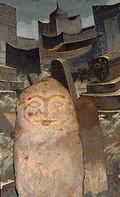 It was clear that in some ways at least Kazak music has changed little and the fact that the melodies we heard today are from the nomadic period seems to support this. Elsewhere, this way of life is still alive, even though these professional performance ensembles seem to be an urban, post 1917 phenomenon. The Soviet system seems to have been a mixed blessing. Whilst state ensembles were supported and musicians were paid, it may have brought about some changes in the music. Since independence, a living still has to be made and this means that the ensembles now frequently travel abroad to perform their music.Abylai was very keen for us to hear a ‘traditional’ ensemble. They gathered ‘concert style ‘ in their own auditorium in the museum . This curious round space, shaped like a yurt tent is made of wood and has an extraordinary resonance.

The instruments played were; two dombra, an accordion (probably from Russia) a bass dombra, a shetigen (a zither which probably originated here and travelled the silk road to become the Japanese koto), a frame drum with two heads (unusual), some castanets made of animal hooves (very loud) and an ulbek (an ocarina). The ensemble also featured a jaws harp, apparently a very ancient instrument.I had hoped that during this trip I would have the chance to play the flute alongside some of the musicians I had encountered. I didn’t realise it would happen on the second day! Mayra the dombra and ocarina player taught me a Kazak melody. This haunting but simple melody fits easily into our Western diatonic scale, yet somehow it has a decidedly non-European feel.
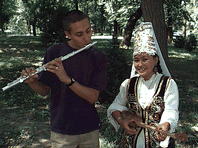
Music is too often cited as the international language but this time it worked. It will be interesting to see how I get on with the musicians further afield in Uzbekistan and the Fergana Valley
Tomorrow should present more opportunities for exploring East-West fusions. The Voice of Asia festival starts this evening. Log on tomorrow for a live update.
Day 1 – We disembark with a sense of foreboding
Posted by Musical Nomad in Daily Blog on July 29, 1997
After months of preparation and several near disasters, we finally land in Almaty. We disembark with a sense of foreboding.
 In London, Heathrow customs hadn’t wanted us to board the plane with a satellite phone. After some wrangling Gary, the project’s producer, emerged from the customs’ office looking exhausted, we hadn’t even left the country! As the plane took off, the flight had been delayed for 20 minutes and we still didn’t know if customs had allowed the satellite aboard.The kit for this project when it’s packed consists of four large flight cases, including a 35 kg generator, several smaller cases of assorted gadgetry and our own bags. All of this together amounts to about 30 pieces of luggage. The prospect of getting all of this through customs avoiding x-rays was somewhat daunting. In fact, it turned out to be easier than expected. Arriving at our first hotel the fun really began. Getting the equipment to our 6th floor rooms, through lift doors approximately two foot wide became the team’s first real challenge.
Challenge number two was finding something to eat at midnight in Almaty. The choice seemed to be: Shashlyk, the local lamb-on-skewer speciality or some shops which sold antique bread and dubious looking slabs of processed cheese. We went for the cheese, complimented by a cup of tea and a lamb doughnut. Perfect. At 2.30 am we crawled to bed still without a very clear idea of where we were.
 Masha (one of our contacts in Almaty) had told us that the Voice Of Asia Festival had been delayed by a day. This meant our excitement at arriving in the midst of furious musical activity was curtailed. Still no need to be downhearted. Almaty like many other cities of the World often shows its true colours through its markets. London has Camden or Portobello, New York has Greenwich Village, Toyko it’s Ginza. The number 9 trolley bus took us from our hotel to Almaty’s central market. This outdoor and indoor market is a feast for the senses. The sights, sounds and smoky smells struck an immediate chord. The place is alive. The scene is literally on fire. ‘Shashlyk’ sellers prodding their charcoal barbecues filling the scene with flames and a familiar odour . Bustling colourful arcades with women chattering in dazzling clothes contrast with the serene fortune teller women with their small white and black stones.
 The people are mostly Kazaks selling and buying local produce which ranges from automobile parts to giant melons. As we walk through the markets, there is a sense you are in some surreal disco. The throb of 130 beats per minute Euro disco collides with the same a few meters away. The music ranges from three year old UK hits to bizarre remixes of Jean Michel Jarre and Ennio Morricone. Strange at first, then you pause in a cool shaded area and two ‘techno’ rhythms combine producing a more fascinating hybrid. Here we are in Central Asia hoping to meet traditional musicians yet all we have heard so far is heavy beat music.
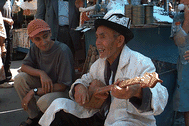
Suddenly amongst the market chaos I stumbled across this glorious old gentlemen playing his Dombra and singing an ‘epic’ song (whose lyrics tell very long traditional tales).
 The Dombra seems to be the most popular instrument in this area – a two stringed long necked lute, tuned in this case in an open fifth (five notes apart) like a violin. The right hand technique is a gentle rhythmic strum with one or two fingers, the left hand utilizes the thumb, not just as a pivot but actually stopping the strings. This technique encourages parallel movement in the resulting melodies, a distinctive feature of Kazak Dombra music. Anyone familiar with Spanish guitar music, particularly Villa Lobos, will recognize the sound.
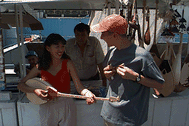
In the market Julduz and I posed for this photo with myself on miniature ‘tourist’ Dombra. Julduz helps run a stall selling Dombra amongst the fruit and vegetables. Interestingly she tuned her Dombra to fourths like a guitar.
Leaving the bustle of the market, we ate a picnic lunch in Panfilov Park and headed for the park’s memorial. This imposing tribute to the Soviets killed in two World wars constrasts strongly with market life. The monument, once a much visited shrine, is tranquil since independence.
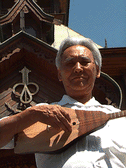 TOMORROW – Also in the park, dwarfed by concrete Soviet architecture is the Museum of Kazak Music – a tiny traditional wooden building. Resident guide Abylai is burning to share with us his enthusiasm for Kazak music, but that’s another story. Join us tomorrow to hear Aby and his ensemble.
-
You are currently browsing the archives for the Daily Blog category.