Archive for category Daily Blog
Day 20 – If I ask for paradise, kill me!
Posted by Musical Nomad in Daily Blog on August 17, 1997
“If I ask for paradise, kill me!” A proverb from the Yasavi Sufi Order
In response to an email from one of the many thousands following us, we were intending to visit Shaykh Kushkarov, a Sufi master of the Yasavi Order. Such opportunities do not occur every day. As we have said before this kind of direct interactivity is what ‘The Musical Nomad’ is all about – so keep requests and questions coming.
 This was going to be another hot, relatively uneventful journey from Samarkand to Tashkent. This the most used roads in Uzbekistan complete with occasional ramps and wandering cattle. The journey took us over a small mountain range sometimes a gorge at other times just a rocky outcrop in the brush landscape.
The exterior of Shaykh Kushkarov’s healing centre is quite plain. Two women dressed in colourful robes greeted us. They had a nun like manner, quiet yet direct and efficient. We sat waiting for Shaykh Kushkarov to arrive and we joked about Jan being left here for the remainder of the journey – the Musical Nomad becomes a resident of this particular Sufi order? Shaykh Kushkarov arrived without ceremony. A tall man with a long black straggly beard hanging down from an oriental face strolled through the wooden doorway. He greeted us with a firm handshake and a smile, the back teeth adorned with gold caps. It felt completely natural to meet him and there seemed to be none of the tension often associated with meeting a ‘stranger’.

He was happy to talk about his organisation and the Yasavi Order – in English or in any of the five or more languages that he speaks. The Order is one of the most widespread in Uzbekistan, along with the Naqshbandiyya. The centre has been operative since 1992 and has five ‘branches’ which are all controlled from their central headquarters. He has about 500 students or ‘murids’ all over the world.
In the course of a fascinating and wide-ranging conversation we were given a tour of the centre. He avoided ‘religious’ dogma, had an intrinsic integrity and pitched his responses at a level we all could grasp.
The attached clinic which specialises in herbal medicine and various kinds of massage. We were told how, at certain times of year, members of the order travel to the Pamir mountains in Tajikistan to collect herbs. This is a difficult task, not only because of the Civil War in Tajikistan but because the herbs only grow above 3700 meters. Several months are spent in the mountains. The physical and spiritual practices are said to be more effective because of the altitude – one month’s work at sea level being achieved in two days. The team also collect a certain kind of root from which they make a special drink. This drink takes five years to prepare and we can all vouch for its extraordinary properties. Shaykh Kushkarov told us that these Sufi medical practices have been used to curing some chronic diseases, including cancer. He stressed that this was not possible in every case but one of his murids whom we met claimed to have been cured of leukemia.
 The secret or non public activities of the order consist of the spiritual training of the murids. This is performed through meditation, music and various forms of movement and martial arts. All the exercises are performed under very precise conditions. Shaykh Kushkarov points out that although much had been written about Sufism, important elements of the training were never committed to paper, always being passed on by word of mouth from master to pupil. The centre consists of three areas or ‘corridors’. The first is the reception area and contains the massage and clinical treatment rooms. The second is the court yard and adjoining rooms where exercises are performed. The third area was strictly guarded and no one except the most advanced students were allowed access.
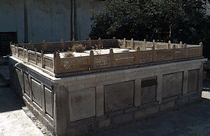
The second area consisted of a martial arts space, a meditation building he told us, a tomb-like structure for ‘focusing’ energy, and a stone on which various movements and meditations are practised. He told us this stone had been used in his family for eleven generations. The meditation hall is an extraordinary building. Built to very precise proportions, it combines the use of colour and certain metals to optimise the conditions for meditation. Nine people can meditate at one time. Three metres underneath the visible structure is another complex of cells and rooms in which people sit in isolation from one to forty days. This they do without any food or water and special air vents have been constructed to allow enough oxygen to penetrate. Shaykh Kushkarov has three times remained underground for forty days. We found it difficult to believe that anyone could survive such an ordeal. He explained how the body can draw upon its own resources of energy, as well as drawing energy from the earth and the cosmos.
Being shown around such a place is no ordinary experience. It has the effect of shifting your perception. We have decided to include personal reports from each member of the team as we were all uniquely affected by these experiences.
 GARY’S PERSPECTIVE
Being a bit of an ‘expedition man’ I felt an immediate connection with Shaykh Kushkarov’s three month trips above four thousand meters in the Pamir mountains. Living off the land and searching for rare, medicinal herbs, this was a man who had a mind and body in perfect harmony. He uses it to keep himself alive at high altitude as well as nine meters below the earth, meditating for forty days without nourishment. Regardless of any belief system, he is a ‘very well tuned’ individual. I sensed the team all felt he was responding to them on an individual level. He has an ability to connect with many people simultaneously, not through words but simply by his presence. I also sensed he could pick up many things beyond the superficial such as body language, or tone of voice and was actually able to ‘read’ you. This became evident in a session we had in his ‘medicine’ room. My colleagues had all received readings about their physical health. A short probing of the wrist area, a look at the tongue, some rolling of the eyes and he could diagnose problems in a very detailed way. He then prescribed some herbs for all of them.
When my turn came I was thinking how ineffective medication is, being a firm believer in the minds ability to control the body. As he gently prodded my arm I looked him in the eye, he seemed to respond. He asked me if I had any problems, I said none. He responded “you have a very pure energy, you are well”. He seemed to be telling the truth. I felt he knew that ‘substances’ to many people are placebo, they can carry some ‘energy’ to specific parts of the body but they are not totally necessary and act as a catalyst for the mind to take the healing process further. Later we sat and ate talking further about music therapy.
 I showed him our Internet project which made his eyes light up. Suddenly he said “who wants a drink?”vodka, we thought? One of his ‘students’ suddenly produced a clear bottle containing a red liquid. Inside floated a root “from under one meter of rock in the Pamirs.” It looked decidedly unappetising. “This drink contains energy, it will go straight to the bodies ‘centers’ and provide much healing.” Of course that could also be said of a cold pint of Guinness! He poured the red liquid into small chai cups. It smelt of strawberry and mushrooms. “Drink it in one go”, he said and watched gleefully as we each ‘knocked’ it back. He expected a major response. I drank, the musky taste faded then totally unexpectedly I felt as if I was gaining altitude. Not a ‘high’ feeling, more like standing on top of a mountain, my senses were heightened and unbelievably my ears popped as they do when descending in an aircraft. This lasted only four or five seconds but it was a definite physical and mental reaction. Whether or not it had any connection to my ‘energy’ centres I can’t say, but it happened.
My reaction to the drink seemed superficial compared to the feeling I had after saying my good-byes to Shaykh Kushkarov. The feeling of a light being switched on in the centre of my body. A very bright incandescent glow emanating from within. As I entered Tashkent, the noise and pollution rose but the light remained. Something had happened, a warmth from one human to another. Not magic or indoctrination – this was real. Something may have begun.
 KATHRIN’S PERSPECTIVE
When I first saw Gulbahor, one of Shaykh Kushkarov’s murides (students), I was immediately struck by her serene beauty and peaceful eyes. We connected in a very quiet yet intense way. When I mentioned that I had terrible stomach pains, she suggested that I have a diagnosis by Shaykh Kushkarov. He discovered various imbalances in my body one of them being my low internal haemoglobin level of -81, which can’t be detected by conventional methods, they would only read the external level of +112. He also noted that fifty percent of my spines energy is ‘blocked.’ I asked him if he could rebalance this. Shaykh Kushkarov then prescribed three herbs. He also recommended a Sufi massage – three sessions would last a lifetime!
Gulbahor asked me to lie down in the massage room. I expected a deep tissue or shiatsu type massage. What followed can only be described as ‘wild ritual.’ She asked me to lie down on my stomach and began to meditate. Gulbahor then picked up a bronze pen-like implement. It had sharp and flat tips. Starting with my feet, she worked her way up my body, scraping, pinning, stroking, pulling and slapping various parts. This was mostly a painful experience, especially when the point connected with various energy points on my back. My arms and legs were pulled beyond their limit. This reminded me of a Shaman’s ritual, beating rapid and regular rhythms on their drums. Again, Gulbahor slapped my body with enormous energy. I thought she was pulling me apart. Suddenly she stopped and stroked me tenderly. She was again her quiet self. Was I dreaming? When I awoke I felt extremely peaceful and happy. Something special had happened. Shaykh Kushkarov checked me again and smiled – “your spine blockage is down to ten percent”.
 PAUL’S PERSPECTIVE
For me mystical hocus pocus and men with long beards seem a long way from the stark reality of my home town of Liverpool. However following an industrial injury I suffer a lot with my back. Suddenly in the middle of our conversation Shaykh Kushkarov, I had to interrupt with a question.
“Did you say the Shaykhs give off energy?”
“Yes Indeed” replied the Shaykh.
“Well I just experienced the strangest thing, in therapy for my back injury I undertook a course of cranial osteopathy – this creates a sensation of electricity pulsing in the spine. I have just experienced the same thing in my neck and shoulders just sitting here next to you. All the aches and fatigue from my recent illness have suddenly dissipated”.
“It’s quite normal,” assured the Shaykh.
He later prescribed some herbs from 3700 metres up in the mountains. He refused payment for either his diagnosis, prescribed herbs or the lavish meal he provided.
“There are more things in heaven and earth…………”
 JAN’S PERSPECTIVE
Shaykh Kushkarov’s Sufi centre is the kind of place one reads about but can never quite believe in. It is no less than a holistic training centre for physical and spiritual development. It is based upon a traditional wisdom, unbroken for hundreds of years.
As I sit and write, I’m struggling to comprehend it all. The range of the conversation had been enormous. Shaykh Kushkarov publishes books on politics and told us that he is influential in political spheres. Certain facts that he divulged make me inclined to believe him. He demonstrated ‘Koranic mantras’ used in preparation fo
r meditation as well as a Shamanic dance. This connection between the Yasaviyya and Shamanism had already emerged on Day 2 and 4 in Almaty. He described in some detail his martial arts system and allowed me to play a metal flute that was also a disguised weapon.
 Shaykh Kushkarov explained that he had pupils who were Christians and Buddhists and that it was necessary to break down all barriers of faith and nationality in order to have a connection with God. There is no doubt however that his practices are based upon an esoteric interpretation of the Koran. We discussed the connection of maqam music and Sufism. He explained that the music acted as a vehicle for the energy of the Shaykh or spiritual master. It was a catalyst to make them receptive. Herbs he said function in a similar way. Maqam music is a part of a whole training system which is now largely forgotten by most musicians even though it is still performed.
In this medium it is impossible to give more than a taste of the effect that Shaykh Kushkarov had upon us. I suspect we will have much to think about in the coming weeks.
Tomorrow – In search of the STILL elusive Baysun ensemble
Day 19 – Culture is a Living Thing
Posted by Musical Nomad in Daily Blog on August 16, 1997
 Samarkand contains some of the most stunning sights in Central Asia. Its huge majestic architecture and blue azure domes are a big attraction. It is not a museum city however, it has the feel of a functioning place. People pass through the old centre in the morning on their way to work or to market. You get the impression that people who live here no longer marvel at its beauty, just as Londoners no longer ‘see’ St. Pauls cathedral.
Being a living city there are some sights that are just ‘monuments’ such as the Registan, and some that retain a religious significance beyond their outward beauty. Shah I Zinda, or tomb of the living king is an impressive example of this. It consists of a street of tombs once elaborately decorated with ceramic tiles. Largely unrestored it’s partly ruinous state encourages the imagination to recreate the original splendour.

The name Shah I Zinda refers to the mausoleum of Qasan Ibn Abbas, a cousin of the prophet Mohammed who is said to have brought Islam to this area. The simple ante room which connects to the actual burial chamber via a small door is a much visited shrine. Tapers are left to burn here and suras (Koranic verses) are read almost continuously. I found myself moved once again by the devotion displayed here, and somewhat mystified by the numbers of video cameras that roamed the sight. Perhaps here more than any other sites we have visited the difference between the tourist and the pilgrim is most obvious.
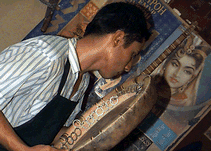 Once again everyone is welcome but it did leave a slightly uncomfortable impression.
Just across the road from the quiet serenity of the tombs is the noisy chaos of the main bazaar. In the heat of the day people argue over prices and laugh and joke together. Once again this is the living city of Samarkand, the farmers market where people buy and sell their produce. Its noisy cassette stalls and vivid colour seem even more intense after the cool of the tombs. The whole market sprawls in the shadow of the Bibi Kharnym Mosque. This enormous ruin looms impressively, dwarfing all around it. It was once one of the Islamic World’s largest mosques, but gradually it crumbled under its own weight, finally collapsing in the earthquake of 1897. Around it the city bustles on.
Musaffar was still very excited about our interest in his ‘serious’ music when we returned to his shop. I hoped he had kept his promise and found me a ‘quality’ nai. Sadly he had forgotten.
 The elusive nai and nai player saga continues. While we were in the shop Musaffar suddenly began playing and singing a maqam. His voice seemed to be slightly out of practice and several notes missed the mark, but I sensed a great deal of integrity in his performance. I asked him to play ‘Munadjat’ (one of the most famous maqam pieces) which he performed wonderfully on his rubab. I asked if we could return later to record some of these pieces. Before I left I purchased a good frame drum case, at least the drums may survive the journey ahead.
Culture is a living thing. The way people dress, the artifacts they make tell their story. As part of Russian imperialism the ‘State Museum of the Cultural History of Uzbekistan’ takes Uzbek culture and sets it in stone. Faded costumes are a poor reminder of a peoples history. As ever the saddest exhibits are the musical instruments – sentenced to a mute death. Tar, gidchak and rubab never to sing. On a positive note the museum does feature a very large Koran, possibly the largest in the world and some intriguing pre-Islamic stones, similar to the ones we saw in Almaty. (see Day 3)
 Back home in England it’s the sad relics of empire that strive for dignity in the British Museum. Even in the West a museum can be a poor testament. Here surrounded by a population living in a new republic a Soviet conceived museum seems an irrelevance.
The real culture of Uzbekistan is out there on the streets, celebrated in kaleidoscope clothes and the throb of a distant doira. In contrast the Registan across the road has life, a focus for current events animated by dancers and mad trumpets. The heat of the day in Samarkand sat still like a dosing alley cat. It had been well over forty five degrees and it still felt dangerous to be out in the roaring sun. The pollution and general ambient noise added two more disturbing ingredients.
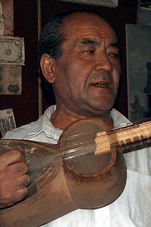
When we returned to Musaffars shop at four he had his fan on, cooling his small shop to a bearable level. He and his son, Nabishon looked eager to play for us but they had work to do, so we could not take them anywhere quiet. Vehicles and disco music were part of the general chaos outside the window. We needed the fan switched off to enable a reasonable recording. The heat rose. Musaffar picked up his tar, his son grabbed the nearest doira and they burst straight into a ‘number’. They had done this before! The perfect duo, accelerating and decelerating in synchronicity as only father and son could. Nabishon tastefully decorated the instrumental sections with his doira. They both seemed to enjoy playing as much as repairing. Their main income comes from repair work, performing gave life to the instruments. The biggest surprise for me was Musaffar’s voice, now much improved, it rose above the tar and doira. As they played the second piece the workshop became a sauna, sweat rolled off Musaffar’s brow splashing onto his now slightly out of tune tar. We had witnessed a traditional music, passing from father to son without any suggestion of a generation gap.
Tomorrow on the way to Tashkent we hope to meet a Sufi Sheikh (mentioned in Day 18 Mail), and we go in search of the elusive Baysun Ensemble.
Day 18 – Market Shares in Aladdin’s Cave
Posted by Musical Nomad in Daily Blog on August 15, 1997
 This morning I awoke at 5.30 am, it was still cool. I stepped out of the guest house to greet the morning light. The Samarkand back street that had been so quiet the night before had been transformed into a lively market. Traders were laying out their wares on rags. Acres of clothes, automobile parts, kitchen utensils, everything you could ever need, strewn along the road. I picked my way through the narrow streets towards the Registan, it’s grandeur tinged by the early morning light. [Registan Panorama] I had a rendezvous with some of the musicians we met last night. They were assembled in cheerful mood and demonstrated a melody in maqam style. The piece ended abruptly, the flute player adorned with Soviet medals, suddenly stopped and fumbled with something near his mouth, his false teeth had fallen out. They were then called to a rehearsal so we had to arrange another meeting with them later in the day.
 Further down from the relative peace of the Registan is the ‘produce market’.
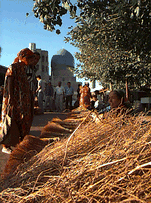 Hundreds of people converge here at sunrise. Rays of sunlight dance across the colourful fruit and spices piled up on long stone slabs. The market is dwarfed below the large dome of the Bibi Kharnym and the scene is full of memorable images. I sat for a while and drank chai on a table in the melon ‘area’ of the market. I chatted to an old mullah called Abdullobobo who told me he comes here everyday at the same time to talk with his friends. He had a deeply soulful face which was both peaceful and wise. He sat contented and seemed to understand what life should be. After the tea break I chatted to a lady called Yura and her son Pahon who were sat by the melons with a fabulous backdrop of the market and mosque.
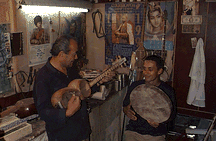 Next port of call was Musaffar’s workshop. It was small, dark and cave like, as an instrument maker’s shop should be. This was a refreshing change from the tourist-trap shops that now inhabit the old madrassahs in the Registan. Here was a maker and repairer who serves local musicians. Musaffar, age 57 is a small man with subtle oriental features. His family have run the ‘masters’ workshop for five generations and he has been in ‘residence’ for 35 years. He plays tar but says he can ‘have a go’ at any Central Asian instrument. Studying at Samarkand Music Institute he specialised in shash maqam vocal music and classical instrumental styles. I told him about the famous musicians we had met in Tashkent and Bukhara, as we spoke about Ari, Munadjat and Pattahon, he repeated their names and his face began to light up – we had seen some real classical ‘stars’. His son, who proudly sits next to his father, studied doira technique for 5 years at the same institute – he will take over the shop when his father ‘rests’ in a few years time.
 Musaffar was repairing some high quality instruments and his own instruments seemed better than others in Samarkand. Trying out instruments turned into duets, Musaffar on tar, me on frame drum. He told me that Samarkand’s most popular instrument is the tar, followed closely by the Kashgar rubab and then an instrument he called a Saz (here a long necked lute, with six strings in pairs – used mainly as a solo instrument). In the shop there was also some interesting variants on the basic design of tar and rubab. Still no flutes however – Musaffar promises me faithfully that he will bring some tomorrow. Needless to say I left with a gidjak and another doira. I think I will need an extra flightcase to carry all this stuff.
Musaffar was surprised to find that we were not staying for the Samarkand festival. He is very excited about it – seven days of traditional music from forty Asian & Eastern European countries including many Shash Maqam artists.
 Earlier we had arranged to meet the two doira players from the Shir Dor madrassah ensemble at 5pm. The heat of the day, allegedly peaking at 45 degrees was easing off and the streets were now beginning to fill with people ready for early evening revelries. The rehearsals for the Music Festival were still in progress in the Registan and it was only after some argument with an officious policeman that we were allowed into the square. The sun cast long shadows through the West facing lattice gate creating a wonderful abstract on the cobbles of the madrassah square. We met the group of musicians relaxing before their next ‘package’ concert. They seemed delighted to see us again, perhaps because we showed more than a passing interest in their music? The leader of the ensemble, the gidchak and flute player was slightly unhappy when we requested to see only the doira players.
 After a long period they appeared out of their room in the wall, apparently they had been warming their drums by the fire – after a long day of 40 plus heat they were actually toasting their drums! (This drives the moisture from the skins and makes the drum ‘ring’). I sat with them on a chaikhana table, under a mulberry tree in the corner of the maddrassah. I asked them to demonstrate the range of sounds a doira can make. With the right hand they can produce five different sounds – deep rounded tones or bright slaps. The left hand which supports most of the weight of the instrument can produce three tones – finger flicks onto the edge of the frame drum. I asked them if they would play a simple two drum rhythm gradually adding more and more decoration – the resulting piece ended in a climax of poly-rhythmic virtuosity. A crowd of tourists had gathered and it was time for them to do their ‘show’. I could tell they had enjoyed showing us their skills, a welcome change from the repetitive ‘package’ they do every night.
Samarkand is a surprisingly accessible and diverse city. It has already exceeded many expectations. Tomorrow I will discover more. Here anything seems possible.
Day 17 – Ten Second Tornadoes on the Road to Samarkand
Posted by Musical Nomad in Daily Blog on August 14, 1997
 “The Road to Samarkand” and not a sign of Bing Crosby or Bob Hope (one of Paul’s jokes for the oldies on the web).
We set off early from Baysun and received a ‘right royal’ send off from the mayor and deputy mayor – they carry our luggage and grip our hands in gratitude for spending time with them and ask us to return. As the ‘Nomadmobile” heads off out of the town a morning light glances low over the Zerafshan ridge. The vertical landscape is dotted occasionally with Yurts, small ‘ten second tornadoes’ and herds of goats. We have to swerve precariously close to the edge of steep gorges narrowly avoiding various bovine animals.
 Our driver, Bahadir who has just had his fifth grandchild, is fully in control. Gradually the heat rises and the hills disappear as we come out of the mountains. A big right turn at Karsi and we are on a fast, flat, perpetually straight road to Samarkand – the only interest being an occasional near vehicle crash either through potholed roads or badly misjudged overtaking. Eventually we near the outskirts of Samarkand and say good-bye to Sasha, he has to catch a bus to Tashkent. “Farewell comrades”, he says.
This trip has had its highs and lows, from the exhilaration of meeting wonderful musicians to the frustration of having no petrol. Through it all one figure seems almost unruffled by anything. Always patient, calm and considered, Sasha, our translator and advisor is a kind of centre of gravity, a point of stability for us. He has been on the road with us now for ten days so is used to our strange ways. He has acted far beyond the call of duty, and his understanding of Uzbek social graces has been invaluable . He always seems to be considering some “problem” (a word he likes to use) or reading a book (preferably in classical Persian). Suddenly something will amuse him and his bearded face will ignite with infectious laughter.

Things work at their own pace here and Sasha understands this better than anyone. It’s easy to forget that this mild mannered man is an accomplished scholar, he wears his learning lightly and doesn’t need to impress anyone.
In one conversation with Sasha I caught a glimpse of the difficulty musicians here face trying to communicate with the outside world. Sasha gave the analogy of an Asian musician trying to describe Beethoven using his own musical terms of reference. Inevitably distortions would arise. This situation compares roughly with the efforts of some European scholars who come to Central Asia to research music. Sasha was at pains to point out that there were Europeans who understood this music better than some local scholars.This problem of unconscious Euro-centrism is something which musicians treat with indulgence here. Sasha kindly added that our project had a completely different brief, to introduce this music to a wide audience.
Patience and wisdom are rare qualities, Sasha possesses them in abundance.
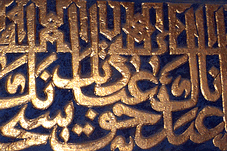
I arrive in Samarkand to find there is no room at the inn (again!). Samarkand only has two ‘bed and breakfasts’ and they’re full. I’m shunted off to a small courtyard with some abandoned bedrooms and parking space for the Nomadmobile. Gary is concerned that we have a clear line of site to the Indian Ocean – whatever that means. (Satellite?) I’m just happy to wash the dust off my feet.

Samarkand is often described as the ‘Pearl of the East.’ The tall madrassahs supporting deep blue domes and the majesty of scale could produce a thousand descriptive superlatives. The city is, like Bukhara undergoing major refurbishment and soon celebrates its 1250th year. It also hosts a week long “Music of the East” Festival starting 25th August, this is one of the biggest events in the area for many years.
The Registan, one of the most celebrated monuments shows signs of preparation – tomorrow I will see it in the dawn light and get you some photos. When we arrive twenty traditional trumpet players rehearse their fanfare and stage positions for the opening ceremony – it reminds me of a Dad’s Army drill. The whole city has a sense of life and movement. Things are changing, fast. There is transition and excitement in the air, music and dance are commonplace on the street and in the specially designated tourist areas. I will explore this more in the next two days. Everywhere in the world, folk culture is presented as entertainment for “package tourists”. Samarkand is no exception. At 6 pm every evening local musicians and dancers re-enact an Uzbek legend with music, mime, puppetry and fire eating. It’s beautifully done and although stylized maintains a joyful innocence.
 The costumes are probably exaggerated, the music simplified, the legend made larger than life with roaring flame. Yet for all that bemused confused tourists get a taste of a wonderful culture. If they want to know more there are CDs and ‘Musical Nomads’. I was particularly impressed by the doira (frame drum) players with their intricate poly rhythms – I arranged to see them for a detailed session on Usul – the rhythmic patterns of Central Asia. The chang (oriental hammered dulcimer) player is also worth a closer listen.
Join me tomorrow as we explore the city and meet frame drum and other traditional Uzbek folk musicians – I may even get to meet my first Central Asian flautist
Day 16 – Let us hear your voice
Posted by Musical Nomad in Daily Blog on August 13, 1997
 The journey to Baysun in South Eastern Uzbekistan, today took us over several mountain passes close to the Afghan and Tajik border. The environment is barren and inhospitable with few rivers or lakes to nourish the harsh land. We passed through several suspicious random checkpoints which had no obvious reason for existance – the regional boundaries seem inappropriate in such ‘samey’ terrain. Many of the panoramas call to mind Arizona, mini Grand Canyons appear with extraordinary regularity. As we approached from the West, the sun sets turning the sandy landscape Martian. We round a bend and nestled below a 12,000 ft ridge an apparent oasis comes into view. Baysun is surprisingly large with a population of nearly 23,000; its main sources of income are meat and wheat. It has a large supermarket, a diminutive produce market and a house of culture, complete with 1000 seater cinema.
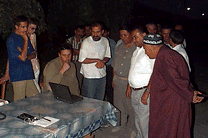 When we arrived there was some confusion as the famous Baysun ensemble had left town. They had been sent for a two week ‘gig’ in Tashkent and were our only form of contact – initially we were asked to leave.
After the shock died down the town’s officials began to buzz around us. What to do? Some people from another land had descended on their town. There followed a lengthy approval procedure, we were taken to Turakul Hamraev’s office (Baysun’s Mayor) – a yard with a table and phone. We had to explain our mission, do an impromtu Multimedia presentation and smile a lot at the various dignitaries. After an hour or so of ‘checking’ each other out we were suddenly honored guests – the transition into that mode almost lost on a tired ‘Nomad’ team. Many of the local musicians were also in the throng. Another musician we wanted to meet, Shoberdy Bakshy who had now been told to spend time with us tomorrow and to cancel a financially lucrative wedding ceremony.
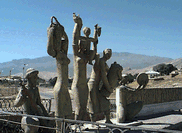 Once accepted we received a welcome of such kindness and honesty that we were at first very disconcerted. The deputy major of the Baysun region, Samariddin Mustafakulov had been given the unenvious job of looking after us at 9 pm. He opened a restaurant for us to eat after our long trip, he made available at a moments notice, a Daja (a summer house in the past used by Russian officials) and he even waited at our late night table plying us with vodka. Throughout the coming day he would accompany us everywhere, standing over the lengthy video and audio recordings, following us into the mountains for a location shoot with the Bakshy singer – making sure we were happy and at every moment filling our chai cups with vodka. Ourstandard refusal of we have too much work to do eventually worked.
The Soviet’s pulled out of this area and indeed the whole of Uzbekistan back in 1992. The control reverted back to the indigenous people who retained many of the Soviet ways. Here in Baysun there is the remarkable combination of a warm and friendly people living in the shadow of the past – things have moved on but at a far decelerated pace.
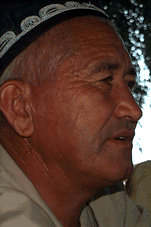 Sometimes musicians are more than just players of music. Sometimes concert pianists disappear into a world of their own creation – lost in music. Jazz musicians talk of being ‘high on music’ and anyone lucky enough to play an instrument occasionally feels that sense of the music taking over. When Shoberdy Bakshy sings, gently thrumming on his dombra, clocks pause. His voice is a low chested throb rising to a scream. His dombra dances with the rhythm of something anciently human. Short songs in his repertoire last 20 minutes, the long ones several days. For us he wishes to record a 2-hour epic – our longest tape lasts merely 60 minutes. Shoberdy composes on the spot, taking an old theme and reweaving it into a new opus featuring all members of the “Musical Nomad”.
The biggest frustration of travelling is not being able to share experiences with the ‘folks’ back home. Here we have the immediacy of satellite communication, sharing a moment with the World. My ‘moment’ today was driving through the mountains sitting next to Shoberdy who was singing his song about our arrival in Uzbekistan. Sasha, Bahadir, the deputy mayor, everyone was in the story – each laughted and nodded as their name was mentioned. It suddenly struck me that he was doing exactly what we were doing, telling a story live, responding to the environment. This spontaneity affected me more than anything else.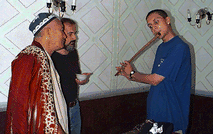 In interview he spoke of his songs of friendship, love and nature. In the presence of the microphone he declined to speak of Shamanism – he just oozes ‘spirit’ from the ends of his calluosed fingers. Shoberdy Bakshy is a wild man who dances to a different drum and drinks vodka like water. May he live a long and mysterious life.
Tomorrow – Samarkand. We take the ‘Golden Road’ to discover the music of the ‘Pearl of the East’.
Day 15 – Bukhara to Baysun, into the mountains at last
Posted by Musical Nomad in Daily Blog on August 12, 1997
 Before setting off from Bukhara this morning, we called in at the workshop of an instrument maker, Karomat Mukimov. It was not long before we were surrounded by the master’s young apprentices and were being shown the intricacies of tuning tars. Karomat and Sasha had been at the Tashkent Conservatory together 23 years ago, so there was a mini reunion going on. Amongst the instruments in his shop was a tanbur from the nineteenth century, it had been lovingly restored by this master. It transpired that the tanbur had once belonged to Leviche Babakhanor, grandfather of Ari (a musician we met three days ago). This news came as something of a shock. Why would the family sell such a beautiful instrument? It was heavily inlaid and was quite obviously made for an important player. Sasha told us that Ari had referred to an instrument of Leviche’s which had been sold to a maker. This tanbur was an antique with historical value, having belonged to one of the last Bukharan court musicians. Here it was for sale. Admittedly not cheap, but we would have been free to take it abroad. It crossed our minds to buy it and give it back to Ari – where it belonged. The story went that one of Ari’s brothers had gone to live in Israel and had exchanged this instrument for an new one. It seemed sad to see it here but at least it was now restored and perhaps would end up in the hands of a player.
My thoughts now turned to a doira, a frame drum, that I had seen several days before, but had then seemed absurdly overpriced. Whether it was the effect of half an hour of conversation, or Sasha’s connection with the instrument maker, I’ll never know, but the price suddenly dropped by a third. We struck a deal and I walked away the proud owner of a high quality doira. Now all I have to do is persuade someone to show me a few tricks.
 This project involves plenty of travelling around Central Asia. After all I am the ‘Musical Nomad’. Of course the truth of the matter is I am accompanied by a small, specialist team. Our ‘nomad horse’ for the last two weeks is a Volkswagen Caravelle, with enough seats for six people and five large flightcases.In Central Asia a driver is more than simply a driver, he constantly nurses and cleans the car, never leaves it and finds petrol in the most unlikely places. Our Uzbek driver Bahadir is a real character and devout individual. He is a stout man with a face half resembling Mel Brooks and a sleepy manner. We were amused watching Bahadir buying petrol. He would chase lorry drivers, hug and kiss them and spend hours in the back yard of strangers.
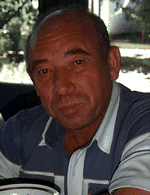 Our delicate computer, communications and audio/video equipment are at the mercy of his driving skills and we all too often have to tell him, through Sasha, to ‘slow down!’ This gets lost in the translation as within minutes we are once again careering through potholed hairpin bends. Bahadir also has an uncanny ability to forget things – only basic things such as which town we asked to stop in!. With all his faults though he has some key redeeming features – his devotion to his religion and his mild manner which conceals a strength alien to many in the West.
Yurts and oil wells line the improbable road to Baysun. A semi desert of stunted shrubs strectches to a hazy horizon. The mode of transport switches from dodgy trucks to lively donkeys, laden with unknown produce bound for market.
I n many Islamic countries you wield a camera at your peril. In Tunisia for example, even pointing a camera at a person is considered deeply offensive. I entered the lively market at Karsi full of trepidation. Everywhere the rich fruit colours of high summer beg for Kodachrome. Reds in apples and tomatoes, golden yellow pears, grapes, as black as night. In direct competition for photogenic appeal were the gorgeous Tajic clothes of the Uzbek women. I gestured to my camera with a thumbs up and a smile – smiles were returned. Suddenly I was the most popular guy in town – everybody wanted to be photographed and video’d. It gets better. The fruit sellers started to compete for my attention by paying me in fruit. I left the market laden with bags, totally bemused but thrilled. The generosity of these people had been such a surprising contrast.
 In the cities of the former Soviet Union the legacy of too many conquering Tzars and an autonomous state is a frozen fear still reflected in faces. Here in the country people further from the hub of beaurocracy seem to retain an earlier innocence. As we arrive in Baysun unannounced in the early evening, word spreads fast. Soon a whole greeting committee turn out to welcome us to this small town in the mountains famous for its music.
Tomorrow the ‘Bakshy of Baysun’.
Day 14 – To succeed this project must be interactive
Posted by Musical Nomad in Daily Blog on August 11, 1997
 In the same way that a musician craves an audience I must hear from you. I invite you to help produce this exploration into Central Asian music – do you wish to know more about vocal music or instrumental? Are you interested in the related art of dance? Looking back on the previous pages, did we leave any questions unanswered? Are you gaining a clearer picture of this rich culture? Would you like to hear more from any of the featured musicians? – we have up to three recordings of each player. Are we telling you enough about the cultural context? Are you interested in the history, the religion or indeed the politics? We can’t promise all the answers, we will give it our best. Be a director in this bold new medium, I invite you to call the shots.
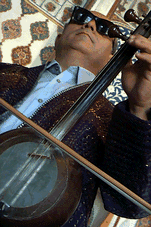
Meeting Ulmas Rasulov, Uzbekistan’s foremost classical ghidjak player, was an unforgettable 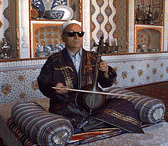 experience. The ghidjak is a spike fiddle and has many similarities to the violin. It has a short neck attached to a gourd shaped soundboard and has a slightly shrill timbre which can only be controlled by very experienced players. Ulmas, who is totally blind, communicates straight from the heart with an incredible openess and honest sensitivity. He has an awareness of the people around him that transcended his lack of sight. He talked to Kathrin and she found it a wonderful surprise to hear that the cello is his favourite European instrument. He suggested she immediately get a cello and play a few duets with him. Ulmas has a great passion for European music, especially Spanish and although the pieces he played were traditional, they exhibited influences far and wide. He played with a deeply felt passion and intensity that touched us all.
 Ulmas told us later that the ghidjak “connects with the heart and soul of the people in Central Asia.” To him this is sacred music, “the music of God”. He feels that together with the sato (another bowed string instrument) and surnai (a reed instrument), the ghidjak comes closest to the human voice. He adds that the voice is the most important ‘instrument’ here and all other instruments aspire to its qualities.”In post-Islamic and pre-revolutionary Transoxania the whole of artistic culture, literature, music and architecture was based on Sufi ideas.”
Alexander Djumaev (Sasha)
 On our travels I’ve had many opportunities to chat to our friend and musical adviser, Dr Alexander Djumaev. Sasha is a leading musicologist and historian who is particularly interested in the relationship between Sufism and culture. He is a mine of information and has been responsible for introducing us to some extraordinary musicians. I too have become extremely interested to discover more about a mystical tradition that has inspired such an extraordinary culture. As part of this quest I felt it would be important to visit the tomb of Bahauddin Naqsband who is a ‘patron saint’ here in Bukhara.
The tomb is now part of a large complex which includes a mosque, an old dervish house, a museum, a cafe, gardens and of course the gnarled old mulberry tree, reputedly planted by Bahauddin himself. Legend has it that wishes will be granted and women made fertile by passing under the tree three times. There is the air of a tourist complex about the place. It is not until you approach the tomb that the intensity of feeling he engenders becomes apparent. A Koran reciter sits under a shady tree, people join him to have suras recited for dead relatives or just to hear them. An elderly gentleman’s voice chokes with emotion as he prays. The pleading and emploring in his voice makes me feel somewhat uncomfortable. It is like witnessing someone’s distress. This is the same yearning that comes across in some of the music we have heard here, especially maqam.People bring their children here and walk three times around the tomb for luck. Women kiss and stroke the old mulberry tree. Whether or not any of those people maintain a practical connection with the Sufi tradition is unclear.
 Long beforethe revolution the Naqsbandi Order travelled to Turkey and India. There are now branches of the order all over the world. It is undergoing a revival, instigated by influences from outside. I do not know if I have discovered anything new
today, but I have gained an insight into the devotion that people here have for this great Sufi teacher.
Tomorrow I go, for the first time, into the mountains near Baysun to seek out a Bakshy and the legendary Baysun Ensemble.
Day 13 – a satellite beams from Bukhara
Posted by Musical Nomad in Daily Blog on August 10, 1997
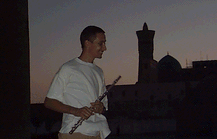 Human contact can take many forms. There is contact when you play or hear a piece of music which triggers a primal reaction within. There is contact when you meet someone who, though living a different life to your own, can understand and relate. There is a contact through ‘communications’, be it a simple conversation or a satellite bouncing signals around the world. Today we made contact. Through music, with people of Bukhara and finally, at last with you the audience.
In our wonderful location preparations are underway to turn the already lavish interior into a ‘new’ set for a different musician. Today we meet a gidchak player (traditional lap violin). Video and audio are in record pause and the scene is set for action. We suddenly get the news that the musician has had to ‘do’ a wedding and cannot make today. Our first ‘non-starter’! Simultaneously, a young man who has traveled eighteen hours to be with us walks into ‘The Musical Nomad’ circle. Howard Drake has brought us a new, fully functional portable communications satellite unit – this is the third one and expectations are high. Will the project finally become two way?
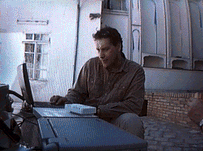 Gary becomes more ecstatic as the levers are pulled and the turbines begin to roll – we feel there is a direct parallel here with the early days of TV, this shaky yet elegant production echoes those early pioneers. Suddenly we get full connection, we are in full contact with the outside world. There is little jumping up and down, it’s too hot for that but a great sense of relief as the music, photographs and writing of the past twelve days are efficiently pumped onto the World Wide Web.
 Something significant is happening in Bukhara. The ancient city takes on a new role. No longer a staging post on the silk road, Bukhara’s main asset in now its magnificent architecture. Everywhere scaffolding is springing up and crumbling fortresses and monuments are acquiring a facelift. People who remember the city in its faded glory fear ‘Bukhara-Disney’ and ‘theme park city’. Personally I am sure it will look magnificent. The Bukhara that celebrates 2500 years is part manufactured but somehow the spirit rings true. What I would like to see is a stronger resistance to Coca Cola culture and cheap diluted europop – both already starting to take over in the otherwise tranquil city square.
Everything moves on and its important that we keep some record of the past. The tools of a musician develop and change with the needs of the music.
 In the local museum I saw some sad old relics of what used to be a gidchak, a tanbur and some 17th century drums. In an unprecedented way the guide allowed us to play one of the drums and again its voice rang out. Living instruments need this, when stuffed and entombed in glass they die – the strings rot and the heads split and they no longer represent the essential vivacity of their function.
The Musical Nomad project fulfills and important function – with every musician we meet we make a state of the art digital audio visual record of their technique, they play at least one whole piece. We hope in this way to make a living record of Central Asian Music now – a real legacy for our grandchildren.
 Its is common in Bukhara to find yourself sitting on a wall or bench to admire a building or chat to locals. I chatted to Mohammed, I asked him whether he knows any musicians in town. “My brothers are musicians”, he said, “they run a music shop”. Not quite believing our luck we followed him to his house in the early evening. After a few minutes walk through the narrow backstreets we entered a simple local house with a characteristic courtyard, reminiscent of an African compound. We greeted Mohammed’s wife, Aisha and their young son of three months old lay asleep on a blanket. Soon their two young daughters aged about three and five arrived home from playing in the streets. We drank tea and Mohammed went to fetch some musical instruments.
 There is an ease about people in Bukhara. A warmth which shows itself in the small everyday incidents. Bukharans are naturally hospitable and still curious enough about foreigners to stop and chat . It is obvious however that times are harder since independence and some locals are struggling. Encounters with people like Mohammed’s family are precious therefore for getting an insight into how people live. Undoubtedly Mohammed wanted to sell us instruments but he was also pleased to be able to entertain. We chatted to his daughters and when the conversation ran out I played a Hebrew folk song on my flute – the children seemed intrigued and listened intently. Out came the photo album and we saw their wedding snaps and family momentos. We were asked if we had children. Aisha was surprised that only Paul and I did (she was married when she was seventeen and must only be in her early twenties now). Missing my baby son Tal back home in the UK, I picked up their little one and felt him to be a comforting presence there in my lap. These are feelings that translate well wherever you find yourself in the world. Feelings everyone understands.
 Mohammed returned with his instruments and a raucous noise was struck up within seconds. Rubab, doira, surnai and nai. Unfortunately all the instruments were of poor quality and I bought the ney more as a souvenir of the evening than as a useful instrument. Mohammed seemed pleased and we all trooped cheerfully out into the now dark Bukharan backstreets. We said our good-byes, promised them a copy of the photo Gary had taken of the family, and headed back to the guest house.
Tomorrow I meet a musician playing a gidchak, the traditional violin of Uzbekistan. I then go on a pilgrimage to the tomb of a 13th Century mystic, one of my main reasons for coming to Central Asia
Day 12 – Bukhara – holy city. 2500 years of written history, 6000 years of mythology
Posted by Musical Nomad in Daily Blog on August 9, 1997
 I’m lucky to lodge in the old Jewish quarter, a film set fit for Cecil B. De Mille. At each corner architectural delights charm the eye, gold shimmers in the intricate mosaic. My guest house, built in 1908 for a Jewish family, has a wonderful room of Tajik design. The high beam ceiling of plain wood contrasts with the vibrant glory of the richly ornamented walls. Here is the inspiration for William Morris and ‘Art Noveau’, all combined in a glorious synthesis of colour and light. Alcoves richly decorated are adorned further with Chinese bowls and Turkic tea sets. The shuttered windows filter the morning sunlight and silk curtains drift in a Bukharan breeze.
 The centrepiece is a small wooden platform covered with a gold-threaded cloth and cushions coloured to shame a biblical Joseph.Our musician Ari Babakhanov frets his Kashgar rubab and weaves a spell in sound. Outside a rogue shutter crashes but the spell cannot be broken. Emissaries from the ‘Musical Nomad’ silence every window for miles and Ari once more weaves a quiet magic. High on the walls Hebrew script proclaims a faith long at home in Bukhara.
“Persian-speaking Jewish communities seem to have existed in the larger oasis and riverine towns of Transoxiania for over a millennium. Documentation of the origins and early history of these communities is extremely sparse, but legends speak of the importation of skilled Jewish craftsmen from Iran by a succession of Central Asian rulers, beginning with Timur (1338-1405), and a Tashkent based archaeologist has reported on the existence of a Jewish cemetery in Samarkand before Timur’s time.”
Theodore Levin: “The Hundred Thousand Fools of God” (reproduced by permission of the Author, pub. Indiana Univ. Press)
After his marvellous performance Ari invited us to spend some time with his family on the outskirts of ‘modern’ Bukhara. As we pull up outside his flat he steps out to meet us. He has the kind of face that you immediately warm to, with as distinctively Jewish features as I have ever seen, a sun-torn face which speaks volumes. I sense he is a deeply thoughtful man.
Inside his typically styled soviet flat there are faded paintings of Bukhara and ‘colourised’ black and white photographs of his son and daughter. We are welcomed, and meet his wife, daughter and grandchildren. Traditional rugs line the walls and there is a piano, played by his daughter, Susanna. They are a musical dynasty. As we drink tea and chat everyone seems quite at home. He has a ‘deceased’ Bulgarian guitar hung above the TV, a tanbur props up a bookcase and his prize rubab lives in one of the back bedrooms. We “have a go” at playing Ari’s instruments much to his amusement and Paul is instructed to play the antiquated guitar. It needs new strings and an overhaul but Paul struggles manfully on.
 Lunch arrives, it is delicious but unfortunately we cannot do justice to it. Try as we might it just keeps on coming. Whether this is Jewish hospitality or Bukharan we cannot tell but Ari’s wife urges us on with despairing looks and huge portions of everything. The ice, by now seems well and truly broken and Paul’s guitar comes out for another tune. We try to persuade Ari and Susanna to play together but they don’t seem in the mood. Ari, besides being a consummate Shash Maqam artist, also plays Western classical music on his rubab. He likes Spanish and Italian music and wants to make a “World music” CD. As I look around the table at us, the team, Ari’s family, Bahadir (our driver) and Sasha (our musical adviser), I wonder whether we somehow reflect the polyethnic character of the city – Jews, Muslims, Christians and doubters all happily sitting down together.
 We later huddle together in a back bedroom for an intimate discussion. The Bukharan wind whistles through the overground pipes outside singing a discordant melody. Ari seems very relaxed as we talk, occasionally his voice becomes animated, deeper and more powerful when he warms to a question. He tells of his background and of learning the Shash Maqam as a child. Now in his seventies, Ari shows us a medal he gained in Moscow playing at a ‘Soviet Festival for Youth’. He has composed songs still sung today by famous singers in the capital. From the age of twelve he learnt the maqams. He showed us transcriptions (published in 1924) of the maqams notated by the Russian, Uspenski. He is keen to talk about his hereditary tradition and of a past when musicians were held in high esteem. His grandfather, Levi, was a court musician and would play, before the Russian revolution to the Emirs (Uzbek ‘Royalty’) and after 1924 to high ranking Soviet officials. I hear in his rich Russian voice a real sense of longing for the ‘good old days’ when musicians like his grandfather, would play with musicians such as Maarufjon Tashpulatov, Najmiddin Nasriddinov.
“For three generations the Babakhanov family had played a central role in the musical life of Bukhara. Levi Babakhabov (1874-1926) is still revered as one of the greatest of Bukharian singers…”
Theodore Levin “Fools of God”
 The Soviets began to see this music as dangerous along with the movements led by the Mullahs and Sheikhs of the time. Ari’s grandfather feeling at risk in Bukhara had to escape to Samarkand. Mysteriously he suddenly died. Some believe he was deliberately poisoned by the oppressive power but there is no real proof of this. I am keen to find out whether there is anyone else who can continue the old Bukharian traditions? His voice stutters and he sounds resigned as he says “nobody, nobody now. I am the last one”.These words echo painfully as he tells further of a few students who may one day be able to play the music. Are we witness to a form of musical ‘extinction’? Commercial and political pressure has all but stamped out the last members of a joyous and heartfelt musical tradition. A tradition relevant to today’s societies in the West – tales and music of longing and devotion. We say goodbye to the family and leave them in their apartment block and we return to our lavish B&B in the ‘old Jewish quarter’.
Ari still dreams of one day restoring Shash Maqam to it’s former glory.
Tomorrow – This city is full of music. Join us as we bring the sights and sounds of Bukhara, live – yes, a third satellite unit is arriving!
Day 11 – A great deal of what we see depends on what we are looking for
Posted by Musical Nomad in Daily Blog on August 8, 1997
 At last I hit the old silk road although now it’s cotton that lines the highway. I travel in hope from Tashkent to Bukhara, the Holy City. Hot miles of fields, the vanishing point defined by incongruous power lines. Was this really the road trodden by Ghengis Khan, Marco Polo and Timur. It is 90 degrees in the shade but the only shade is an 11th century Caravanserai, and even that crumbles, returns to sand. Hundreds of miles of overgrown irrigation ditches are the only vestige of some bold ten year plan. At a tiny oasis beneath an exotic maple? I take chai and admire the local faces.
Back on the road a combine harvester reaps the Nomad plain. From a hill I catch my first sight of Samarkand, Bibi Khanum. The dome shimmers blue in the midday haze.
 Not far outside Samarkand lies the tomb of Imam Ismail Al Bukhari, an important figure in early Islamic history. He is famous for collecting Hadith, or stories of the life of the prophet Mohammed. As Bahadir, our driver, wanted to pray we thought we would have a look around. The entrance to the mosque complex opens into a serene and tranquil garden with artificial lakes and fountains. Venerable looking gentlemen sit on the “Iwan” or raised platforms, characteristic of all Central Asian chaikanas or teahouses. As people slowly gather for the Friday prayers chatting and catching up with news, I notice that everyone is in their equivalent of Sunday Best. Older men in their silk frock coats, knee length leather boots, sashes and turbans, women in colourful silks.
 Although people tend to cover their heads out of respect it doesn’t seem compulsory. Visitors are welcome to stay in the gardens to watch the prayers as long as they show some decorum. This is a holy place but there is an overriding tolerance and hospitality. These are not values that people in the West often associate with Islam. Even Paul tottering around with his DV camera and tripod, hat on head didn’t attract any curiosity. Perhaps there have not yet been enough intrusive or inquisitive Westerners here to make a nuisance of themselves. During prayers I spent some time by the tomb itself and afterwards was joined by many people from the mosque. The gardens and tomb have a timelessness about them to be enjoyed by all.
 Lunch is at the local ‘greasy spoon’, a lorry stop. I sample lamb stew and potatoes and admire the ancient bread oven almost biblical in simplicity. As the miles drag on I try and imagine the scene before the 20th century scarred the landscape. Ill thought out irrigation schemes and rusty power lines are sad monuments to leave our children.
We arrive in Bukhara at sunset. The golden glow permeates everything especially the overwhelming sandy colours of the buildings. We are staying in a local B&B with a fabulous, ornately painted wooden verandah overlooking a central courtyard, a wonderful location for musicians – perhaps we will invite some here. The B&B is next to a central square and pool called Labi-hauz which has, according to Gary who was here before, lost all its ‘old Bukharan’ charm. The renovations taking place for the 2500th year anniversary in a few weeks has turned it into a clean yet bland square complete with plastic white tables, chairs and ghetto blaster music. I feel quite sad that my vision of a Holy City is initially shattered by so much modern influence – the Coke and Kodak syndrome is starting to take a hold. After dinner we stroll in the dark city. The domes of the mosques, tall madrassahs and dominating minarets cloaked in black seem to exhude centuries of wisdom. Perfect silhouettes against the starry, moonlit sky, the night hides some failings.
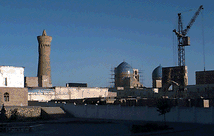 A canal runs down Bukharas main street, carrying with it both life and death – much needed water which in the past has carried many diseases. We turn a corner and see an entrance through a large wooden gate. This leads into a barely lit courtyard and on a board above a chaikana table hangs a dazzling array of Central Asian instruments – tanburs, tars, satos and doiras (frame drums). I am in the market for a frame drum and these look particularly well made and playable. The maker of the instruments takes me to his workshop hidden behind some trees. A small room is filled with half finished instruments. Drying animal skins and the smell of freshly cut timber give the impression that here is a professional craftsman. Newspaper cuttings show him and some musical diginitaries smiling to camera. Paul meanwhile is attempting to see if any of the local players have heard of a vocal technique for articulating the rhythms or ‘usul’ of frame drums, similar to that used in India. Sadly they all look bemused, another preconception shattered. After a short session playing with the locals, I am interested in purchasing one of the drums. I am told it costs $150, this is definitely too high as I know $75 is a good price and tell them I will return in a few days. It is too late for a long drawn out haggle session, anyway who’s gonna carry all this stuff! As we wind our way back, the wind whistles around the small ‘venetian-like’ streets, curtains are sucked out of windows and bats play in the tungsten streams of light. This is going to be interesting.
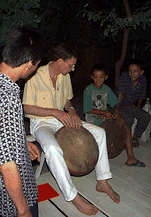 On my return to the B&B there seems to have been some confusion, there is no room at the inn. Tonight I sleep outside.
“When you sleep in a house your thoughts are as high as the ceiling, when you sleep outside they are as high as the stars” (Bedouin proverb)
Tomorrow join me as we meet Ari, a player of the Kashgar Rebab. We are told he is the last of his kind.
-
You are currently browsing the archives for the Daily Blog category.