Archive for category Daily Blog
Day 30 – we try and make sense of our world Pt II
Posted by Musical Nomad in Daily Blog on August 27, 1997
Whats new – Nomad Mixer
This afternoon we were visited by Saparbek Kasmambetov, one of Kyrgyztan’s few manas epic singers. Besides being an esteemed musician Saparbek is also a well known journalist. The parallels between journalistic ‘storytelling’ and the role of the storyteller/musician had already struck us when we met Shoberdy the bakshy singer.
Saparbek sang us some excerpts from the stories. The first is about two heroes. One Kyrgyz, Almanbet Chubak and a Chinese giant named Makeldur . They fight an epic battle in the mountains until Almanbet eventually traps the giant between two mountains and hits him on the head. The head is then displayed in a large bag next to a large pile of stones to demonstrate it’s size. Even without knowing much about Kyrgyz-Chinese relations the symbolism seems clear. We also heard a song about Saparbek’s travels to London. A trip which he recalls with affection. This he described as an improvisation – an elaboration on an existing structure but using contemporary events. Even without understanding the meaning of the words this is a very expressive medium for story-telling. Saparbek uses dramatic hand gestures and a kind of rhythmic chanting which draws the listener into the story. Even out of context it is possible to imagine the effect of this style of performance stretching over twelve or more hours – a kind of hypnotic state could be induced, or at least a heightened receptivity.
The manas epic is a story cycle which takes up to thirteen days to perform. Understandably this is a rare occurrence these days. Consisting of a series of legendary stories it often contains philosophical themes and historical references. It has been passed on orally from father to son for generations. Saparbek, an exception to this rule, ‘learnt it naturally’ and described how it is necessary to have a talent for manas – given by God. It is a huge task to learn all the stories and Saparbek is one of only two ‘manaschi’ who can improvise upon the themes of all the stories. Supposedly the first epics were composed in the 4th century but written references to them (in Arabic) only appear from the 8th century.
The contexts in which manas may be performed include: weddings, funerals and public occasions. It has come to represent a link to the past. A contemporary cultural icon which connects Kyrgyz people to an older way of life. The nomadic culture was non-literate it is therefore only through oral traditions that children learn about the past.
Day 0 raised many issues. ‘Through the telling of stories we try and make sense of our world’. The stories and songs of the three countries we have visited have a purpose. They tell of suffering, joy and of a long, rich past. The songs have a reason for existence and they are alive here. We have met performers who have developed in an oral tradition. A tradition where songs are passed down naturally to each subsequent generation. Like seeds, they grow and flourish if the environment supports them. Music survives through those willing to nurture and spread those seeds – Musical Nomads?
Kyrgyzstan has changed rapidly – according to Gulnaz, the Russians did not arrive until the 19th century. In this short space of time the majority of the population has become settled. Gulnaz works with Information Technology and is thoroughly at home on the internet. This is a hugely accelerated pace of change.
Gulnaz epitomizes what it means to be a citizen of Central Asia. Her family are Kyrgyz, but raised in Russian part of town she attended a Russian school. Her first language is Russian but she understands both Kazak and Uzbek. Her husbands language is also Russian but he speaks no Kyrygz. As they live in Kyrgyzstan she regularly interprets for him.
Gulnaz is a modern woman. She loves pop music especially ‘A-Studio’, Kyrgyzstan’s most popular band. Though she dances until dawn at local discotheques, Gulnaz became fascinated with our project and listened with rapt attention to our unaccompanied folk singers and virtuoso komuz players. A new career beckoned as Gulnaz became an enthusiastic clapper loader – putting the synchronization slates on the front of our recordings (take one etc.). Today Gulnaz leaves us and we shall remember her affectionately as ‘giggling
Tomorrow we return to Kazakstan, older perhaps wiser and certainly overwhelmed by the richness of culture that remains in Central Asia.
The journey has come full circle.
In the mountains near Almaty will we find a resolution?
Have there been any lessons learned?
Did the music and way of life of the people hold any answers?
Perhaps we will meet more musicians in the mountains who are not as settled and who have other perspectives to offer. It’s a long way from over yet, stick around for surprises to come.
Day 29 – Home Cooking on the Road to Issyk-Kul
Posted by Musical Nomad in Daily Blog on August 26, 1997
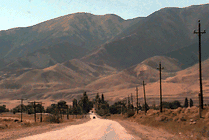 My journey covers over 3500 miles mostly by road. Today I set out for Lake Issyk-Kul, a resort area famous for its mineral rich water. I am told the road is bad. Nomadmobile 2 has left us and I anxiously wait to see how much further we can descend into highway hell. With trepidation I look-out from our apartment and behold an apparition. A brand new Chevrolet Winnebago mobile home – it even has a fridge! The only problem is our ton of satellite equipment – this is precariously balanced in a plywood bulkhead over my head. One bump too many and I’m an ex-Nomad.

On the way to Balykchy to meet our musician Saparbek Kasmambetov we stopped off for a visit at Barchagul’s house (the mother-in-law of Gulnaz our interpreter). I always enjoy visiting local houses as it gives the truest insight into the way of life. Barchagul invited us in for chai, which turned out to be chai, bread, chips, jam, yogurt, bread etc. We should have guessed by now.
Barchagul is a special lady. Besides being a doctor she lives in a typical rural house and keeps sheep, chickens, rabbits as well as growing fruit and veg. 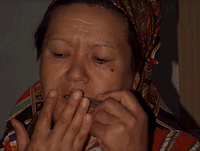 The gardens are full of produce and conserves and pickles were being made in readiness for the winter. No doubt the family work very hard but it is an enviable life. All the food is fresh, the bread homemade and the milk straight from the cow. Barchagul played us her jaws harp (Krygyz call these temir ooz komuz). The jaws harp was kept in a beautiful wooden box handmade by her husband. As we left their house laden with apples and pickles, Barchagul presented the instrument to Kathrin, saying ‘it’s a women’s instrument’. Once again the hospitality overwhelms us.
I am soon engulfed in beautiful precipitous mountains, blue and snow capped. To the left a desert town
 Tashblak – ‘the land of stones’, to my right a motorway services with a difference. Joe’s Yurt Cafe is a surreal mix – fizzy American cola and traditional chai both served in a bozui (Krygyz Yurt literally meaning ‘white house’). The waitresses are dressed for a Manhattan disco and outside a stuffed Ibex succumbs to the moths.
I’m due to meet the musician Saparbek but on arrival in Balykchy, I receive the sad news that he unexpectedly had to go to hospital in Biskek. His son tells me it is not too serious and I will see him in Biskek tomorrow – all part of life’s rich tapestry.
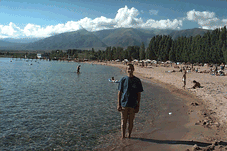
Instead I sample Lake Iyssk-Kul – it’s wonderfully relaxing swimming surrounded by Alpine-like peaks. When I emerge I experience a bout of the shivers – apparently this is normal – a lady from one of the bozui gives me some free chai and a blanket and I soon recover.
Tomorrow back to Biskek in the imperial Nomadmobile and the wonderful music of Kasmabetov.
Day 28 – Even the Wind Sings
Posted by Musical Nomad in Daily Blog on August 25, 1997
 On our journey through Uzbekistan we came into contact with a vast array of instruments. There were the lutes, Shoberdy’s dombra, Ari’s rubab, Abdurahim’s dutar and Mussafar’s tar to name but a few. The doira (frame drum) featured heavily in Fergana music and the gidchak (lap violin) in Bukharan maqam music. We also saw many other instruments in Samarkand such as the chang, trumpets, nais and surnais.
Traditional musical instruments in Kyrgyzstan do not seem at first glance to be as varied as in Uzbekistan. The key instruments here are the komuz (a 3 stringed plucked dombra, tuned tonic, fifth, tonic) and the kyl-kyiak (the bowed two string lap viol we first saw in Almaty on day 4). The one ‘som’ note (Kyrgyz currency) proudly displays both instruments, symbols of national identity. This identity was also evident in independence day rehearsals. Around the Lenin monument today, hundreds of children gathered in the midday sun. Dressed in bright sequined costumes and playing state issue komuz’s they practiced their routines. The sound was both inspiring and disturbing –
 where is the individualism? In the West we expect at a young age to have a choice of musical instruments. Not surprisingly the cello-like kyl-kyiak is not present in today’s celebrations, it would be a nightmare to play, marching across city squares.
As this is a nomadic country there’s also a prevalence of rural, ‘shepherd’ instruments, some of which have been largely forgotten. Used almost as an accompaniment to nature rather than recital instruments, these include end blown flutes, jaws harps and side blown flutes – we find similar selections in other mountainous countries such as South America. In Biskek we are lucky to be guided by the multi-instrumentalist, Kurmangazy who introduces us to his collection.
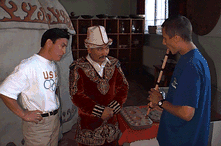 Kurmangazy and his friend and colleague Barkut Shatenov, play a huge variety of instruments, we only had time to see a few today. They performed in front of a large burzoi (yurt) in Biskek University, Department of Archaeology. In Central Asia it is possible to study the ‘national’ instruments in the conservatories. Barkut is a graduate of the conservatoire specialising in komuz and kyl-kyiak. He has considerable presence and mastery of his instruments and we later learned that he is a member of Krygyzstan’s foremost traditional music ensemble.
I asked Barkut about the melodies he played for us and he replied that some went back to the 18th Century. Whether this is part of a continuous older tradition or whether it has been ‘revived’ is hard to say. It is clear that professional players, here in Biskek are concert hall performers who
 dress in national costume and may not have much first-hand experience of the original rural music. Both Barkut and Kurmangazy talked about visiting old, rural musicians to research their music. Kurmangazy asserts that to really understand his music it should be listened to in a rural setting where birdsong and the wind can be heard. Kurmangazy is trained as a classical flautist but he feels that since independence more people are interested in their national culture. He has adapted his classical technique to play a variety of wind instruments, some of which he has made himself. He is likely to produce unnerving vocal sounds at any time and there is a feeling that his sound world is inspired by nature. He plays mainly his own compositions and improvisations with titles such as ‘Conversations with Birds’, ‘Sailor’s Song’ and ‘Children’s Song’.
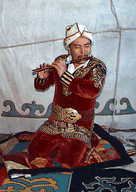 It seems to be a feature of Kyrgyz and Kazak music that musicians will take a sound or rhythm that occurs naturally and translate it onto their instruments. By a process of alchemy this turns into something very poetic. A good example of this is Barkut’s performance of ‘Paravoz’ or train which the composer O. Tumanov, wrote in 1932 after hearing the first train in Kyrgyzstan. There are pieces based on galloping horses and waterfalls. Perhaps urbanisation has had a more disastrous effect on the music than we can comprehend. It is only through the efforts of a few musicians that the music survives in the cities.
The orientation towards nature, dimly perceptible through the din of modern urban culture may also be the reason why Islam never caught on. The Uzbeks already had a strong, settled urban culture before Islam (a very urban religion). The Kazaks and Kyrgyz were still fierce nomads. In the summer many contemporary city dwellers still head for the countryside to live in a burzoi for a month or two and relive their nomadic past.Deeply impressed by yesterdays parade of hats I’m off to buy my own at the Zum department store. I travel by Taxi – which is just another Lada with a light on top. I journey an epic 200 yards before grinding to a halt, we are out of petrol. Quick as a flash our friendly host Djik pulls out a syphon tube and a bucket, and we share petrol. All part of the rich “Central Asia Experience”.
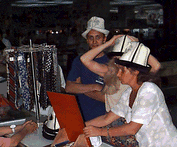
Zum isn’t so much a department store as a bazaar with tickets. Like the infamous Gum store in Moscow you can’t spend money. You choose your item, show it to the assistant, get a ticket, go to a seperate money booth, pay, get another ticket, go back to where you started, and maybe get your item, though by now the assistant has probably forgotten who you are! I bought a hat and a tube of Fanta flavoured toothpaste. There are three sales floors with hats for sale on each – all at different prices! You can go up in the escalator but not down – once you’ve purchased you don’t deserve an escalator.
Each bizarre bazaar sells a variety of products, typically hats, bras, whips and toothpaste. The ramshackle atmosphere is quaint, like Littlewoods in the 50’s (for our British licence fee payers) or maybe the present New York Woolworths for all you colonials. My hat is brill – I will wear it at all forthcoming gigs.
Tomorrow we travel out into the Kyrgyz countryside to Lake Issyk-Kul and meet one of the last surviving rural musicians. Join us.
Day 27 – Two Weddings and a Satellite
Posted by Musical Nomad in Daily Blog on August 24, 1997
 We have set up the satellite in many strange places – it is surprising the number of times we have managed to get a clear view of the Indian Ocean receiver without venturing beyond the nearest road. Sadly there have been too many times when mountains, trees or Soviet apartment blocks have got in the way. Today we had to go somewhere. In a children’s playground in the suburbs of Biskek, Kyrgyzstan, English Nomads could be seen setting up a bizarre array of equipment – morning entertainment for the youngsters. The sound of a motor generator and sight of a ‘sputnik’ in the middle of their playground was too much to resist. After some confused policemen had left us a throng of children gathered and cheered us on as we connected to the world. No big flashing lights or music just Gary saying ‘great – another one off’. We asked them to return at 10 PM for part two.
 I had the opportunity to spend a late Sunday afternoon walking through Biskek with our new Kyrgyz translator Gulnaz Abdrahmanova. It has been 42 degrees for the last few weeks. Now, after a sudden rain, the weather is typically British and a welcome change for the team. One of the first things that strikes me is the people – they are, like in Almaty, dressed in ‘modern’ clothes, very different from the traditional Muslims of the Fergana Valley of two days ago. The city itself is wide, open and filled with Soviet style buildings and monuments. As we walked through Dubovy park filled with decaying carvings, Gulnaz explained how Biskek had bought up many Russian artifacts from other ex-Soviet countries – they were quite keen to pass them on! Biskek is the most ‘Russian’ city we have visited. It is the only ex-CIS city with a statue of Lenin still dominating it’s main square. It is difficult to know how most of the city react to these relics. Will Lenin last much longer? The people do seem proud of some of thier monuments, especially Urkuya Saliyevas a reformer from Osh who led the Kyrgyz female movement after the revolution.

Along the main street there is the familiar mix of subway markets, karaoke cafes and photographer stalls. There are eccentric props used by the photographers including large white gorillas, dead birds in a palm trees and broken down cars. One street stall that caused the team much surprise was an evil spirit removal and fortune telling service. A man in jeans and green shirt waved his arms and hissed Shaman-like chants around each customer. A queue of women sat in the open as each were treated in turn. Our presence caused some embarrassment but we were told this service is very much in demand. Gulnaz’s husband goes once a year and she told me how valuable it was to him. I found it so strange to see this kind of thing performed so openly and I thought how much it differed from our meeting with Shaykh Kushkarov on day 20.
The musician, Kurmangazy Aiylchievich who we are going to meet tomorrow, is larger than life. There is something about him that reminds me of Shoberdy – the Baysun Bakshy [see Day16]. He is a wild, flamboyant virtuosic vodka drinker. Unlike Shoberdy he talks extravagantly about musical healing, Shamans and holistic principles but also plays popular hits at public functions.

By reputation Kurmangazy is Kyrgyzstan’s top musician. I’ve been invited by Kurmangazy to a special location. A double celebration of a 70th birthday and a 50th wedding anniversary. As I climb the staircase of the ‘Kyrgyz National Restaurant’, I’m immediately struck by a sea of hats – the white Alpine-like national hat of the Kyrgyz nomads. The old women all wear head scarves softening their sun-gold faces, few smile, their heads filled with memories?
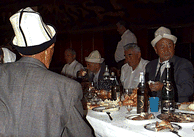
The details vary but I’m sure these occasions have common ground the world over. Solemn vodka laced speeches about ‘fifty happy years,’ on a stage decorated with bouquets and fruit. Children reluctantly pushed to the front, perform party pieces – this time on the national instrument, the komuz. A special delicacy is presented to table – today it’s horse meat – another nomad symbol? Perhaps amongst the gossip there is nostalgia for a Soviet era of greater prosperity and a more certain infrastructure. Nostalgia tempered now by an influx of jobs in fizzy soft drink factories and the fluorescent appeal of catalogue fashions – it’s Sunday and everybody looks their best. In the key of slightly Eb auntie Flo will sing a song: ‘Her mother should know’ – the band struggles to follow.
 Special occasions need special music and Kurmangazy seemed happy to provide the crowd-pleasers. To European ears his band is a bizarre cocktail of popular Kyrgyz melodies, South American music, Jazz and Classical pops. His band are all accomplished conservatoire-trained musicians and appear very relaxed.
 Kurmangazy fronts the band with a frantic energy, swapping frequently between his many wind instruments. The band’s funked-up versions of everything receive a somewhat cool response from the audience of over 50s. The medley of ‘Classic’ hits which Kurmangazy dedicated to us included snippets of Bach, Mozart and Paganini, all arranged in a ‘hooked-on-Classics’ style with a synthesised back-beat. He invited us to attend a healing session he will conduct at midnight!
Once again the team have to extricate themselves from a tricky situation. We are invited to stay and drink endless vodkas and eat horse with the band. Horse intestines are a local delicacy and it testifies to the wealth of the host that it was in plentiful supply. We were told each horse makes four plates of ‘delicacy’ and costs about 1500 USD. We decide to sneak off and send you this transmission.
 Emerging into the street we encounter a traditional wedding in full flight. Two surnai (shawm) players and a drummer play spiralling polyrhythmic music that makes you want to dance. The bride, groom and entourage arrive and a circle dance starts up in the street. Money is pushed into the hands of the dancers. There is a strong link here with the music of Turkey (the Kyrgyz people are a Turkic people) but the surnai is also very similar to the ghaita of Morocco. In France there is a similar double-reed instrument, the bombard. The double headed drum exists worldwide and in France it is known as the tabor. These connections must be well documented, but to see it in real life gives a startling sense of the cultural overlap between Europe and Asia.
Tomorrow we meet the extraordinary Kurmangazy again and hope to discover more about both his music and his research into ancient Kyrgyz culture.
Day 26 – Vultures Circle Looking for Musical Nomads?
Posted by Musical Nomad in Daily Blog on August 23, 1997
 As I write this at 9 pm Krygz time we are driving precariously close to a deep ravine carrying the Naryn river. We work our way up to the top of the Ala-Bel pass at 3184 metres. The road is rocky, slow and the team and equipment are being thrown around. It begins to rain. I have no idea if this report will reach you – will the satellite survive? We have a second pass to come, the Tor-Ashuu at 3600 metres when from the top in the dark, we will attempt to erect the satellite and send you today’s experience.
Last night we said to say Good bye to Bahadir, his son Alisher and Matluba.
 Having crossed the border with us to Osh, they turned round and headed back to Uzbekistan. Nuts. bread and chai for supper, (Uzbek food) 6 hours sleep and back on the road in a much older Russian built Nomad mobile. Out two drivers are friendly and helpful but we have been on the road for 17 days with Bahadir and his gruff manner has grown on us.
As the mountains close around us, the valley is the greenest so far. Agriculture stretches to the horizon, orchards and fields of sweetcorn. The view is occasionally blighted by early 20th century industrial ‘daymares.’ Vultures circle looking for musical nomads without water? We stocked up in Osh – is it enough for 16 hours? Nomadmobile 1 couldn’t travel into Kyrgyztsan – farewell to air-conditioning and the whiff of leaking petrol. Nomadmobile 2 has all the comfort necessary for a quick trip to the seaside on a cool Easter day in England.
 This is Central Asia in August, the seats grind your bum and you sweat a pound for every mile.
Three time zones in one hour, as we cross briefly back into Uzbekistan and then back again into Kyrgyzstan. Even on the foothills of the mountains dreary Soviet style apartment blocks spring up like bloated fungus. The foothills remind me of Llangollen, Wales – without loo paper!
 Kyrgyzstan is different. It is difficult to judge a country by its ‘truck’ stops and small apartments. There is a feeling in the air that these are people who like to move. The Kyrgz in the cities give you a feeling they are frustrated nomads. Kyrgyzstan has a more improvised feel to it. Buildings appear to be placed randomly, the road from Osh to Bishkek appears as a major artery on our map but is often no more than a mountain track. We are not complaining, this is the nomad life… or just mad life..
 The country is vertical. The Soviet’s in their grand scheme obviously realised the enormous potential for damming key valleys and turning the region into a large electricity producer. One of Kyrgyzstan’s biggest exports is electricity. This policy has had some catastrophic effects, there are electric pylons everywhere and subsidiary industries have taken root in areas of great scenic beauty. There are though some positive effects. Traveling through sandy, dry hillscapes for five hours it comes as a magnificent and beautiful surprise to see deep gorges carrying cool turquoise water to large reservoirs. One of the most impressive is lake Toktogul. We turn a hairpin bend and it appears like a mirage, a large blue, mirror ‘sea’ stretching from horizon to horizon. If it were set to music it would be the timpani roll leading to a perfect orhestral cadence.
 We met some interesting characters enroute. One chap at a roadside chaikhana had a motorcycle. He was travelling the same route and was proud of the sheep he had killed for the seat on his bike. He then made an offer of four sheep for Kathrin, Gary suggested twenty dollars intead.
Close to the tea house on a long ridge stands a Burial area. A series of both enclosed and open mounds sit silent as a warm wind whistles. In the distance Lake Toktogul shimmers blue in the afternoon haze. The grave enclosures vary from cathedral-like structures to brick ‘yurts.’ Some even have yurt shaped metal frames, inside a simple mound of earth marks the spot. At the front of the ridge a body, simply wrapped in Muslin leaves an eerie and lasting impression.
It slowly goes dark. We have mountains to climb. Waterfalls and Yurts fade into the steep slopes. Its been a gruelling 18 trek. It’s 4 in the morning and we have just arrived in Biskek – sorry for the late transmission, goodnight. Tomorrow the capital Biskek and best music Krygyzstan can offer.
Day 25 – The Pulse of the Maternal Heart
Posted by Musical Nomad in Daily Blog on August 22, 1997
 There are few female drummers, Evelyn Glennie takes on a male world almost alone. I can’t ever remember seeing female drummers in Africa. For the last couple of days we have been entertained by five women doira players from Kokand. There’s something about the pulse, the heartbeat of the drum that seems close to the maternal spirit, why are there not more female drummers? Rakhimahon Mazokhidova lives her life to a strong rhythm, our interpreter Matluba described her as an entrepreneur worthy of support from BWAK (see day 23). When we met Rakhimahon again in the courtyard of her home, surrounded by children and wild birds, she suggested she sang us a lullaby. No drums just a dignified grandmother singing to an imagined child as many of her real charges now formed an adult audience. I sat spellbound by this charismatic Uzbek star.
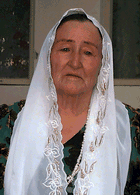 As long as mothers sing to children there’s hope for this world, I hope her many pupils take up this complement to the rattling doira.
We set out on an early morning journey from Kokand to Andijan across the valley to track down a lady called Malika Askarova. She had been recommended to us by our music advisor Dr. Razia Sultanova who was born in the area. We had limited time to find her – with a deadline to get across the border into Kyrgyzstan. Our driver Bahadir took the quest into his own hands. At first we did not mind this, it was his last day with us. He thought the town we were looking for was near Fergana. He then repeated a similar pattern of question, answer, drive: 1 Screech to a halt next to someone who looks ‘intelligent’ 2 Shout politely at them for directions to a village they have never heard of. 3 Go whichever way they suggest and finally 4 At the very next junction, usually 3 minutes later, repeat the loop. After two hours of this we had had enough and gave up. By mistake we found ourselves at the village of Durtor. One feature aroused the curiousity of the team. A circular, mud encased building stood bizarrely in the centre of the square. Balanced on top of this hollow mound was a tree complete with roots, precariously balanced. Strangest of all were the carvings on the top – three swan/dragon-like creatures all in motion, facing the same way. I walked inside and saw Arabic inscriptions carved deep into the ceiling, ‘Allah Askadu’ (Allah is Unique). The locals didn’t know the building’s real purpose but said it had been built during the last war, though it looked pretty new.
A man stood quietly next to a roundabout “Do you know the town Durdur”, “Yes” he replied and continued knowingly, “I know Malika, she’s my neighbour. I’ll take you there”. Later he said Allah had placed him there so he could take us to her. Who knows?
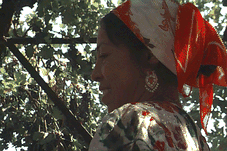 Malika Askarova looks in her forties. She has an expressive and beautiful face which smiles easily. She’s naturally a humble person and could not believe for sometime that we had come to see her. Before long the Uzbek hospitality was bringing us all together and friends and family were gathering to see what was going on. We must have seemed like aliens suddenly arriving out of nowhere in our shiny ‘Nomadmobile’ full of equipment.
 Malika is an Otin-Oy or female Sufi. She reads Arabic and studies the ‘old books’ including the works of Ahmad Yasavi – see day 20. She’s called upon for occasions such as weddings and funerals and reads from these old texts in a strong and beautiful voice. She also composes her own songs. When we asked what they were about she explained that she had often been alone in her life, losing her husband when still young. These songs she sang ‘from her heart’ about her life. Malika takes several minutes to prepare herself before singing. Even without understanding the words we could tell they were delivered with considerable emotional force, several of the women present were moved to tears.
We played some recordings to the gathering, Shaykh Kuskarov?s mantra and the Zikr from Kokand. The mantra aroused some curiosity but didn’t seem familiar, however the Zikr induced nods and smiles of recognition. We were told that Malika also performs this Zikr. She became interested in spiritual matters when she was fourteen. Her spiritual mentor was an old woman from the village who also taught her Arabic. Malika’s role is similar to the Kokand women that we met recently. Even though our meeting came about in a strange and unexpected way it seemed quite natural. She has an openness about her that makes you feel welcome and we were all sad to leave.
As the sun slowly falls behind the approaching peaks, we head across the border to Osh.
Tomorrow a mammoth 15 hour journey across Kyrgyzstan to Biskek. We will send a report en-route
Day 24 – The Elusive Shaman
Posted by Musical Nomad in Daily Blog on August 21, 1997
The shaman elludes us. Sadly she was busy at a funeral. Luckily we were introduced to Uzbekistan’s finest folk singer, Rakhimahon. More later.When we arrive at Rakhimahon’s spacy and elaborate house, food and tea is already on the table. We are immediately shown a video of her many performances on TV and video. This is surprisingly well made for a ‘State film’. Rakhimahon Mazokhidova sings and plays doira. She is the most celebrated folk singer in the country and she could perform at weddings every day if she had the time. She is also the teacher of the two musicians we met yesterday.
 As we begin to settle, Rakhimahon is called to perform at a nearby wedding. We are suddenly at another table loaded with food and drink, surrounded by a large crowd of women. Apparently they have gathered (in the groom’s house) to witness the bride’s unveiling. Here the newly married woman opens her veil after a chilla – the bride and groom are locked in a room for three days, are not allowed to receive any visitors and are treated like Royalty. The air is filled with expectancy when a door opens and the bride enters the scene. Rakhimahon is slowly beating her doira and begins to chant a wedding song.
 Two girls are leading the bride to the female crowd, they dance in wave-like motion as they slowly move forward. The bride lifts her white-golden veil and disappears into another room. Rakhimahon now plays a faster rhythm. In front of her several women perform a wild dance twisting their feet and arms in animal-like motion. At 68, Rakhimahon still has a lot of energy and bewitches the listener with her charm. The ceremony finishes with Rakhimahon chanting a short prayer.
While we have chai with the host, Kathrin disappears to join the women’s gathering inside the house. Being male I could not enter so Kathrin relates her experience; I find myself sitting cross-legged surrounded by a circle of women in traditional dress. They all wore head scarves in a diverse range of colours. Richly decorated tables overflowed with plov, exotic fruit, strange sweets and drinks. They looked at me with great curiosity and a wonderful openness – it didn’t take long to connect. I am invited to join them for food and prayers. Magical sounds fill the air. The voice belongs to a female Koran reader who is chanting a sura, now the ‘party’ can begin.
Suddenly it’s time for us to leave. We have to get back to Rakhimahon’s house where we are expected by her friends and entourage.
After eating yet another meal back at Rakhimahon’s house we were invited into another part of the house, and told to bring our cameras. Rakhimahon wanted to show us something. Inside a small room were several women wearing white headscarfs. They started to intone a sura from the Koran as soon as we were seated. The recitation is punctuated at intervals by the receiving of blessings (or baraka) from God. This gesture, a cupping of the hands which are then passed over the face soon becomes second nature here in Central Asia. It is performed at various times during the day particularly at meal times. On this occasion the recitation grew in intensity until several of the women began to sway and move their hands rhythmically. This turned into chanting of syllables such as “hai” and “hu” and I realised I was witnessing a Zikr. Zikr is an Arabic word meaning remembrance and there are two main kinds; loud and silent. It consists of the repetition of words or syllables and is used by the various Sufi orders to establish a connection with God.
 The chanting was becoming more rhythmic and the women stood up and began to move more vigorously. I sensed that none of the Nomad team were expecting this and this is quite disturbing when it happens so suddenly. Rakhimahon, our host, was becoming physically affected by the experience and she began to cry. It was one of those moments when you feel you ought not to be there let alone with two video and three still cameras. We had most definitely been invited to record this. Before we knew it the atmosphere changed abruptly, the tempo relaxed, smiles flashed, drums were brought in and all tension vanished. There was dancing and celebration. Kathy’s dancing being the cause of much mirth, her hip gyrations were possibly out of context – later though we noticed it had caught on with the younger women. Each of us was presented with a silk scarf which was tied around our waist. We sat down and drank chai. Still shell shocked from our experience I could tell from the uncomprehending looks passing across the room that events had once more taken an unexpected turn. We had witnessed a ceremony normally performed at a funeral.
 These women are hereditary singers who are trained to learn the Koran from a very young age. I suspect that they undergo other kinds of spiritual training as well, but this is difficult to substantiate. We were told that this is first time this had been shown to anyone and certainly the first time it had been recorded. Exactly why it was shown to us remains a mystery.
 If you ever come to Uzbekistan you need a hat. Small square and black, decorated with a motif that will mark you out – there’s a Fergana motif and a Tashkent motif, a Samarkand motif and a Baysun motif – people know you by your hat – there’s probably one for Peckham. The hats are mostly worn by the older men. These ‘white beards’ (a translation from the Uzbek words) are the custodians of wisdom and sit for hours sipping chai (green tea) in chaikhanas – mostly humble areas of shade beneath a clump of trees. Today I sit in a very grand chaikana, decorated with carved pillars and a multicoloured ceiling. A ‘Ghengis Khan’ lookalike sits in the corner discussing ancient battles his boots carry the mud of the Mongolian steppes.
 In the nearby market a woman sits chewing Kokand rock – not the seaside candy variety but serious bits of geology – she tells me it’s good for the blood and circulation – she sells it by the kilo.
With my hat I make many friends, people shake hands in the street I am a local, I wear the Kokand hat.
I came across a stall selling wooden toys. I approached and was greeted ‘asalam aleikum’, peace upon you. Behind the stall the young stall holder had an Afghan Rubab lying on a bed. I pointed to it and he seemed surprised that I recognised it. Suddenly I was in his ‘shop’ drinking chai, being treated like a VIP. Olim played the rubab, luckily I had my penny whistle to return the favour. This seemed too much for him and he immediately started looking through his stock of decorative knives to find the best one to give me. He examined each blade for straightness and sharpness and spent several minutes find the best sheath to fit it. It was then presented to me as a gift. he absolutely refused any payment. The only thing I had to give him in return were my sunglasses, cheap ones, but he seemed pleased. We exchanged addresses and felt like lifelong friends.
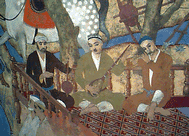 This tradition of hospitality to strangers is extraordinary – Kathrin was showered with gifts of spices just for being in the market. People want to give you everything. This is an extraordinary feeling for a Londoner. In the chaikhana today they didn’t want to take payment for our tea. It’s no good explaining that we can afford to pay 20 pence for seven people to drink tea and eat bread. Admittedly this is Kokand and tourism is not big here. In some ways I hope it stays that way. In Samarkand and Bukhara where tourism is more developed the people are friendlier than most but they have learnt to handle tourists. If one measures civilisation by warmth of character, grace and humour, then we’ve got a lot to learn from the folks in Uzbekistan.
Tomorrow we go to a new land, Kyrgyzstan. On the way we plan to finally meet an Otin-Oy, a female Sufi singer. Join me
Day 23 – Everyone’s free in Uzbekistan to live however they want
Posted by Musical Nomad in Daily Blog on August 20, 1997
“Everyone’s free in Uzbekistan to live however they want” Matluba, Kokand
 In pre-Soviet times Kokand was a major capital. It is now a small industrial town in the Fergana Valley. The main industry is still textiles, though over 50 percent of the population depend for their living on casual labour or working the local market. It is a familiar mix of Soviet apartment blocks, older Uzbek architecture and the grandiose statues and fountains celebrating the first Bolshevik leaders. The atmosphere is of calm tolerance with traditional Muslim lifestyles coexisting alongside modern aspirations and styles of dress.
As we drive through Muqimi park, Kokand’s recreation space I witness a disconcerting array of sights. An Uzbekistan Airways jet languishes in the trees, a steam engine resides on a disused circular railway and next to the swings, a palace, the ‘Palace of the Last King’. This structure sits uneasily with its eccentric neighbours. A ramp leads up to one of several decorative courtyards, wooden pillars support primary coloured patterned ceilings.
 Completed in 1873 and destroyed soon after by invading tzarist troops, the Palace was converted into a Museum in 1925. The remaining rooms and courtyards now host local history curios. Two original wooden gates from the walls that previously surrounded the city alongside musical instruments imprisoned behind glass. The display included a kobuz (see day 4) possibly evidence of Kokand’s prominent position on the old ‘Silk Road’.
One area that seemed to excite the team was a room full of patterned paintings. These works by Saidakhmad Makhmudov were bright, eye-catching and seemed to echo many of the decoration we had seen before – the walls of the Registan in Samarkand, the ceiling in our Jewish Guest House in Bukhara even the walls of the Museum of Applied Arts in Tashkent. These were fabulous designs and Gary took some stills which can be viewed on a separate page.
 Local TV director Burkhon Shermatov arranged a meeting for us with Kursanoi Kodirova and Muborakhon Akramova. In a courtyard in the Palace they performed some Uzbek folk songs. Singing and playing doira, their songs mostly concern courtship and marriage. The traditional Uzbek wedding consists of three parts: Erkak Ash, a morning ceremony for men during which male musicians play, Khotin Ash an afternoon ceremony for women and Toy, an evening celebration for everyone. Kursanoi and Muborakhon usually perform in the afternoon and evening. One of the songs they sang for us was a standard of the repertoire called Yor Yor. It is sung as the tearful bride leaves her parents’ house for her new home. Legend has it that the prophet Muhammad once saw women taking a bride to be married and asked them where they were going. They said they were going to a wedding.
 The prophet then declared that everyone should be notified of weddings using a special song. Fatima, Muhammad’s wife, is supposed to have handed down this song which is still sung, over one thousand years later.Besides singing at weddings, Kursanoi and Muborakhon also perform in concert halls and at state events. They were recently awarded third prize at an international festival in Turkey. Their singing and dancing is direct and unfussy with an immediacy and humour that seems appropriate for weddings. Their manner is charming and engaging and it is easy to see, even out of context, why they are the most famous singers (or Yallachi) in the Kokand region.
Whatever may be the popular perception of women’s roles within Islam, it is clear that in this culture women have their own views and modes of expression.
I had the opportunity to talk to Matluba (our present translator) about the position of women in Uzbek society and in particular about the work of the Business Women’s Association of Kokand (BWAK). Matluba presented a very positive view of the way things are progressing. The BWAK is a non governmental organisation which gives advice and training to women wanting to work in both private and governmental sectors. Some of its stated aims are:
– to form an ideology of female business
– to support entrepreneurial initiatives
– to protect the rights of business women
– to improve professional skills.
 According to Matluba more and more women are coming to them for help and she sees the future of Uzbekistan in terms of an open and democratic system. Matluba describes herself as a Muslim, who ‘trusts in God’ and who is trying in her busy life to learn the namaz or prayers. At the same time she sees no reason why she shouldn’t wear modern clothes and make-up. It was extremely refreshing to hear so much optimism from a young person so soon after Independence.
I asked Matluba what she thought of an earlier description of the Fergana valley as being ‘a hotbed of Islamic Militancy’. This seemed totally at odds with her perception of the region. She stressed the extent to which people are increasingly free to live as they wish. Women may follow a traditional way of life or can dress in a modern way and have careers – as long as their families allow them to !
Matluba places a lot of faith in their President, Islam Karimov to take the country further forward into a tolerant and democratic future.
Tomorrow, Ochil Khan – shaman or female Sufi, join us and find out
Day 22 – Angels of Fire, Tashkent to Kokand
Posted by Musical Nomad in Daily Blog on August 19, 1997
 Back on the Silk road. I travel across a mountain pass into the Fergana Valley. This area has been producing silk since the fourth century. It remains a cottage industry despite producing 30 000 metric tonnes per annum. Ironically this is also the most densely populated area in Central Asia and heavily industrialized. From the window of the vehicle I see Dickensian mills churning out black smoke. Cooling towers and open cast mining add to the industrial skyline. Each small town we pass through has its heroic Soviet monuments – arms reaching for the sky, sword wielding soldiers, ‘angels of fire.’
 Each town also has its police checkpoint where the men in red hats peer at us in disbelief and say ‘niet’ quite a lot. Along the road motorists picnic in the petrol queues, this being a rare commodity. As in the Welsh valleys the rather bleak foreground is made worse by the majestic beauty of the surrounding mountains. Roadwork’s delay us for several hours and I eventually arrive in Kokand after dark..
Tourism has not happened yet in Kokand and we find ourselves attracting more curious looks than anywhere we have been so far. We arrived at our accommodation (Soviet style apartment block) somewhat shattered and suffering from the dramatic increase in humidity.
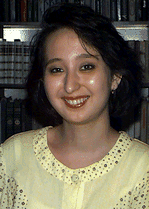 The hospitality is as warm as anywhere but today it seems more difficult to be good company as we are all so tired. Gary has had a 24 hour flu bug, perhaps three weeks of 16 hour days has taken it’s toll. My new guide is Matluba a member of the Business Women Association of Kokand (BWAK), we will be their guests tomorrow night.
Join us over the next three days when we will be meeting Otin-Oy women – female Sufi singers and a Kokand TV Director will be introducing us to some leading musicians in the area.
Day 21 – the person who arrives is not the one who left
Posted by Musical Nomad in Daily Blog on August 18, 1997
Yesterday I found myself reflecting on some words from day 0
‘the person who arrives is not the one who left’.
 This trip has been very intense for me. Meeting so many people, visiting so many places in such a short span. Some ‘moments’ have had a profound effect on me. Day 4, as I encountered the intense Shamanistic music of Raushan and her kobuz. Day 7, hearing Munadjat moved me to tears. Day 11, the quiet reflection of Hoja Ismail al Bukhari?s Tomb. Day 12, the intimacy and humour of a family lunch with ‘the last of his kind’, Ari Babakhanov. Day 13, at last the satellite works and I share my discoveries and invite your questions. Day 16, I meet the wild man of Baysun, Shoberdy Bakshy who dares to dance to a different drum. Yesterday the Sufi Shayk Kushkarov astounded me with his strength of spirit, generosity and wit. The internet site though is the tip of an iceberg.
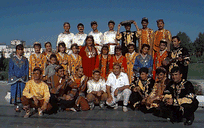 After tracking the Baysun Ensemble several hundred kilometres across Uzbekistan, we finally caught up with them in Tashkent. They assembled in Friendship Square at 3.00 in the afternoon heat. Despite the conditions we managed to catch a brief example of their unique brand of folk music. The Ensemble is large, 45 people including musicians and dancers. We only saw 30 of them today, but I still had the impression of a village collectively telling a story. Baysun itself is renowned for its music [see Day 16] and the
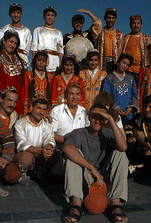 Ensemble have a considerable reputation in Uzbekistan. Established for ten years they have travelled widely, including UK, Turkey, Bulgaria and USA. Their music might be described as folk revival, aiming for a reconstruction of traditional music about everyday life. It is a long way from the Russian inspired ‘folkloric’ groups, and retains something of the simplicity and directness of authentic folk music. Stories and poems are sung and semi-staged. The repertoire is adapted for the concert hall and is very well rehearsed. Its naturalness conceals years of painstaking reconstruction, mostly from oral sources. They now adapt traditional melodies to modern texts.
 I sat down with their manager, Abdunabi Ravshanov and their musical director and flute player, Habib Umarov. After some discussion about the Group’s history and current activities, I asked about the similarities between their music and the music of the Balkans, particularly Bulgaria. This similarity had struck me particularly strongly this afternoon. Habib said that Uzbeks and Bulgars had mixed with Turkic people. I took out my flute and played a Turkish melody. Habib’s face flashed a smile of recognition. Within seconds he was playing along and I was trying to imitate some of his ornamentation and variations. It seems this tune is from Istanbul. We each knew slightly different versions but it was undoubtedly the same melody. It was a strange but hard-warming feeling to be sitting in a Tashkent hotel with a Baysun flute player playing a melody from Istanbul.
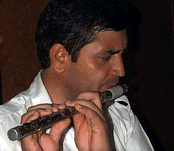 It crossed my mind that because musicians seem to pick up tunes wherever they hear them, the music itself becomes nomadic – it travels. This has always been the case. Habib played ‘What do we do with the drunken sailor?’ to which he knew a strange variation on the words presumably picked up on a tour of the UK. On day 2 Abylai played us an Italian tune, on day 18 the chang player in Samarkand entertained us with Mozart. With my Russian limited to one or two words this is by far the best way to get acquainted.
The journey continues, we turn another corner. The Shaman eludes us, and we still only glimpse real yurts on distant hill sides. 19 more days, tomorrow the Ferghana valley and then onward to Krygyzstan.
-
You are currently browsing the archives for the Daily Blog category.