Archive for August, 1997
Day 14 – To succeed this project must be interactive
Posted by Musical Nomad in Daily Blog on August 11, 1997
 In the same way that a musician craves an audience I must hear from you. I invite you to help produce this exploration into Central Asian music – do you wish to know more about vocal music or instrumental? Are you interested in the related art of dance? Looking back on the previous pages, did we leave any questions unanswered? Are you gaining a clearer picture of this rich culture? Would you like to hear more from any of the featured musicians? – we have up to three recordings of each player. Are we telling you enough about the cultural context? Are you interested in the history, the religion or indeed the politics? We can’t promise all the answers, we will give it our best. Be a director in this bold new medium, I invite you to call the shots.
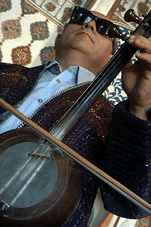
Meeting Ulmas Rasulov, Uzbekistan’s foremost classical ghidjak player, was an unforgettable 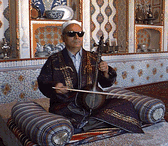 experience. The ghidjak is a spike fiddle and has many similarities to the violin. It has a short neck attached to a gourd shaped soundboard and has a slightly shrill timbre which can only be controlled by very experienced players. Ulmas, who is totally blind, communicates straight from the heart with an incredible openess and honest sensitivity. He has an awareness of the people around him that transcended his lack of sight. He talked to Kathrin and she found it a wonderful surprise to hear that the cello is his favourite European instrument. He suggested she immediately get a cello and play a few duets with him. Ulmas has a great passion for European music, especially Spanish and although the pieces he played were traditional, they exhibited influences far and wide. He played with a deeply felt passion and intensity that touched us all.
 Ulmas told us later that the ghidjak “connects with the heart and soul of the people in Central Asia.” To him this is sacred music, “the music of God”. He feels that together with the sato (another bowed string instrument) and surnai (a reed instrument), the ghidjak comes closest to the human voice. He adds that the voice is the most important ‘instrument’ here and all other instruments aspire to its qualities.”In post-Islamic and pre-revolutionary Transoxania the whole of artistic culture, literature, music and architecture was based on Sufi ideas.”
Alexander Djumaev (Sasha)
 On our travels I’ve had many opportunities to chat to our friend and musical adviser, Dr Alexander Djumaev. Sasha is a leading musicologist and historian who is particularly interested in the relationship between Sufism and culture. He is a mine of information and has been responsible for introducing us to some extraordinary musicians. I too have become extremely interested to discover more about a mystical tradition that has inspired such an extraordinary culture. As part of this quest I felt it would be important to visit the tomb of Bahauddin Naqsband who is a ‘patron saint’ here in Bukhara.
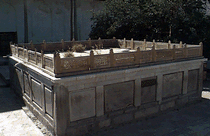
The tomb is now part of a large complex which includes a mosque, an old dervish house, a museum, a cafe, gardens and of course the gnarled old mulberry tree, reputedly planted by Bahauddin himself. Legend has it that wishes will be granted and women made fertile by passing under the tree three times. There is the air of a tourist complex about the place. It is not until you approach the tomb that the intensity of feeling he engenders becomes apparent. A Koran reciter sits under a shady tree, people join him to have suras recited for dead relatives or just to hear them. An elderly gentleman’s voice chokes with emotion as he prays. The pleading and emploring in his voice makes me feel somewhat uncomfortable. It is like witnessing someone’s distress. This is the same yearning that comes across in some of the music we have heard here, especially maqam.People bring their children here and walk three times around the tomb for luck. Women kiss and stroke the old mulberry tree. Whether or not any of those people maintain a practical connection with the Sufi tradition is unclear.
 Long beforethe revolution the Naqsbandi Order travelled to Turkey and India. There are now branches of the order all over the world. It is undergoing a revival, instigated by influences from outside. I do not know if I have discovered anything new
today, but I have gained an insight into the devotion that people here have for this great Sufi teacher.
Tomorrow I go, for the first time, into the mountains near Baysun to seek out a Bakshy and the legendary Baysun Ensemble.
Day 13 – a satellite beams from Bukhara
Posted by Musical Nomad in Daily Blog on August 10, 1997
 Human contact can take many forms. There is contact when you play or hear a piece of music which triggers a primal reaction within. There is contact when you meet someone who, though living a different life to your own, can understand and relate. There is a contact through ‘communications’, be it a simple conversation or a satellite bouncing signals around the world. Today we made contact. Through music, with people of Bukhara and finally, at last with you the audience.
In our wonderful location preparations are underway to turn the already lavish interior into a ‘new’ set for a different musician. Today we meet a gidchak player (traditional lap violin). Video and audio are in record pause and the scene is set for action. We suddenly get the news that the musician has had to ‘do’ a wedding and cannot make today. Our first ‘non-starter’! Simultaneously, a young man who has traveled eighteen hours to be with us walks into ‘The Musical Nomad’ circle. Howard Drake has brought us a new, fully functional portable communications satellite unit – this is the third one and expectations are high. Will the project finally become two way?
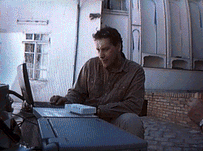 Gary becomes more ecstatic as the levers are pulled and the turbines begin to roll – we feel there is a direct parallel here with the early days of TV, this shaky yet elegant production echoes those early pioneers. Suddenly we get full connection, we are in full contact with the outside world. There is little jumping up and down, it’s too hot for that but a great sense of relief as the music, photographs and writing of the past twelve days are efficiently pumped onto the World Wide Web.
 Something significant is happening in Bukhara. The ancient city takes on a new role. No longer a staging post on the silk road, Bukhara’s main asset in now its magnificent architecture. Everywhere scaffolding is springing up and crumbling fortresses and monuments are acquiring a facelift. People who remember the city in its faded glory fear ‘Bukhara-Disney’ and ‘theme park city’. Personally I am sure it will look magnificent. The Bukhara that celebrates 2500 years is part manufactured but somehow the spirit rings true. What I would like to see is a stronger resistance to Coca Cola culture and cheap diluted europop – both already starting to take over in the otherwise tranquil city square.
Everything moves on and its important that we keep some record of the past. The tools of a musician develop and change with the needs of the music.
 In the local museum I saw some sad old relics of what used to be a gidchak, a tanbur and some 17th century drums. In an unprecedented way the guide allowed us to play one of the drums and again its voice rang out. Living instruments need this, when stuffed and entombed in glass they die – the strings rot and the heads split and they no longer represent the essential vivacity of their function.
The Musical Nomad project fulfills and important function – with every musician we meet we make a state of the art digital audio visual record of their technique, they play at least one whole piece. We hope in this way to make a living record of Central Asian Music now – a real legacy for our grandchildren.
 Its is common in Bukhara to find yourself sitting on a wall or bench to admire a building or chat to locals. I chatted to Mohammed, I asked him whether he knows any musicians in town. “My brothers are musicians”, he said, “they run a music shop”. Not quite believing our luck we followed him to his house in the early evening. After a few minutes walk through the narrow backstreets we entered a simple local house with a characteristic courtyard, reminiscent of an African compound. We greeted Mohammed’s wife, Aisha and their young son of three months old lay asleep on a blanket. Soon their two young daughters aged about three and five arrived home from playing in the streets. We drank tea and Mohammed went to fetch some musical instruments.
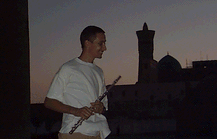
 There is an ease about people in Bukhara. A warmth which shows itself in the small everyday incidents. Bukharans are naturally hospitable and still curious enough about foreigners to stop and chat . It is obvious however that times are harder since independence and some locals are struggling. Encounters with people like Mohammed’s family are precious therefore for getting an insight into how people live. Undoubtedly Mohammed wanted to sell us instruments but he was also pleased to be able to entertain. We chatted to his daughters and when the conversation ran out I played a Hebrew folk song on my flute – the children seemed intrigued and listened intently. Out came the photo album and we saw their wedding snaps and family momentos. We were asked if we had children. Aisha was surprised that only Paul and I did (she was married when she was seventeen and must only be in her early twenties now). Missing my baby son Tal back home in the UK, I picked up their little one and felt him to be a comforting presence there in my lap. These are feelings that translate well wherever you find yourself in the world. Feelings everyone understands.
 Mohammed returned with his instruments and a raucous noise was struck up within seconds. Rubab, doira, surnai and nai. Unfortunately all the instruments were of poor quality and I bought the ney more as a souvenir of the evening than as a useful instrument. Mohammed seemed pleased and we all trooped cheerfully out into the now dark Bukharan backstreets. We said our good-byes, promised them a copy of the photo Gary had taken of the family, and headed back to the guest house.
Tomorrow I meet a musician playing a gidchak, the traditional violin of Uzbekistan. I then go on a pilgrimage to the tomb of a 13th Century mystic, one of my main reasons for coming to Central Asia
Day 12 – Bukhara – holy city. 2500 years of written history, 6000 years of mythology
Posted by Musical Nomad in Daily Blog on August 9, 1997
 I’m lucky to lodge in the old Jewish quarter, a film set fit for Cecil B. De Mille. At each corner architectural delights charm the eye, gold shimmers in the intricate mosaic. My guest house, built in 1908 for a Jewish family, has a wonderful room of Tajik design. The high beam ceiling of plain wood contrasts with the vibrant glory of the richly ornamented walls. Here is the inspiration for William Morris and ‘Art Noveau’, all combined in a glorious synthesis of colour and light. Alcoves richly decorated are adorned further with Chinese bowls and Turkic tea sets. The shuttered windows filter the morning sunlight and silk curtains drift in a Bukharan breeze.
 The centrepiece is a small wooden platform covered with a gold-threaded cloth and cushions coloured to shame a biblical Joseph.Our musician Ari Babakhanov frets his Kashgar rubab and weaves a spell in sound. Outside a rogue shutter crashes but the spell cannot be broken. Emissaries from the ‘Musical Nomad’ silence every window for miles and Ari once more weaves a quiet magic. High on the walls Hebrew script proclaims a faith long at home in Bukhara.
“Persian-speaking Jewish communities seem to have existed in the larger oasis and riverine towns of Transoxiania for over a millennium. Documentation of the origins and early history of these communities is extremely sparse, but legends speak of the importation of skilled Jewish craftsmen from Iran by a succession of Central Asian rulers, beginning with Timur (1338-1405), and a Tashkent based archaeologist has reported on the existence of a Jewish cemetery in Samarkand before Timur’s time.”
Theodore Levin: “The Hundred Thousand Fools of God” (reproduced by permission of the Author, pub. Indiana Univ. Press)
After his marvellous performance Ari invited us to spend some time with his family on the outskirts of ‘modern’ Bukhara. As we pull up outside his flat he steps out to meet us. He has the kind of face that you immediately warm to, with as distinctively Jewish features as I have ever seen, a sun-torn face which speaks volumes. I sense he is a deeply thoughtful man.
Inside his typically styled soviet flat there are faded paintings of Bukhara and ‘colourised’ black and white photographs of his son and daughter. We are welcomed, and meet his wife, daughter and grandchildren. Traditional rugs line the walls and there is a piano, played by his daughter, Susanna. They are a musical dynasty. As we drink tea and chat everyone seems quite at home. He has a ‘deceased’ Bulgarian guitar hung above the TV, a tanbur props up a bookcase and his prize rubab lives in one of the back bedrooms. We “have a go” at playing Ari’s instruments much to his amusement and Paul is instructed to play the antiquated guitar. It needs new strings and an overhaul but Paul struggles manfully on.
 Lunch arrives, it is delicious but unfortunately we cannot do justice to it. Try as we might it just keeps on coming. Whether this is Jewish hospitality or Bukharan we cannot tell but Ari’s wife urges us on with despairing looks and huge portions of everything. The ice, by now seems well and truly broken and Paul’s guitar comes out for another tune. We try to persuade Ari and Susanna to play together but they don’t seem in the mood. Ari, besides being a consummate Shash Maqam artist, also plays Western classical music on his rubab. He likes Spanish and Italian music and wants to make a “World music” CD. As I look around the table at us, the team, Ari’s family, Bahadir (our driver) and Sasha (our musical adviser), I wonder whether we somehow reflect the polyethnic character of the city – Jews, Muslims, Christians and doubters all happily sitting down together.
 We later huddle together in a back bedroom for an intimate discussion. The Bukharan wind whistles through the overground pipes outside singing a discordant melody. Ari seems very relaxed as we talk, occasionally his voice becomes animated, deeper and more powerful when he warms to a question. He tells of his background and of learning the Shash Maqam as a child. Now in his seventies, Ari shows us a medal he gained in Moscow playing at a ‘Soviet Festival for Youth’. He has composed songs still sung today by famous singers in the capital. From the age of twelve he learnt the maqams. He showed us transcriptions (published in 1924) of the maqams notated by the Russian, Uspenski. He is keen to talk about his hereditary tradition and of a past when musicians were held in high esteem. His grandfather, Levi, was a court musician and would play, before the Russian revolution to the Emirs (Uzbek ‘Royalty’) and after 1924 to high ranking Soviet officials. I hear in his rich Russian voice a real sense of longing for the ‘good old days’ when musicians like his grandfather, would play with musicians such as Maarufjon Tashpulatov, Najmiddin Nasriddinov.
“For three generations the Babakhanov family had played a central role in the musical life of Bukhara. Levi Babakhabov (1874-1926) is still revered as one of the greatest of Bukharian singers…”
Theodore Levin “Fools of God”
 The Soviets began to see this music as dangerous along with the movements led by the Mullahs and Sheikhs of the time. Ari’s grandfather feeling at risk in Bukhara had to escape to Samarkand. Mysteriously he suddenly died. Some believe he was deliberately poisoned by the oppressive power but there is no real proof of this. I am keen to find out whether there is anyone else who can continue the old Bukharian traditions? His voice stutters and he sounds resigned as he says “nobody, nobody now. I am the last one”.These words echo painfully as he tells further of a few students who may one day be able to play the music. Are we witness to a form of musical ‘extinction’? Commercial and political pressure has all but stamped out the last members of a joyous and heartfelt musical tradition. A tradition relevant to today’s societies in the West – tales and music of longing and devotion. We say goodbye to the family and leave them in their apartment block and we return to our lavish B&B in the ‘old Jewish quarter’.
Ari still dreams of one day restoring Shash Maqam to it’s former glory.
Tomorrow – This city is full of music. Join us as we bring the sights and sounds of Bukhara, live – yes, a third satellite unit is arriving!
Day 11 – A great deal of what we see depends on what we are looking for
Posted by Musical Nomad in Daily Blog on August 8, 1997
 At last I hit the old silk road although now it’s cotton that lines the highway. I travel in hope from Tashkent to Bukhara, the Holy City. Hot miles of fields, the vanishing point defined by incongruous power lines. Was this really the road trodden by Ghengis Khan, Marco Polo and Timur. It is 90 degrees in the shade but the only shade is an 11th century Caravanserai, and even that crumbles, returns to sand. Hundreds of miles of overgrown irrigation ditches are the only vestige of some bold ten year plan. At a tiny oasis beneath an exotic maple? I take chai and admire the local faces.
Back on the road a combine harvester reaps the Nomad plain. From a hill I catch my first sight of Samarkand, Bibi Khanum. The dome shimmers blue in the midday haze.
 Not far outside Samarkand lies the tomb of Imam Ismail Al Bukhari, an important figure in early Islamic history. He is famous for collecting Hadith, or stories of the life of the prophet Mohammed. As Bahadir, our driver, wanted to pray we thought we would have a look around. The entrance to the mosque complex opens into a serene and tranquil garden with artificial lakes and fountains. Venerable looking gentlemen sit on the “Iwan” or raised platforms, characteristic of all Central Asian chaikanas or teahouses. As people slowly gather for the Friday prayers chatting and catching up with news, I notice that everyone is in their equivalent of Sunday Best. Older men in their silk frock coats, knee length leather boots, sashes and turbans, women in colourful silks.
 Although people tend to cover their heads out of respect it doesn’t seem compulsory. Visitors are welcome to stay in the gardens to watch the prayers as long as they show some decorum. This is a holy place but there is an overriding tolerance and hospitality. These are not values that people in the West often associate with Islam. Even Paul tottering around with his DV camera and tripod, hat on head didn’t attract any curiosity. Perhaps there have not yet been enough intrusive or inquisitive Westerners here to make a nuisance of themselves. During prayers I spent some time by the tomb itself and afterwards was joined by many people from the mosque. The gardens and tomb have a timelessness about them to be enjoyed by all.
 Lunch is at the local ‘greasy spoon’, a lorry stop. I sample lamb stew and potatoes and admire the ancient bread oven almost biblical in simplicity. As the miles drag on I try and imagine the scene before the 20th century scarred the landscape. Ill thought out irrigation schemes and rusty power lines are sad monuments to leave our children.
We arrive in Bukhara at sunset. The golden glow permeates everything especially the overwhelming sandy colours of the buildings. We are staying in a local B&B with a fabulous, ornately painted wooden verandah overlooking a central courtyard, a wonderful location for musicians – perhaps we will invite some here. The B&B is next to a central square and pool called Labi-hauz which has, according to Gary who was here before, lost all its ‘old Bukharan’ charm. The renovations taking place for the 2500th year anniversary in a few weeks has turned it into a clean yet bland square complete with plastic white tables, chairs and ghetto blaster music. I feel quite sad that my vision of a Holy City is initially shattered by so much modern influence – the Coke and Kodak syndrome is starting to take a hold. After dinner we stroll in the dark city. The domes of the mosques, tall madrassahs and dominating minarets cloaked in black seem to exhude centuries of wisdom. Perfect silhouettes against the starry, moonlit sky, the night hides some failings.
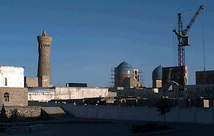 A canal runs down Bukharas main street, carrying with it both life and death – much needed water which in the past has carried many diseases. We turn a corner and see an entrance through a large wooden gate. This leads into a barely lit courtyard and on a board above a chaikana table hangs a dazzling array of Central Asian instruments – tanburs, tars, satos and doiras (frame drums). I am in the market for a frame drum and these look particularly well made and playable. The maker of the instruments takes me to his workshop hidden behind some trees. A small room is filled with half finished instruments. Drying animal skins and the smell of freshly cut timber give the impression that here is a professional craftsman. Newspaper cuttings show him and some musical diginitaries smiling to camera. Paul meanwhile is attempting to see if any of the local players have heard of a vocal technique for articulating the rhythms or ‘usul’ of frame drums, similar to that used in India. Sadly they all look bemused, another preconception shattered. After a short session playing with the locals, I am interested in purchasing one of the drums. I am told it costs $150, this is definitely too high as I know $75 is a good price and tell them I will return in a few days. It is too late for a long drawn out haggle session, anyway who’s gonna carry all this stuff! As we wind our way back, the wind whistles around the small ‘venetian-like’ streets, curtains are sucked out of windows and bats play in the tungsten streams of light. This is going to be interesting.
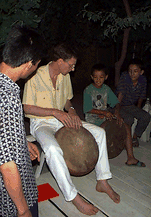 On my return to the B&B there seems to have been some confusion, there is no room at the inn. Tonight I sleep outside.
“When you sleep in a house your thoughts are as high as the ceiling, when you sleep outside they are as high as the stars” (Bedouin proverb)
Tomorrow join me as we meet Ari, a player of the Kashgar Rebab. We are told he is the last of his kind.
Day 10 – Seven Heavens Beneath a Waterfall
Posted by Musical Nomad in Daily Blog on August 7, 1997
 It was a strange experience walking into a BBC building in the middle of Tashkent – a small piece of England, a refuge, an embassy. Jenny Norton who runs BBC Monitoring Tashkent had been a very good contact for us when this journey was planned. Today she met us in her office, a room rented as part of a hotel complex. Being very interested in our journey, she was happy to advise us about the areas we are planning to travel to. She pointed out that as part of our description of musicians and music it is likely some sensitive issues will be touched on. “Tell it like it is” she announced. She mentioned the relative peace and stability in Uzbekistan compared with the problems in Afghanistan and Tajikistan. She assured us we would be safe following the planned route of the rest of our journey.
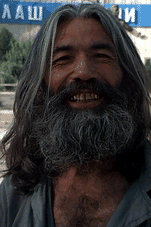 Whilst wandering around Tashkent in the sweltering heat, we came across an intriguing character standing by a fountain in Alimdjan’s Square – in memory of the great Uzbek writer. His face had the weather-beaten look of someone who spends a lot of time in the open. He could have been forty …or sixty, it was hard to tell. He started to tell us about the significance of this place. It was not, as we had thought, just another piece of grandiose Soviet architecture but had all kinds of cosmological significance. This genial and likeable gentleman goes by the rather unusual name of Alpha-Omega. Intrigued by his stories, we followed him down some steps to what appeared to be a maintenance room of some kind – this was his home. He welcomed us in, sat us down and offered us tea. He then continued with his story.
As far as we could understand, he was describing all the cosmic forces acting upon this spot. He gave an explanation of the ‘seven heavens’, the five parts of the human body and the four elements. His wide-ranging conversation darted from one subject to the next, seemlessly. Somehow it all seemed connected. By now there were complex cosmological diagrams and mathematical symbols drawn on a piece of paper.He explained how all the religions were in fact one and how Jesus Christ was coming again soon, in fact he was already born. He described himself as a Dervish, a Sufi holy man and said that he was a reincarnation of Ibn Al Arabi, a famous Andalucian saint. This statement was followed by a complex astrological breakdown of how this fortuitous event (his reincarnation) had happened.

A couple of books we saw lying around his room were indeed works by classical Sufi authors. He lived very tidily in this simple room and wanted no money from us. ‘Everyone is welcome here’, he said. We asked if he knew any musicians. ‘I’ve met some… up there’ , and he pointed to the sky.
Tomorrow we are travelling to the Holy City of Bukhara. Our first real interception with the Silk Road. I am eagerly anticipating this city – log in and find out about musicians we will be meeting.
Day 9 – Red Tape Hell, Musical Heaven
Posted by Musical Nomad in Daily Blog on August 6, 1997
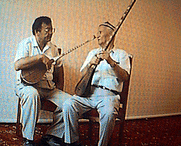 Having been out of action for a while I have not been able to tell you about our meeting with Pattahon Mamadaliev. Sometimes it’s difficult to interview musicians here because of their modesty . if you ask them about themselves they will naturally represent themselves in a very humble way. Pattahon is a good example of this.A respected maqam performer he is particularly famous for his wedding singing in the Fergana style. He is professor at Tashkent state Conservatoire and has performed numerous times on TV and Radio. In fact, the people working in our hotel were thoroughly surprised to see him sitting in their dining room. Perhaps the thing that most distinguishes him is his status as a composer. Pattahon was the first musician to be awarded the honorary title of Hafiz by the new administration after independence. This title is used in the Islamic World to describe one who has learned the Koran by heart, but it can also refer to a master musician. Pattahon is not only an interpreter, he also composes maqam music and texts.
I always enjoy watching older musicians who have played for years, they often have a minimalist style, an economy of expression. Pattahon plays as if his tanbur is a part of him and his voice still retains a power which belies his seventy years. Interestingly when we asked about the age of the tanbur he said it was not old, only fifty years.
 As Pattahon’s life spans much of the period of Soviet rule in Uzbekistan I was keen to ask him about the changes that had come about. Both he and Abdurahim were clear that it had been an ill conceived experiment on the part of the Russians to try to change the musical tradition here. They felt it to be a tribute to the strength of the music and the peoples’ feeling for it that it had survived. Sasha our interpreter and musicologist companion pointed out that this viewpoint was fairly nationalistic and not necessarily representative of all musicians in the country, although there is much evidence that Soviet Cultural Policy had set out to repress the music. Sasha can be heard translating this viewpoint in an excerpt from the interview.This day was to be special for the project. A high ranking official from the Ministry of Foreign Affairs was going to make customs give us our satellite phone. We left for the airport at 9 am in triumphant frame of mind believing we would return within the hour. At 2 pm two bedraggled people walked through the door, black satellite phone in hand. We had been through red tape hell. The country may have reached independence but the old Russian way of doing things remains fully intact. An endless stream of grey concrete ‘huts’ scattered randomly around a wide, bland pot-holed road leading away from the airport. Sleepy Army soldiers guard rusty gates and several stages of payment, slips of paper and rubber stamps get you in.
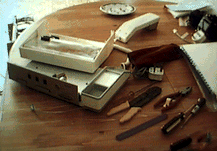
Over a roaring fire a large wok containing gallons of water. Lumps of dirty raw meat and vegetables, sit bubbling away in the middle of one of the yards – who is it for? The atmosphere of the place is slow and still, certainly not an area bubbling with efficiency. The various stages that Uzbekistan customs ask you to go through to acquire your own property is excruitiatingly painful when like us, you are in a rush. The paperwork and arguments burn irretrievably into the memory of all who pass through each ‘hut of frustration’.Though I’m still unwell, I’m keen to see how the new satellite is shaping up. I descend the stairs to find Gary and Paul surrounded by 100 pieces of wreckage – I can’t believe it, the replacement satellite has possibly been corrupted in transit and they are trying to trace an obvious fault. Despite all their efforts the team cannot find one, desperate calls to England are hampered when we can’t get a phone line. I retire to a safe distance, Gary and Paul are not happy. Ten minutes later I am awoken by a combined banging and throbbing – what now? Peering through the door I see Gary manfully priming a petrol generator and Paul planting an earth spike in the dusty courtyard. There wasn’t enough current in the local electricity supply to even work a soldering iron, so this is the solution – make your own electricity. It’s bizarre seeing all this sophisticated satellite gear driven by a petrol generator.
We are told a third satellite transmitter will be hand delivered in a few days to Bukhara. Please stick with us we are doing everything we can, normal ‘service’ will commence shortly.
Day 8 – The Land of Lutes
Posted by Musical Nomad in Daily Blog on August 5, 1997
The Land of Lutes
Every journey has it’s trials and today we’re having our fair share. Last night I was struck down with a bug, without going into graphic detail. I am now laid up in bed unable to be of much use to anyone. As if this were not enough Gary and Kathrin are at various Government Departments wading through acres of red tape. The officials in Tashkent are very suspicious about our new imported Satellite transmitter – are we really James Bondski? Only a letter from the Minister of Foreign Affairs can convince them to release this much needed lifeline. Without this we cannot continue our dialogue or bring you the exciting music we have been hearing. We hope we will soon be ‘on-line’ eager to reply to your e-mails. Only Paul is left back at the ranch, Dat machine in one hand, camera in the other. He loves it really! While I catch up on much needed sleep I leave you in his capable hands. I know he’s dying to tell you about lutes.
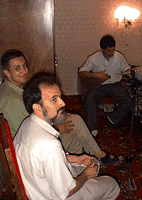 As one of the guitarists and sitarist in our team I’m fascinated by the ‘lutes’ we encounter. I’ve just been lent a dutar by Abdurahim Hamidov. Living with the dutar, having it around my room playing it, I feel invited in to a sort of magic. It has made me incredibly aware of the close relationship between all these Central Asian instruments and most of the world’s ‘lutes’. The two-stringed dombras and dutars have all the latent characteristics of the guitar, the Oud and the sitar. The tuning in fourths (and fifths), the tendency to play parallel patterns up and down the fingerboard – the modal scales are all common to these more familiar instruments. The rasguedo of the dutar is almost “flamenco” in character. The vibrato and portamento techniques are reminiscent of the classical Oud of Arabia.
If the lute began in Central Asia as many scholars believe, what fascinating journeys it has made – into China, India, Arabia and Europe – taking new names and new shapes but retaining its Central Asian roots.
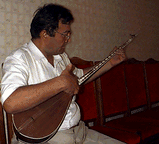 Abdurahim Hamidov who I met today is an incredible virtuoso on the dutar. He also knows many of the other lutes of the area and explained their relationship. According to Abdurahim the dombra which we heard a lot of in Kazakstan is primarily a folk instrument. Though if you refer back to Day 4, you can hear that Aygul Ulkenbaeva is now taking the dombra to a more sophisticated level.Abdurahim regards his dutar as a classical instrument, especially in the context of the Shash maqam though he often performs solo as well as accompanying singers.
Physically, the dutar is more sophisticated and highly decorated with beautifully made silk strings instead of the factory produced nylon strings of the dombra. Curiously his dutar retains its modal scale – it has not been ‘improved’ to a fully chromatic version (yet!). Abdurahim also asserts that his dutar has different tunings; in fourths, fifths and unison whereas he alleges the dombra doesn’t (I’m not convinced).
I encountered another fascinating lute yesterday, the Kashgar rubab played by Munajat’s teacher Shavkat Mirzaev. This is a five string lute with four metal and one silk string – an unusual mix. The silk string is very thick and provides a rich bass. The four metal strings are arranged in two pairs and are used for melody. The rubab has a haunting sound enhanced by its parchment sounding board and the harmonic richness of those pairs of metal strings. There are superficial relationships here to the saz of Turkey and the bouzouki of Greece. Earlier, in a taxi I heard the local version of Greek popular music or Rembetika – it’s a strange and wonderful world.
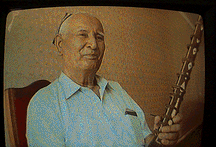 Wow, another lute – today we met Pattahon Mamadaliev, a fantastic 70 year old guy. He sings with a consuming passion and accompanies himself on the tanbur. It has four bronze strings. In India bronze is a sacred metal, I must check out its significance here. The tanbur has very thick gut frets to enable a deep vibrato, it’s made from mulberry and apricot. Pattahon possesses an intensity of performance and a sincere unmannered humility. I played some Spanish lute music for the musicians, Pattahon and Abdurahim. Abdurahim said he understood this 15th century lute music perfectly, which is interesting. This music is very polyphonic ‘in many parts’ as opposed to most Central Asian music which is often monodic. They also enjoyed a bit of pseudo-Flamenco – this is also interesting as Pattahon’s passion and style is reminiscent of Canto Joto from Andalucia in Southern Spain, a deep form of flamenco. Somebody must have told the lute to “go forth and multiply “- I’m ever more convinced that the lute family originated here as most scholars assert.
I’m currently in the lap of luxury – our little guest house even has a tiny swimming pool. I banged my head trying it out – perhaps it will knock some sense into me? The food here is the best so far in Central Asia – delicious Vegetarian stuff – not that common in the land of the rising Kebab.
I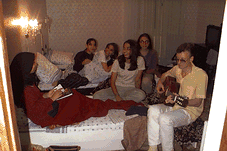 got caught last night serenading five Muslim girls in their bedroom – their father just laughed and went to bed – not the expected reaction. The girls enjoyed a Bo-Diddly song but thought Shash maqam was ‘pretty cool’. They are on holiday from Chicago, so that probably explains their frankly modern behaviour. Jan still has the “montezumas revenge”, so retires early. Kathrin and Gary are simply exhausted, endless wrangling and still we can’t get our satellite out of customs.
Tomorrow, who knows?
Day 7 – “My soul was taking flight” Navai
Posted by Musical Nomad in Daily Blog on August 4, 1997
 “My soul was taking flight” Navai
Tashkent is Uzbekistan’s capital and by all accounts the busiest city in Central Asia. At first it feels very similar to Almaty, it has that Russian sprawlness about it, wide roads, an endless stream of Soviet structures surrounded by semi-shanty suburbia. Closer inspection reveals many hidden treasures. The apricot trees used in many musical instruments especially the tanbur, line up along the dusty Russian backroads and avenues, giving the place a Mediterranean feel.
The heat builds to a forbidding level by 10am and it’s best to keep out of direct sunlight, particularly in one of Tashkent’s most lively environments, Chorsu Bazar. Gary, who has traveled here before, suggested we look around. The bazar is a large market, a place where local people gather. The centre piece is a large skeletal dome at least 150ft high in the middle which envelops a vast range of spice, dairy and fruit stalls, spreading outwards in concentric circles. As we walked through here the smells of produce and sounds of multiple Uzbek ghetto blasters bellowing at distortion level seemed quite familiar. One of the first things I noticed are the women who dress in bright, traditional clothes – a far cry from the Almaty women who have adopted a relativly bland ‘chain store’ look.
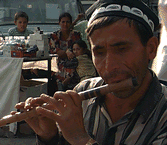 Throughout the market there are stalls (often metal buckets with fruit in them), entertainers and chaikhana’s (small tables on which to sip tea). Paul was able to finally buy a belt for his decreasing waist and I was attracted by a lonely flutist, busking in a secluded corner. He was blind and gave the traditional open palm, hands over face to accept blessings whenever he felt some money land in his lap. He occasionally played a haunting Maqam-type melody and I was moved, not just by the music but by his obvious predicament. Not far from the flute player three young boys entertained.One was supplying the ‘come and see’ music on a Western snare drum beating a marching rhythm while circling the younger ones. They performed acrobatics and increasingly dangerous manoevres over broken glass and nails. I didn’t stay for the tricks they had planned for later in the act, some of the sharp implements were bigger than the boy’s themselves. Before we left the bazar I was struck by an image, a series of steps leading back up to the second level. On each side women sold bread as smoke from Shashlyk stands billowed across many brightly coloured metal ornamental stalls. This was where local people came to do their daily business, where you can eat good food for a tenth of the price of the Hamburger joints in the centre of town. Gary is right, this is the real Tashkent.
Later on that morning we ventured across town to the Museum of Applied Arts. A prosaic name for something very precious and visually stunning. It had once been the private house of a rich Russian with a taste for the traditional arts. The courtyard entrance leads up a staircase to a small hall. The hall is decorated in Islamic style with brightly painted plaster and wood carvings. Every direction is ‘candy’ for the eye. Alcoves hold vases aglow with primary tint and the marble centre piece turns out to be a perfect place for our stereo microphone. This morning we are meeting one of Uzbekistans most celebrated singers and her ensemble. In the serene calm of the hall we met Munadjat Yulchieva and her teacher and mentor Shavkat Mirzaev – if this wasn’t enough of a daunting prospect it was also to be our first encounter with the ancient Shash Maqam tradition of Central Asia.
Shash Maqam possibly dates from as far back as the Timurid dynasty, around the 15th century. It was the music of the courts and in the important centres of Bukhara, Khiva and Khokhand this repertoire flourished. The words Shash Maqam refer to the Bukharan tradition and mean six maqams (in Persian) there is also a Khivan tradition of Alti Yarim Maqam (6 and a half maqams) and from Khokand Chahar Maqam (four maqams)
The word Maqam is often translated as ‘mode’, but in fact the word has many more connotations than our ‘mode’ or ‘scale’. In this case it refers to collections of compositions ordered into cycles or suites. This represents the classical “art music” tradition of Uzbekistan.
Munadjat is one of the most popular performers in the Fergana- Tashkent style (four maqams). This school differs from the Bukharan style, it is strongly linked to the Uzbek language (as opposed to Tajik) and is sometimes referred to as ‘free maqam’.
For such a celebrity, Munadjat has taken an unconventional route to success. She was born in a small village near Andijan, and worked the feilds with the rest of her family. The story goes that she applied to the Higher Conservatoire of Music, vocal arts department, not realising that they trained opera singers. She was turned down for singing ‘out of tune’ but was heard from outside the door of the audition room by one of Uzbekistan’s most famous composers, Shavkat Mirzaev. He became her teacher and the rest, as they say, is history.
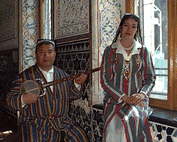 In the weeks leading up to this trip I had studied recordings of Munadjat for the purposes of research. I immediately found her voice almost absurdly moving and was soon listening to her constantly. Today’s meeting was a great opportunity to get a bit closer to the music and to find out more about its background.I am told that when Munadjat performed in London recently the audience cried and I can believe it. Besides being possessed of one of the most moving voices you have ever heard, she has an undefinable magnetism which is transfixing.
This seems to stem from a sincerity of feeling , a devotion that pervades every note and every gesture. The Uzbek and Persian texts that Munadjat sings are remarkable for the feelings of love and yearning they portray, even in English translation. These poems are classical texts written by famous Sufi poets. They cover philosophical and metaphysical themes, often using the metaphor of a lover yearning for their beloved. Through this device the poets portray the yearning for the presence of God. As Shawkat pointed out however, you need a special education to understand their poetry . The texts are multi-layered with words implying several meanings. One would need to speak several languages and have a training in Sufi philosophy and spiritual practice to plumb the depths of the meaning.
For most of us, however, the pure sound of the language has a profound effect. The music tends to be slow, creating a feeling of space and serenity. Within this timeless space the yearning of the voice is almost painful
“My beloved was to come tonight, with his face like a rose and his figure like that of a cypress-tree; but he didn’t
The whole night, sleep deserted my eyes
Full of hope, I would take a few steps on the road towards him
My soul was taking flight, but this fickle betrayer didn’t come
Bereft of his angel face, I wept and wept like a mad woman
Whoever saw me must have thought that I was a fool
Is there such a thing as a faithful suitor? If there is one, why does not every step lead him to his beloved?
Navai, rejoice in the house of your heart
For sadness never floods a house where wine flows”
The song “Munadjat” means prayer, and the melody was used by Sufis even before the poem by Navai (1441-1501) was written. It is now a famous melody of the region and Munadjat (whose name also means prayer) has made it her own. The performance begins with the voice whispering a secret confidence. As the piece progresses the melody ascends in pitch and volume with incredible control and restraint. The climax of the piece (or awj) is searing in intensity and superhuman in volume.
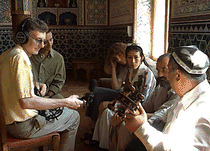 During this trip we have been lucky enough to meet musicians who are national celebrities. They have been relaxed, accessible people who possess great humility. Munadjat and Shavkat are no exception.
As we sat and chatted to them about their lives and music, there emerged a sense that Shavkat and Munadjat feel music is an essential ingredient in life, it is impossible to live without it. To give vent to one’s feelings of pain and joy, almost in a Cathartic way is somehow purifying. When asked about Uzbek pop music Shavkat simply said that he did not listen to it. There was an implication, however, that he felt it might be detrimental to the Classical music.
Munadjat often defers to Shavkat to answer questions, which he does in a very articulate way. They seemed encouraged by the number of students training to play Uzbek Classical music. I was curious to know whether musicians still maintained a connection with the Sufi practice that inspired this heartfelt music. This is a difficult thing to judge, especially since Sufism was discouraged during Soviet times. There was an attempt to secularise this music, which the Russians saw as feudal, into an innocuous lyric poetry. Reading between the lines though, I sense that there are still musicians for whom music is a sacred art.
Tommorow we meet two of the most celebrated lutenists (dutar and tanbur) in the country, Abdurakim Hamidov and Pattahon Mamadaliev – who is also one of Uzbekistan’s foremost composer/singers. Join us for a full report.
Day 6 – On the aircraft it’s bedlam and as people push and fight for the seats
Posted by Musical Nomad in Daily Blog on August 3, 1997
Travel Day – Almaty, Kazakstan to Tashkent, Uzbekistan]  The time in Almaty has been a fantastic beginning to the Musical Nomad. Despite satellite problems, a dodgy diet and oppressive heat the music has sustained us all. It’s 4.15 in the morning and we have been back on the road for over four hours. We are at the airport and some decidedly dodgy dealing is going on.
Some official has just run off with our air tickets and everybody is pushing for kickbacks to get the Musical Nomad equipment on the tiny jet assigned to take us to Tashkent. At 5.30 am we stand on the steps of the aircraft, finally poised to board, one of the aircrew demands “50 dollars or you don’t get on.” We reluctantly succumb.

On the aircraft it’s bedlam and as people push and fight for the seats. The in-flight catering consists of a bottle of water and some paper cups.
I land safely in Tashkent, the best is yet to come. The ground crew refuse to unload the plane and I find myself part of a human chain. The Musical Nomad crew become ‘Tashkent Ground Services Limited’ and we offload not just our stuff, but everybody else’s! Gary, our multimedia whizz, is also a registered giant and thinks nothing of hauling four cases at a time. Paul said ‘You see life in the new BBC.’
 It’s all part of the adventure. Tomorrow that includes meeting Uzbekistan’s foremost singer, Munadjat Yulchieva, I’m full of anticipation – I may play the flute with her, I’m trying to learn about the Shash Maqam (six modes). Log on tomorrow and hear how I get on.
Day 5 – When I play it seems that I understand the Shamanic tradition
Posted by Musical Nomad in Daily Blog on August 2, 1997
“When I play it seems that I understand the Shamanic tradition. There was a time when I had a supernatural connection with the audience but now I have lost this a little.”
 Raushan is softly spoken and very articulate . She speaks passionately about Kazak music and in particular about the kobuz. She comes from a musical family. Her father, also a musician, always wanted Raushan to play the kobuz. They are from a region near the Aral Sea, which has its own rich musical tradition. Her sisters play flute and oboe, by all accounts outstandingly well. This musicality stretches back for generations.
I started by asking about the history of the kobuz. She explained that very little had been formally recorded as this was predominantly an oral tradition. She recounted a legend of a real person, Korkut, who is often looked upon as a father of the kobuz tradition. He was a Shaman. At his birth the heavens opened and the climate changed. There was thunder and lightning, people were terrified. When the child was older, it became clear that he could foretell the future, and people were afraid of him. They named him Korkut which means the terrible one. One night he was visited in his dreams by an old man who told him that he would die when he was very young.Korkut set about trying to evade death by playing the kobuz. He could not play day and night and so everywhere he went people would dig graves for him. He would ask “Who are these graves for?” They would reply “They are for Korkut.”
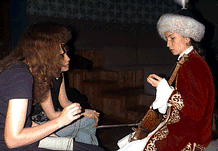 Raushan explained that Korkut wrote many melodies for the kobuz, and is now seen as a classical composer. She performed a piece for us which utilised the metal jingles attached to the instrument. This was a medley of his tunes and is called Abistolgan. This is very ancient music and she often plays it for herself. “It has to be with me always.”
I was very interested by the connection between this instrument and Shamanism. Raushan explained to me that the Shamans had used rattles to heal people. This was the origin of the jingles attached to her instrument. The Shamans improvised on the kobuz, not playing set pieces. It was a sacred instrument.
When Islam came to Central Asia the Muslims disapproved of the Shamans and tried to discourage their practices. As Raushan was a Muslim I asked whether she felt the two traditions were compatible. She said that she felt that they were, but it was not a logical thing. She played me a melody representing how she felt when she read the Koran.
Raushan is a living, creative musician who makes sense of life through sound. This is not a rational process, and it is precisely this ability to evoke things which cannot be explained which marks out a true musician.
“When I play it seems that I understand the Shamanic tradition”.
“There was a time when I had a supernatural connection with the audience but now I have lost this a little.”

Raushan’s instrument is one of the most extraordinary I have ever seen. She explained that the basic design was one which was common amongst the Turkic peoples. This particular one is made in the traditional way, from one piece of wood with no glue or nails. The resonating membrane at the bottom is made of camel skin. The camel, she explained, was almost a sacred animal to her; “A camel’s voice is deeply moving.” The skin used for the instrument comes appropriately from the camel’s throat.
The kobuz has a heart-shaped resonating chamber which in this case is painted dark red emphasising the heart-like imagery. Inside the heart were placed some small pieces of mirror. This was not traditional, but could represent a number of things; summoning ancestral spirits or reflecting bad thoughts were two possibilities. I mentioned the Sufi image of “polishing the mirror of the heart”, a description of purifying the heart for God. She thought it likely that this instrument maker had thought along these lines. There were a number of small details on the instrument – carved symbols representing sun, moon and a star. There were resonances of the Islamic Star & Crescent but subtly changed.
Raushan expressed a wish to search for more repertoire for the kobuz, and to research old pieces.
“Modern composers don’t understand the spirit of the tradition……..they spoil everything…… Kolumbaev was a brilliant player who composed and arranged pieces for the instrument. He was a brilliant improviser…. now he is gone nobody can replace him.”
Raushan aims to play like the ancient masters, not literal authenticity but preservation of the spirit.
Alice, our interpretor during the past few days, invited me to chat with her in her parents home not far from the centre of Almaty. When we arrive the clouds that had been gathering during the day, suddenly opened. The heat of the last few days is immediately quashed by torrential rain. The thunder rages in the darkening sky as I sit down in her room and ask a few questions about her life and music. She talks with an accent divided evenly between Russian and scouse.
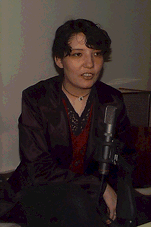 Would you like to be called Alia or Alice?
It doesn’t matter, I’m not bothered
Tell us a little bit about what you are doing in Almaty
I am actually involved in pop music, not really classical traditional but I do appreciate traditional roots, mostly pop musicians and blues based musicians. I have just got back from LIPA which is an institute in Liverpool that was opened by Paul McCartney two years ago. What I really want to do is to participate in the music scene here in Almaty, Kazakstan – because I think its booming now at the moment. Brilliant musicians, absolutely fantastic musicians – guitar players, drummers, vocalists. I want to get a band together. I do have a bass player and a singer but we need a drummer and were gonna start gigging at the end of August. What I wanna do is loads of gigs, I think that’s actually the way to success, do loads of gigs so the word gets spread around. Then probably do a single, then probably an album… I know it sounds cynical but I just wanna be rich and famous, have a jet and travel everywhere.
How would you say the musicians here differ from the musicians you’ve come across in England?
Oh they differ tremendously, because all the guitar players at LIPA (Liverpool Institute of Performing Arts) are into really weird stuff like White Zombie, Panthera and Metallica. Even Metallica is too soft for them. I found that really weird. Plus people are into things like Prodigy which are not popular here at all. In the former Soviet Union Rock and Roll was forbidden, you could go to jail for possessing an Elvis Presley record or wearing bell bottoms or whatever, ridiculous things like that. But still people were really into rock and roll, records were brought here illegally and then copied thousands of times onto tapes. People here are still into things like Nazareth and Led Zeppelin and Deep Purple and that sort of stuff. Nazareth are number one in the charts in Moscow at the moment. They’re into classical rock and classical blues.
Can you see in the future a kind of rock that will be unique to this part of the World, perhaps combining traditional music with rock music?
There is a band at the moment here which attempts to do that and they are just bloody, bloody awful. They are all conservatoire graduates and they study things like Dombra and Kobuz but they just sound awful. Just the worst band I have ever heard in my life… At LIPA for example we were studying guitar players like Ingui Malmsteim, Richie Blackmore and Steve Mores. Once they invited a guitarist, a very distinguished player from Moscow whose name Sasha Lipinsk, he came over to demonstrate his technique. he was playing Jimi Hendrix, all the standards Chuck Berry. People were asking questions like do you wanna play some Russian traditional music something specific weve never heard before something authentic. “No thanks just Jimi Hendrix, Johnny Be Good” stuff like that.
So music is primarily a vehicle for you to be rich and famous rather than the music itself?
I do my music and express myself. I would never do the sort of pop music that some people do in Russia, sort of whores on TV that really sell themselves to become rich and famous, I would never do that I think that is ugly and horrible. Rock and roll comes first really.
I am off to Tashkent, Uzbekistan tomorrow. The journey is either a ten hour drive or a two hour flight. I think I will choose the latter. Join us tomorrow, new country, new city, new music.
-
You are currently browsing the archives for August, 1997