Posts Tagged dombra player
Day 37 – Timeless songs for the next generation
Posted by Musical Nomad in Daily Blog on September 3, 1997
 I almost didn’t meet Aygul. As soon as I arrived in the village of Saty I was told of a dombra player I simply must hear. “Not another dombra player” went the cry. What a wonderful surprise then to meet a young girl of thirteen with such talent and charisma.
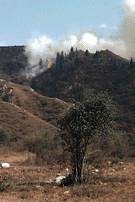
The Musical Nomad project is all about discovery. Finding out through the universal language of music about a people and their culture. On our penultimate day we left our campsite with very little hope of finding musicians. We headed for a town called Saty (meaning steps in Kazak) about 30 minutes drive away. We came out of the fertile tributary valley and into the wide, barren plain of the silty Charyn river. On our way smoke could be seen billowing from the grassy forested areas of the valley peaks. Occasionally a flame would explode, twenty or thirty feet high. The long hot summer is taking its toll and forest fires burn freely and naturally. In the long brown grasslands horses and cattle barely move in the midday heat. Suddenly the dusty road turns into the town.
 With very little to signify a transition, a row of houses appear. The town stretches for about a mile, the wide road lined on each side by wooden farm and administrative building. Next to a large yellow school a wooden hut doubles as the main store. We approached and bought drinks. We asked the shopkeeper if there are any local musicians. Moldira, our interpreter, scribbled down three names. One is an old man who apparently sings. We went to his house. A mad wolf-like dog attacked me. I then learned that the old man is ill and cannot be seen. I suspected the other contacts would prove as fruitless. It was now the hottest part of the day and we were trying to track down the second contact. Local people in the street seemed to point in the same direction when we ask. A group of teenagers passed us with a guitar. The guitar has a skull etched into the back and the boys also pointed in the same direction.
 We followed a road through the dusty, cattle infested streets. There was an air of sleepiness about the town. Occasionally a wagon filled with hay to dangerous levels careered carelessly through the narrow roads. We stopped near a large metal gate. Moldira peered over the top and confronted an old lady. After a short conversation I found out that this is a musical home. The whole family play dombra and sing. The daughter has won competitions and the eldest brother, currently working in the field, plays weddings and is well known to everyone in the village. We told the old lady, Salima about our project and who we are. She seemed almost expectant of our arrival. She invited the whole team with full equipment into her garden, her house, her world. A small girl in school uniform skipped towards the house. The garden is large. There are stables, small orchards and white clay ovens for cooking and bread making. This family like many others in this area are self sufficient. Salima asked us to take our shoes off and come into the house.
 Inside the house we were shown around by Salima and introduced to her daughter, Aygul. Looking like any thirteen year old just back from school she greeted us politely. It was only a little later we discovered that she was the star musician of the family.
The traditional village house is small and simple, but very homely. The entrance way is wood panelled on the outside giving a very ‘alpine’ feel and metal clad on the inside. This looked, rather disconcertingly, like the inside of a spaceship with resonance’s of Shaykh Kushkarov’s centre. See day 20. Presumably this had some functional value of which we were not aware. Certainly the house was very cool. Within ten minutes Aygul was changing into national costume. She assumed an extraordinary presence as soon as she took the dombra into her hands. Seeing so many musicians in such a short space of time can cause the palette to become jaded. Aygul’s fresh and direct voice has a poignancy and honesty that is rare among performers of any age. All of us were touched by her performance. Aygul has recently won a music competition and so is no stranger to performing. She appeared on Kazak TV as a result. This might explain her natural manner in front of cameras and microphones. The fact that her family are all musical may also contribute. Whatever the reason it was noticeable that neither Aygul, or her brother Nurlan seemed in the slightest bit perturbed by our presence.
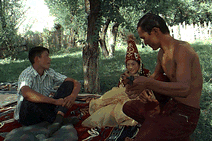
People arrived at the house, watched, drank tea and left as if it was all completely normal. This was good for us as we didn’t feel we were putting them through an ordeal. Nurlan has an unusually strong and intense voice with an energetic style of dombra playing. He has been a school music teacher but now works the fields. He performs professionally at weddings (toys) and on public holidays. He’s been playing since childhood. It seems that both he and his brother have helped Aygul to learn to play, but they stress the fact that she had a desire to learn.
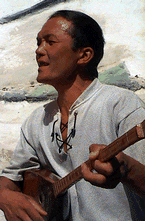
She learnt naturally – in other words she’s largely self taught. Aygul has been surrounded by music from a young age. Both have extraordinary voices which they describe as ‘coming from nature.’ For such a musical family it seemed strange to us that they don’t perform together. They possess only one working dombra, and they explained that ‘each person has their own voice’. This means presumably that they have different vocal ranges, but perhaps also different ways of expressing a song. Theirs is a solo singing tradition.Aygul sang a love song called ‘Altynai’. This song is addressed to a girl whose name means golden moon. These kinds of songs seem quite typical. Nurlan’s song ‘Karagymai’ was also a love song “Sweetheart, life without you is nothing”

Last night’s campsite had little to commend it, previous incumbents had left a trail of empty beer bottles and cigarette ends. We decided to move on and spend our last night on the steppe somewhere we wished to remember. Only twenty minutes drive found us further down the valley with a cleaner site and a clearer river.

I decided to light a fire, to gather one last time around the ancient embers – to reflect. With singers like Aygul and Nurlan the tradition is in safe hands and some timeless songs will probably pass to the next generation. Tomorrow we journey 8 hours back to Almaty. The Musical Nomad project nears an end. Please join us as we, the Nomad team share our personal reflections on a journey that has changed us all.
Day 4 – Let the music and musical instruments be the bridge between the peoples of the World
Posted by Musical Nomad in Daily Blog on August 2, 1997
“Let the music and musical instruments be the bridge between the peoples of the World…You are the ambassadors and I wish you success” Izbazar Balbazulov – Director of Museum of Kazak Musical Instruments
 The Minister of Culture pulls some strings. Arranged at the last minute, here we are in the presence of two great virtuosi back in the Museum of Kazak Musical Instruments. We are expectant of good playing, though nothing could prepare us for the brilliance of the emotional journey to follow.
 He had arranged for us to meet one of the greatest exponents of the kobuz. This was an instrument that none of us knew much about so we crammed ourselves and our gear into the first Lada that would stop and headed for Panfilov park. Everywhere in Almaty people have been extremely helpful to us. They seem eager that their arts and culture are represented. This has been wonderful, but has made us aware of having a responsibility towards the artists that we meet. This spirit of helpfulness manifested itself in two musicians – Raushan Obrazbaeva the kobuz player and Aygul Ulkenbaeva a dombra player. We knew we were pushing our luck to record, film and interview them in the time that we had, yet still do them justice.
 As we heard Aygul tuning her dombra we knew this was special. It was clear from the way that she handled her instrument that she was a virtuoso, not a folkloric performer of ‘museum’ music. As she began I was immediately struck by her poise and grace. Just like master musicians anywhere in the world, she transcended the apparent limitations of her instrument. Time stood still and we forgot that we were listening to a two stringed instrument, this music seemed universal. Paul came in from next door where he had been monitoring the recording, visibly paler. This was too good to miss, we just had to record it all. Aygul’s playing style is very extrovert and almost choreographed. She uses magnificent hand gestures to illustrate her music. It would be easy to make comparisons with extravagant concert pianists, but I felt this to be an integral part of her personal playing style. With her fully chromatic dombra she takes the instrument to new heights of expression. Her rasguedo strumming is flamenco in rhythm and fire. Her wide vibrato is almost as outrageous as the whammy bar on a Fender Stratocaster. Perhaps Aygul is a Segovia of the Dombra, extending its repertoire and range of tone colour, taking it to a new audience. This was very definitely classical music. There were no folk songs nostalgically invoking bygone eras, it was pure instrumental music. The drama of watching an instrumentalist weave a story in sound transcends any historical, national or cultural label.
 These are not every-day experiences, and my head buzzed with questions. I hadn’t realised there was a living and vibrant classical tradition in Kazakstan, with composers writing for traditional instruments. Essentially the classical music seems to have developed and refined the folk art form rather than losing contact with it entirely as seems to have happened in the West. This should be seen as a natural process, it has happened all over the world. It seems to be part of urban life, and increasing sophistication. It would be simplistic to describe this as the influence of ‘Russification’, although Russia has clearly been a huge influence here. We should not be bemoaning the loss of ‘traditional’ music, but celebrating the survival of a distinctly Kazak form of musical expression.
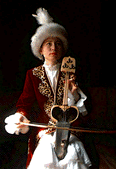 Raushan now took the stage to play the kobuz. Both musicians had been wearing traditional costume, and Raushan looked extraordinary in her long embroidered velvet gown with fur trimmed hat complete with shamanic-looking feathers. Her two-stringed horse hair fiddle is capable of creating almost unbelievably intense sounds. Whereas Aygul had been outgoing and virtuosic in her performance style, Raushan was introspective, as if summoning up ancestral spirits. She plays with closed eyes and rocks like a pendulum, in the dim light of the museum. I feel I’m in the presence of something very, very special. The sound of the kobuz is at times very close to the human voice. The emotional impact is immediate, it almost wails sometimes and it breaks your heart. We were astounded, not just by technical ability, but by the intensity and passion of her playing. The sound seemed to come from everywhere, to embrace you. Multiphonic effects brought to mind Mongolian overtone singing, primal sounds that were curiously abstract, impossible to notate. Simultaneously beautiful and terrifying. Raushan is able to move, in the space of one bow, from sorrowful and restrained Shostokovichian cello to guttural animal scream. I thought of Paul next door with his headphones turned up, and wondered what he must have been thinking. Once again all our expectations had been confounded. Gary pointed out during the performance that some of the music sounded very contemporary and accessible, and yet the pieces were hundreds of years old.
 I managed to find a moment to sit down with Raushan to ask her about the music. Is the kobuz the shaman’s fiddle? Are the attached jingles a vestigial shaman’s rattle? Can ancient Shamanic music connect with modern audiences? Join us tomorrow – let us have your views.
The curator Izbazar Balbazulov is a warm and enthusiastic man. He is extremely proud of his museum and rightly so. We gather with Alia in his kingdom, surrounded by paintings of Kazak greats. Musical instruments overflow from the shelves. As Gary and Paul fill in his guest book with good wishes and thanks, Izbazar points to a very special entry: President Yeltzin dropped by, back in 1991. Our gratitude is evident and he responds:”Let the music and musical instruments be the bridge between the peoples of the World…You are the ambassadors and I wish you success”.

He plays his dombra, Kathrin buys a kobuz, Jan blows on a hollowed out wooden Kazak ney, Paul checks his rushes, Gary checks his flys. On we go.
The musicians we heard today are innovators and trail blazers with a strong sense of identity.
Tomorrow I hope for a different perspective, I interview Alia, our interpreter about her Rhythm and Blues band, a young persons ‘take’ on Kazak music.