Posts Tagged teacher
Day 24 – The Elusive Shaman
Posted by Musical Nomad in Daily Blog on August 21, 1997
The shaman elludes us. Sadly she was busy at a funeral. Luckily we were introduced to Uzbekistan’s finest folk singer, Rakhimahon. More later.When we arrive at Rakhimahon’s spacy and elaborate house, food and tea is already on the table. We are immediately shown a video of her many performances on TV and video. This is surprisingly well made for a ‘State film’. Rakhimahon Mazokhidova sings and plays doira. She is the most celebrated folk singer in the country and she could perform at weddings every day if she had the time. She is also the teacher of the two musicians we met yesterday.
 As we begin to settle, Rakhimahon is called to perform at a nearby wedding. We are suddenly at another table loaded with food and drink, surrounded by a large crowd of women. Apparently they have gathered (in the groom’s house) to witness the bride’s unveiling. Here the newly married woman opens her veil after a chilla – the bride and groom are locked in a room for three days, are not allowed to receive any visitors and are treated like Royalty. The air is filled with expectancy when a door opens and the bride enters the scene. Rakhimahon is slowly beating her doira and begins to chant a wedding song.
 Two girls are leading the bride to the female crowd, they dance in wave-like motion as they slowly move forward. The bride lifts her white-golden veil and disappears into another room. Rakhimahon now plays a faster rhythm. In front of her several women perform a wild dance twisting their feet and arms in animal-like motion. At 68, Rakhimahon still has a lot of energy and bewitches the listener with her charm. The ceremony finishes with Rakhimahon chanting a short prayer.
While we have chai with the host, Kathrin disappears to join the women’s gathering inside the house. Being male I could not enter so Kathrin relates her experience; I find myself sitting cross-legged surrounded by a circle of women in traditional dress. They all wore head scarves in a diverse range of colours. Richly decorated tables overflowed with plov, exotic fruit, strange sweets and drinks. They looked at me with great curiosity and a wonderful openness – it didn’t take long to connect. I am invited to join them for food and prayers. Magical sounds fill the air. The voice belongs to a female Koran reader who is chanting a sura, now the ‘party’ can begin.
Suddenly it’s time for us to leave. We have to get back to Rakhimahon’s house where we are expected by her friends and entourage.
After eating yet another meal back at Rakhimahon’s house we were invited into another part of the house, and told to bring our cameras. Rakhimahon wanted to show us something. Inside a small room were several women wearing white headscarfs. They started to intone a sura from the Koran as soon as we were seated. The recitation is punctuated at intervals by the receiving of blessings (or baraka) from God. This gesture, a cupping of the hands which are then passed over the face soon becomes second nature here in Central Asia. It is performed at various times during the day particularly at meal times. On this occasion the recitation grew in intensity until several of the women began to sway and move their hands rhythmically. This turned into chanting of syllables such as “hai” and “hu” and I realised I was witnessing a Zikr. Zikr is an Arabic word meaning remembrance and there are two main kinds; loud and silent. It consists of the repetition of words or syllables and is used by the various Sufi orders to establish a connection with God.
 The chanting was becoming more rhythmic and the women stood up and began to move more vigorously. I sensed that none of the Nomad team were expecting this and this is quite disturbing when it happens so suddenly. Rakhimahon, our host, was becoming physically affected by the experience and she began to cry. It was one of those moments when you feel you ought not to be there let alone with two video and three still cameras. We had most definitely been invited to record this. Before we knew it the atmosphere changed abruptly, the tempo relaxed, smiles flashed, drums were brought in and all tension vanished. There was dancing and celebration. Kathy’s dancing being the cause of much mirth, her hip gyrations were possibly out of context – later though we noticed it had caught on with the younger women. Each of us was presented with a silk scarf which was tied around our waist. We sat down and drank chai. Still shell shocked from our experience I could tell from the uncomprehending looks passing across the room that events had once more taken an unexpected turn. We had witnessed a ceremony normally performed at a funeral.
 These women are hereditary singers who are trained to learn the Koran from a very young age. I suspect that they undergo other kinds of spiritual training as well, but this is difficult to substantiate. We were told that this is first time this had been shown to anyone and certainly the first time it had been recorded. Exactly why it was shown to us remains a mystery.
 If you ever come to Uzbekistan you need a hat. Small square and black, decorated with a motif that will mark you out – there’s a Fergana motif and a Tashkent motif, a Samarkand motif and a Baysun motif – people know you by your hat – there’s probably one for Peckham. The hats are mostly worn by the older men. These ‘white beards’ (a translation from the Uzbek words) are the custodians of wisdom and sit for hours sipping chai (green tea) in chaikhanas – mostly humble areas of shade beneath a clump of trees. Today I sit in a very grand chaikana, decorated with carved pillars and a multicoloured ceiling. A ‘Ghengis Khan’ lookalike sits in the corner discussing ancient battles his boots carry the mud of the Mongolian steppes.
 In the nearby market a woman sits chewing Kokand rock – not the seaside candy variety but serious bits of geology – she tells me it’s good for the blood and circulation – she sells it by the kilo.
With my hat I make many friends, people shake hands in the street I am a local, I wear the Kokand hat.
I came across a stall selling wooden toys. I approached and was greeted ‘asalam aleikum’, peace upon you. Behind the stall the young stall holder had an Afghan Rubab lying on a bed. I pointed to it and he seemed surprised that I recognised it. Suddenly I was in his ‘shop’ drinking chai, being treated like a VIP. Olim played the rubab, luckily I had my penny whistle to return the favour. This seemed too much for him and he immediately started looking through his stock of decorative knives to find the best one to give me. He examined each blade for straightness and sharpness and spent several minutes find the best sheath to fit it. It was then presented to me as a gift. he absolutely refused any payment. The only thing I had to give him in return were my sunglasses, cheap ones, but he seemed pleased. We exchanged addresses and felt like lifelong friends.
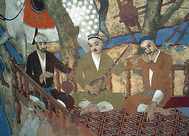 This tradition of hospitality to strangers is extraordinary – Kathrin was showered with gifts of spices just for being in the market. People want to give you everything. This is an extraordinary feeling for a Londoner. In the chaikhana today they didn’t want to take payment for our tea. It’s no good explaining that we can afford to pay 20 pence for seven people to drink tea and eat bread. Admittedly this is Kokand and tourism is not big here. In some ways I hope it stays that way. In Samarkand and Bukhara where tourism is more developed the people are friendlier than most but they have learnt to handle tourists. If one measures civilisation by warmth of character, grace and humour, then we’ve got a lot to learn from the folks in Uzbekistan.
Tomorrow we go to a new land, Kyrgyzstan. On the way we plan to finally meet an Otin-Oy, a female Sufi singer. Join me
Day 8 – The Land of Lutes
Posted by Musical Nomad in Daily Blog on August 5, 1997
The Land of Lutes
Every journey has it’s trials and today we’re having our fair share. Last night I was struck down with a bug, without going into graphic detail. I am now laid up in bed unable to be of much use to anyone. As if this were not enough Gary and Kathrin are at various Government Departments wading through acres of red tape. The officials in Tashkent are very suspicious about our new imported Satellite transmitter – are we really James Bondski? Only a letter from the Minister of Foreign Affairs can convince them to release this much needed lifeline. Without this we cannot continue our dialogue or bring you the exciting music we have been hearing. We hope we will soon be ‘on-line’ eager to reply to your e-mails. Only Paul is left back at the ranch, Dat machine in one hand, camera in the other. He loves it really! While I catch up on much needed sleep I leave you in his capable hands. I know he’s dying to tell you about lutes.
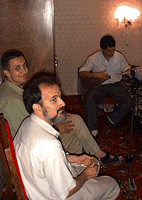 As one of the guitarists and sitarist in our team I’m fascinated by the ‘lutes’ we encounter. I’ve just been lent a dutar by Abdurahim Hamidov. Living with the dutar, having it around my room playing it, I feel invited in to a sort of magic. It has made me incredibly aware of the close relationship between all these Central Asian instruments and most of the world’s ‘lutes’. The two-stringed dombras and dutars have all the latent characteristics of the guitar, the Oud and the sitar. The tuning in fourths (and fifths), the tendency to play parallel patterns up and down the fingerboard – the modal scales are all common to these more familiar instruments. The rasguedo of the dutar is almost “flamenco” in character. The vibrato and portamento techniques are reminiscent of the classical Oud of Arabia.
If the lute began in Central Asia as many scholars believe, what fascinating journeys it has made – into China, India, Arabia and Europe – taking new names and new shapes but retaining its Central Asian roots.
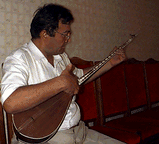 Abdurahim Hamidov who I met today is an incredible virtuoso on the dutar. He also knows many of the other lutes of the area and explained their relationship. According to Abdurahim the dombra which we heard a lot of in Kazakstan is primarily a folk instrument. Though if you refer back to Day 4, you can hear that Aygul Ulkenbaeva is now taking the dombra to a more sophisticated level.Abdurahim regards his dutar as a classical instrument, especially in the context of the Shash maqam though he often performs solo as well as accompanying singers.
Physically, the dutar is more sophisticated and highly decorated with beautifully made silk strings instead of the factory produced nylon strings of the dombra. Curiously his dutar retains its modal scale – it has not been ‘improved’ to a fully chromatic version (yet!). Abdurahim also asserts that his dutar has different tunings; in fourths, fifths and unison whereas he alleges the dombra doesn’t (I’m not convinced).
I encountered another fascinating lute yesterday, the Kashgar rubab played by Munajat’s teacher Shavkat Mirzaev. This is a five string lute with four metal and one silk string – an unusual mix. The silk string is very thick and provides a rich bass. The four metal strings are arranged in two pairs and are used for melody. The rubab has a haunting sound enhanced by its parchment sounding board and the harmonic richness of those pairs of metal strings. There are superficial relationships here to the saz of Turkey and the bouzouki of Greece. Earlier, in a taxi I heard the local version of Greek popular music or Rembetika – it’s a strange and wonderful world.
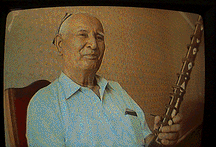 Wow, another lute – today we met Pattahon Mamadaliev, a fantastic 70 year old guy. He sings with a consuming passion and accompanies himself on the tanbur. It has four bronze strings. In India bronze is a sacred metal, I must check out its significance here. The tanbur has very thick gut frets to enable a deep vibrato, it’s made from mulberry and apricot. Pattahon possesses an intensity of performance and a sincere unmannered humility. I played some Spanish lute music for the musicians, Pattahon and Abdurahim. Abdurahim said he understood this 15th century lute music perfectly, which is interesting. This music is very polyphonic ‘in many parts’ as opposed to most Central Asian music which is often monodic. They also enjoyed a bit of pseudo-Flamenco – this is also interesting as Pattahon’s passion and style is reminiscent of Canto Joto from Andalucia in Southern Spain, a deep form of flamenco. Somebody must have told the lute to “go forth and multiply “- I’m ever more convinced that the lute family originated here as most scholars assert.
I’m currently in the lap of luxury – our little guest house even has a tiny swimming pool. I banged my head trying it out – perhaps it will knock some sense into me? The food here is the best so far in Central Asia – delicious Vegetarian stuff – not that common in the land of the rising Kebab.
I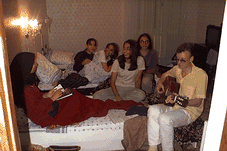 got caught last night serenading five Muslim girls in their bedroom – their father just laughed and went to bed – not the expected reaction. The girls enjoyed a Bo-Diddly song but thought Shash maqam was ‘pretty cool’. They are on holiday from Chicago, so that probably explains their frankly modern behaviour. Jan still has the “montezumas revenge”, so retires early. Kathrin and Gary are simply exhausted, endless wrangling and still we can’t get our satellite out of customs.
Tomorrow, who knows?
Day 7 – “My soul was taking flight” Navai
Posted by Musical Nomad in Daily Blog on August 4, 1997
 “My soul was taking flight” Navai
Tashkent is Uzbekistan’s capital and by all accounts the busiest city in Central Asia. At first it feels very similar to Almaty, it has that Russian sprawlness about it, wide roads, an endless stream of Soviet structures surrounded by semi-shanty suburbia. Closer inspection reveals many hidden treasures. The apricot trees used in many musical instruments especially the tanbur, line up along the dusty Russian backroads and avenues, giving the place a Mediterranean feel.
The heat builds to a forbidding level by 10am and it’s best to keep out of direct sunlight, particularly in one of Tashkent’s most lively environments, Chorsu Bazar. Gary, who has traveled here before, suggested we look around. The bazar is a large market, a place where local people gather. The centre piece is a large skeletal dome at least 150ft high in the middle which envelops a vast range of spice, dairy and fruit stalls, spreading outwards in concentric circles. As we walked through here the smells of produce and sounds of multiple Uzbek ghetto blasters bellowing at distortion level seemed quite familiar. One of the first things I noticed are the women who dress in bright, traditional clothes – a far cry from the Almaty women who have adopted a relativly bland ‘chain store’ look.
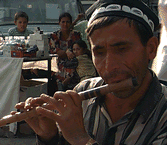 Throughout the market there are stalls (often metal buckets with fruit in them), entertainers and chaikhana’s (small tables on which to sip tea). Paul was able to finally buy a belt for his decreasing waist and I was attracted by a lonely flutist, busking in a secluded corner. He was blind and gave the traditional open palm, hands over face to accept blessings whenever he felt some money land in his lap. He occasionally played a haunting Maqam-type melody and I was moved, not just by the music but by his obvious predicament. Not far from the flute player three young boys entertained.One was supplying the ‘come and see’ music on a Western snare drum beating a marching rhythm while circling the younger ones. They performed acrobatics and increasingly dangerous manoevres over broken glass and nails. I didn’t stay for the tricks they had planned for later in the act, some of the sharp implements were bigger than the boy’s themselves. Before we left the bazar I was struck by an image, a series of steps leading back up to the second level. On each side women sold bread as smoke from Shashlyk stands billowed across many brightly coloured metal ornamental stalls. This was where local people came to do their daily business, where you can eat good food for a tenth of the price of the Hamburger joints in the centre of town. Gary is right, this is the real Tashkent.
Later on that morning we ventured across town to the Museum of Applied Arts. A prosaic name for something very precious and visually stunning. It had once been the private house of a rich Russian with a taste for the traditional arts. The courtyard entrance leads up a staircase to a small hall. The hall is decorated in Islamic style with brightly painted plaster and wood carvings. Every direction is ‘candy’ for the eye. Alcoves hold vases aglow with primary tint and the marble centre piece turns out to be a perfect place for our stereo microphone. This morning we are meeting one of Uzbekistans most celebrated singers and her ensemble. In the serene calm of the hall we met Munadjat Yulchieva and her teacher and mentor Shavkat Mirzaev – if this wasn’t enough of a daunting prospect it was also to be our first encounter with the ancient Shash Maqam tradition of Central Asia.
Shash Maqam possibly dates from as far back as the Timurid dynasty, around the 15th century. It was the music of the courts and in the important centres of Bukhara, Khiva and Khokhand this repertoire flourished. The words Shash Maqam refer to the Bukharan tradition and mean six maqams (in Persian) there is also a Khivan tradition of Alti Yarim Maqam (6 and a half maqams) and from Khokand Chahar Maqam (four maqams)
The word Maqam is often translated as ‘mode’, but in fact the word has many more connotations than our ‘mode’ or ‘scale’. In this case it refers to collections of compositions ordered into cycles or suites. This represents the classical “art music” tradition of Uzbekistan.
Munadjat is one of the most popular performers in the Fergana- Tashkent style (four maqams). This school differs from the Bukharan style, it is strongly linked to the Uzbek language (as opposed to Tajik) and is sometimes referred to as ‘free maqam’.
For such a celebrity, Munadjat has taken an unconventional route to success. She was born in a small village near Andijan, and worked the feilds with the rest of her family. The story goes that she applied to the Higher Conservatoire of Music, vocal arts department, not realising that they trained opera singers. She was turned down for singing ‘out of tune’ but was heard from outside the door of the audition room by one of Uzbekistan’s most famous composers, Shavkat Mirzaev. He became her teacher and the rest, as they say, is history.
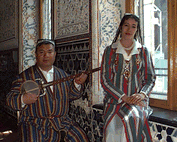 In the weeks leading up to this trip I had studied recordings of Munadjat for the purposes of research. I immediately found her voice almost absurdly moving and was soon listening to her constantly. Today’s meeting was a great opportunity to get a bit closer to the music and to find out more about its background.I am told that when Munadjat performed in London recently the audience cried and I can believe it. Besides being possessed of one of the most moving voices you have ever heard, she has an undefinable magnetism which is transfixing.
This seems to stem from a sincerity of feeling , a devotion that pervades every note and every gesture. The Uzbek and Persian texts that Munadjat sings are remarkable for the feelings of love and yearning they portray, even in English translation. These poems are classical texts written by famous Sufi poets. They cover philosophical and metaphysical themes, often using the metaphor of a lover yearning for their beloved. Through this device the poets portray the yearning for the presence of God. As Shawkat pointed out however, you need a special education to understand their poetry . The texts are multi-layered with words implying several meanings. One would need to speak several languages and have a training in Sufi philosophy and spiritual practice to plumb the depths of the meaning.
For most of us, however, the pure sound of the language has a profound effect. The music tends to be slow, creating a feeling of space and serenity. Within this timeless space the yearning of the voice is almost painful
“My beloved was to come tonight, with his face like a rose and his figure like that of a cypress-tree; but he didn’t
The whole night, sleep deserted my eyes
Full of hope, I would take a few steps on the road towards him
My soul was taking flight, but this fickle betrayer didn’t come
Bereft of his angel face, I wept and wept like a mad woman
Whoever saw me must have thought that I was a fool
Is there such a thing as a faithful suitor? If there is one, why does not every step lead him to his beloved?
Navai, rejoice in the house of your heart
For sadness never floods a house where wine flows”
The song “Munadjat” means prayer, and the melody was used by Sufis even before the poem by Navai (1441-1501) was written. It is now a famous melody of the region and Munadjat (whose name also means prayer) has made it her own. The performance begins with the voice whispering a secret confidence. As the piece progresses the melody ascends in pitch and volume with incredible control and restraint. The climax of the piece (or awj) is searing in intensity and superhuman in volume.
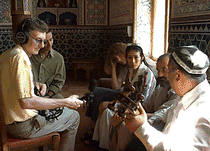 During this trip we have been lucky enough to meet musicians who are national celebrities. They have been relaxed, accessible people who possess great humility. Munadjat and Shavkat are no exception.
As we sat and chatted to them about their lives and music, there emerged a sense that Shavkat and Munadjat feel music is an essential ingredient in life, it is impossible to live without it. To give vent to one’s feelings of pain and joy, almost in a Cathartic way is somehow purifying. When asked about Uzbek pop music Shavkat simply said that he did not listen to it. There was an implication, however, that he felt it might be detrimental to the Classical music.
Munadjat often defers to Shavkat to answer questions, which he does in a very articulate way. They seemed encouraged by the number of students training to play Uzbek Classical music. I was curious to know whether musicians still maintained a connection with the Sufi practice that inspired this heartfelt music. This is a difficult thing to judge, especially since Sufism was discouraged during Soviet times. There was an attempt to secularise this music, which the Russians saw as feudal, into an innocuous lyric poetry. Reading between the lines though, I sense that there are still musicians for whom music is a sacred art.
Tommorow we meet two of the most celebrated lutenists (dutar and tanbur) in the country, Abdurakim Hamidov and Pattahon Mamadaliev – who is also one of Uzbekistan’s foremost composer/singers. Join us for a full report.